- This event has passed.
Dramatis Personae: 1001 Lives — A Major Exhibition of 15 Female Southeast Asian Artists Exploring the Multiplicity of Identity
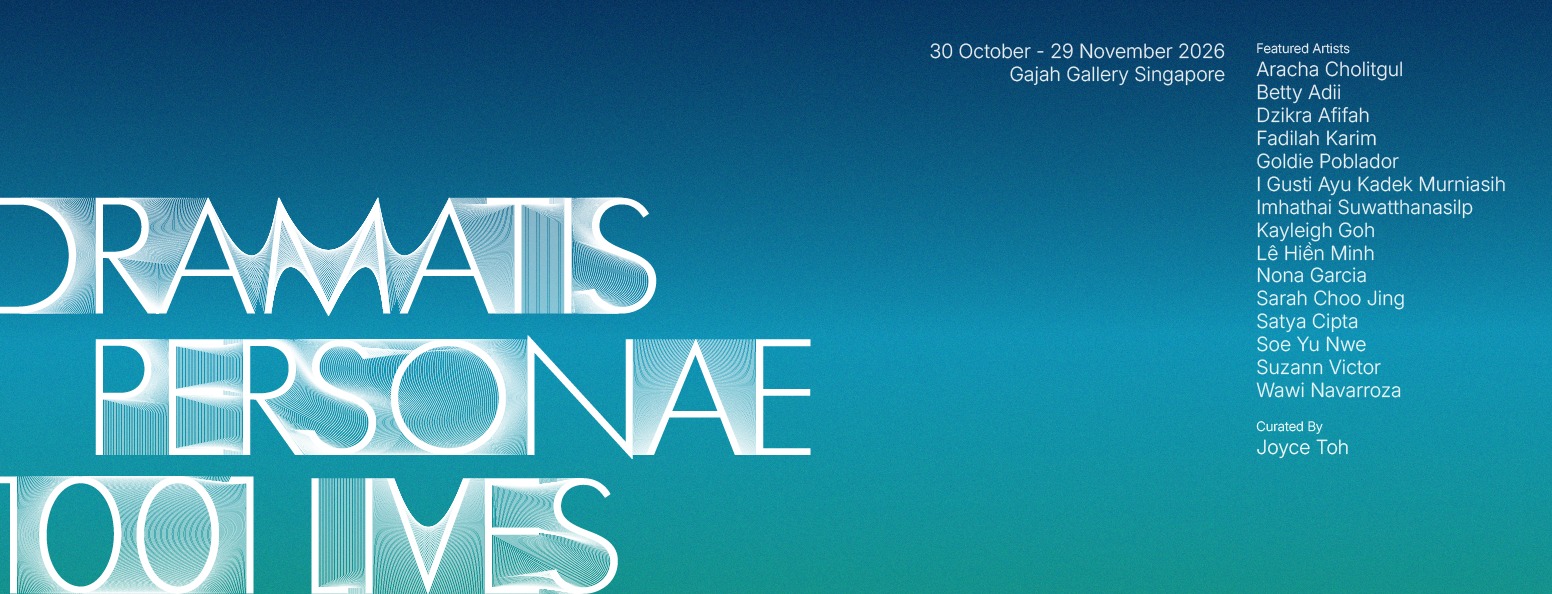
Gajah Gallery Singapore presents Dramatis Personae: 1001 Lives, a major group exhibition featuring works by 15 visionary female artists across Southeast Asia and beyond, exploring the fluidity of identity and the imaginative possibilities of selfhood. The opening reception will be graced by the presence of Ms Jane Ittogi, Spouse of the 9th President of the Republic of Singapore, as Guest of Honour.
Curated by Joyce Toh, the exhibition features internationally acclaimed Singaporean artists Suzann Victor and Sarah Choo Jing; seminal Balinese artist I Gusti Ayu Kadek Murniasih alongside Fadilah Karim (Malaysia), Kayleigh Goh (Malaysia), Dzikra Afifah (Indonesia), Satya Cipta (Indonesia), Betty Adii (Indonesia), Nona Garcia (Philippines), Wawi Navarroza (Philippines), Goldie Poblador (Philippines), Lê Hiền Minh (Vietnam/United States), Soe Yu Nwe (Myanmar), Aracha Cholitgul (Thailand) and Imhathai Suwatthanasilp (Thailand).
Dramatis Personae: 1001 Lives unfolds as a theatre of selves, where the artist assumes the dual role of actor and author, conjuring a multiplicity of personhoods within the space of the artwork. Paired with the narrative resonance of One Thousand and One Nights, the exhibition frames artistic practice as an expansive and generative act—one that celebrates the possibility of manifold lives. Across these varied practices, identity becomes a site of exploration in which contradictory impulses and multiple ways of being can coexist. The exhibition also reflects on the roles women inhabit and negotiate in everyday life, while foregrounding their agency to construct identities beyond prescribed expectations.
Threaded throughout the exhibition is the figure of Scheherazade, whose nightly acts of storytelling become strategies of survival and transformation. Like Scheherazade, the artists turn to narrative as a means of opening possibilities and reimagining the conditions of their own existence. Multiplicity thus emerges as a form of agency: an insistence that the self can hold many lives, voices and possibilities at once.