In Retrospect With Sonny Liew — The Art of Charlie Chan Hock Chye: The Exhibition


In celebration of the 10-year anniversary of the groundbreaking graphic novel The Art of Charlie Chan Hock Chye, Singaporean comic artist and illustrator Sonny Liew has opened a triple-site exhibition — The Art of Charlie Chan Hock Chye: The Exhibition.
Held at the print-focused Chaos Gallery, heritage bookstore Basheer Graphic Books, and comic book and pop culture store InkInk Collectibles, the exhibition allows visitors to learn about the interwoven narratives, behind-the-scenes stories, and international reception of Liew’s most iconic and internationally acclaimed work.
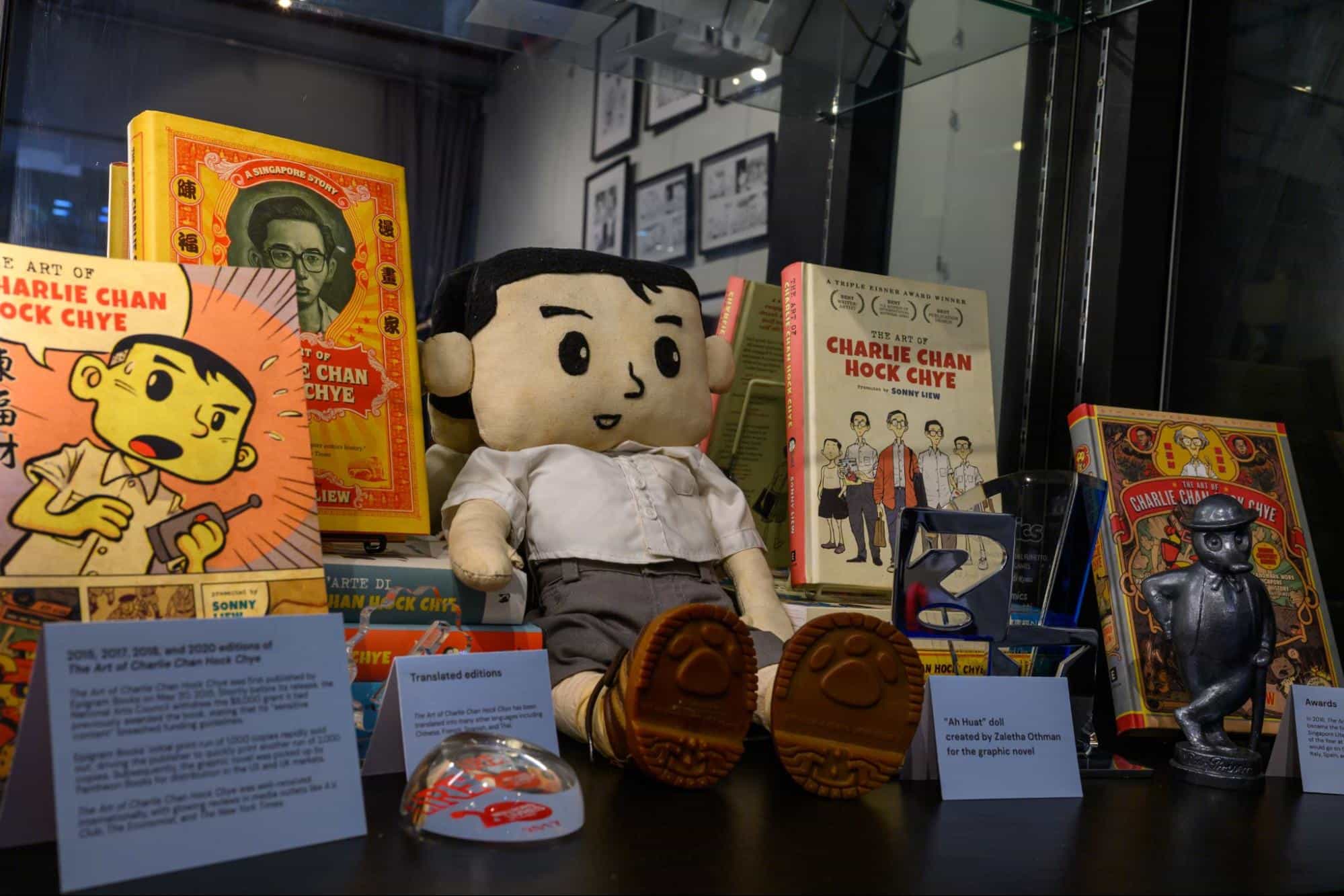
First published by Epigram Books in 2015, The Art of Charlie Chan Hock Chye became the first and only Singaporean work to win three prestigious Eisner Awards, as well as a catalyst for public discourse on freedom of expression and approaches to history.
After gaining controversial spotlight from having its funding grant withdrawn, the title attracted even greater attention when it became the first Singaporean literary piece to bag three Eisner Awards.
Revisiting the beginnings of this decade-old novel, I spoke with Sonny Liew about his work and how some of his perspectives may have shifted over time.
Legacies and letting go

When I first read The Art of Charlie Chan Hock Chye upon learning about the exhibition, I noticed that Charlie’s parents were portrayed as being supportive of his desire to become a comic artist. As I read through their realistic comments and perspectives, I found myself wondering if this aspect of the graphic novel was inspired by Liew’s own parents. When I shared this observation with him, Liew told me:
“I wouldn’t say it’s a one-to-one reflection; Charlie Chan’s biography is built from various threads … but some of these are autobiographical, and I suppose some of my parents’ attitudes about me pursuing a career in the arts are reflected in the story, especially the worry and concern that go along with acceptance.”

Following the success of Liew’s career over the years, The Art of Charlie Chan Hock Chye: The Exhibition serves as a retrospective. In the show, selected original pages from the beloved book are also available for acquisition. Describing it as a bittersweet moment of letting go of the novel’s original works — pieces that shaped a large part of his career and reputation — Liew spoke about his past experiences of sharing earlier original works, alongside his hopes for these pieces.
“There was actually a show at Mulan Gallery back in 2017, together with Koh Hong Teng, when we had comics pages for sale, including some original pages from Charlie Chan Hock Chye,” he explained.

When asked how he felt about the original manuscript of the graphic novel being “taken apart” and sold, Liew offered these thoughts:
“I suppose there is an instinct or desire to want to keep everything together [and] intact, but, at the same time, everything has to be let go at some point! Most of the pages are still intact, [so] I guess if anyone wants to get them in the future, they could try to reacquire all the pieces out there.”
The conversation took a reflective turn as Liew acknowledged his personal attachment to the drawings, clarifying that, even now, only a few select pages are available for sale.
“I suppose,” he continued, “you also realise that at some point you can’t hold on to things forever. But part of me hopes some or most of the material might become part of an institutional collection, though I don’t really know how that process works, or if it will ever actually happen.”
Curatorial insights
Speaking of passing down a legacy or preserving such a collection, co-curator Rachel Lim also shared her views on the graphic novel regaining attention through this show. Asked whether she anticipated a different reaction or hoped for a similar reaction compared to when the book was first published, Lim shared:
“Though things may have changed since The Art of Charlie Chan Hock Chye was first published in 2015, a lot of the topics raised in the graphic novel, like press freedom, still remain relevant 10 years on.”
“While I don’t profess to be an expert in what Singapore was like 10 years ago,” she continued, “when I read Charlie Chan in 2025, I still feel it’s a fairly accurate portrait of the Singaporean psyche.”
Lim noted, for instance, that while the local visual art scene has undoubtedly made progress since 2015, artists today still face many of the same struggles that Charlie did in the 20th century, such as the need to work a second job to make ends meet or choose between a financially viable career and their artistic ideals.

She mused: “Take Charlie’s comic Sinkapor Inks. This comic imagines Singapore as a stationery company run by a strict boss, using this allegorical setting to retell how the government curtailed criticism and controlled the press in the 1970s-80s. Reading the graphic novel in 2025, I still recognise the Singapore of today in Sonny’s 2015 detailing of events from the last century.”
There is still a “murkiness,” she observed, around what is considered acceptable or unacceptable to say, as well as a guardedness in how Singaporeans express themselves when sharing potentially controversial opinions, for fear of backlash or threats to their livelihoods.
“These aspects of our culture are rooted in the historical events explored in Sinkapor Inks, and their effects are still felt, whether in 2015 or today. I wonder if the exhibition will help reopen these conversations around the book?”
Ultimately, Lim reminded me that there will also be people who are reading the graphic novel for the first time.
While the exhibition’s themes remain relevant, Lim noted that audiences from different generations would experience the work in different ways. She hoped the show would serve as a starting point for meaningful cross-generational conversations.

Co-curator Nurul Kaiyisah also shared her thoughts on how attitudes have morphed over time:
“There has been a discernible shift and proclivity towards narratives that are not rooted in institutional or authoritative entities throughout the years. We can see that in changing appetites towards reading materials and research, and also with emerging questions that revisit empirical facts we thought to be true.”
“An example I’d cite would be the kinds of inquiries on Singapore’s era of independence that have grown popular since the Bicentennial project in 2019. I observe an inclination towards a discernment of national histories, a kind of growing curiosity towards the ways in which Singapore negotiates and eventually achieves independence (in both 1963 and 1965) and a greater consideration of the many underlying political and societal events that led to that momentous milestone.”
“History, as we are often taught, is anchored by empirical facts, but the kinds of narratives we consume are also indicative of the variety of facts we can access, or are given access to,” she elaborated, pointing to the traction gained by texts such as The University Socialist Club and the Contest for Malaya (by Kah Seng Loh), Revisiting Malaya: Uncovering Historical and Political Thoughts in Nusantara (edited by Show Ying Xin and Ngoi Guat Peng), and The Unrepentant (a short story collection by Sharmini Aphrodite).
The life of a story
As our chat came to a close, I discussed with Liew how his masterpiece not only won the Eisner awards, but also became a piece that motivated critical examination of Singapore history among the public.
Not only does the graphic novel resurface controversial historical events such as the riots of 1955, the detention of left-wing politicians, and the alleged Marxist conspiracy of 1987, but the National Arts Council of Singapore (NAC) also withdrew their S$8,000 publishing grant due to concerns regarding its “sensitive content.”
A notable 2015 statement made by Khor Kok Wah, senior director of the NAC’s literary arts sector, explained: “The retelling of Singapore’s history in the graphic novel potentially undermines the authority or legitimacy of the Government and its public institutions and thus breaches our funding guidelines, which are published online and are well known in the arts community.” And in 2017, when the NAC congratulated Liew “on being the first Singaporean to bag three Eisner awards,” netizens’ criticism soon followed, pointing out how the post had omitted the name of the award-winning book.

Amidst all the difficulties and discourse surrounding the novel’s release and reception, a question that truly piqued my interest was whether that was ever Liew’s intention at all.
“My own description of the book has been: a fictional artist biography that is in fact a critical examination of the Singapore Story. So, yes, that was always the hope, though maybe it was equally about learning more about Singapore’s history myself during the research process,” he said.

Truth be told, I was only nine years old when the title The Art of Charlie Chan Hock Chye was released, and I wasn’t much of an avid reader then. Although I do remember the familiar illustrations and covers from the novel back in my primary and secondary school days, I never expected to reencounter this story.
Upon finishing the book and learning about the real-life events which influenced the novel, I began to wonder how many more perspective-shifting books could have been hiding in plain sight during my school days. Having been a huge literature fan during my time in secondary school, I could imagine the book turning into a hot topic amongst my peers. Then again, perhaps we were simply too busy breaking down Macbeth to have taken interest in this story at the time.
Regardless, I find it better to learn about it now than never, especially with the opportunity to have a discussion with the curators and Liew himself.
More than any other emotion, I felt deeply touched when I visited the exhibition. As I encountered years of drafts, multiple published editions, and commemorative prints, Liew’s unwavering dedication to both illustration and literary craft resonated powerfully with me. Facing the withdrawal of a once-promising grant, Liew pushed ahead despite uncertainties, winning prestigious awards with the same title that met with governmental qualms. It seemed like the exhibition was the last piece to come full circle, a retrospective honouring Liew’s author journey.
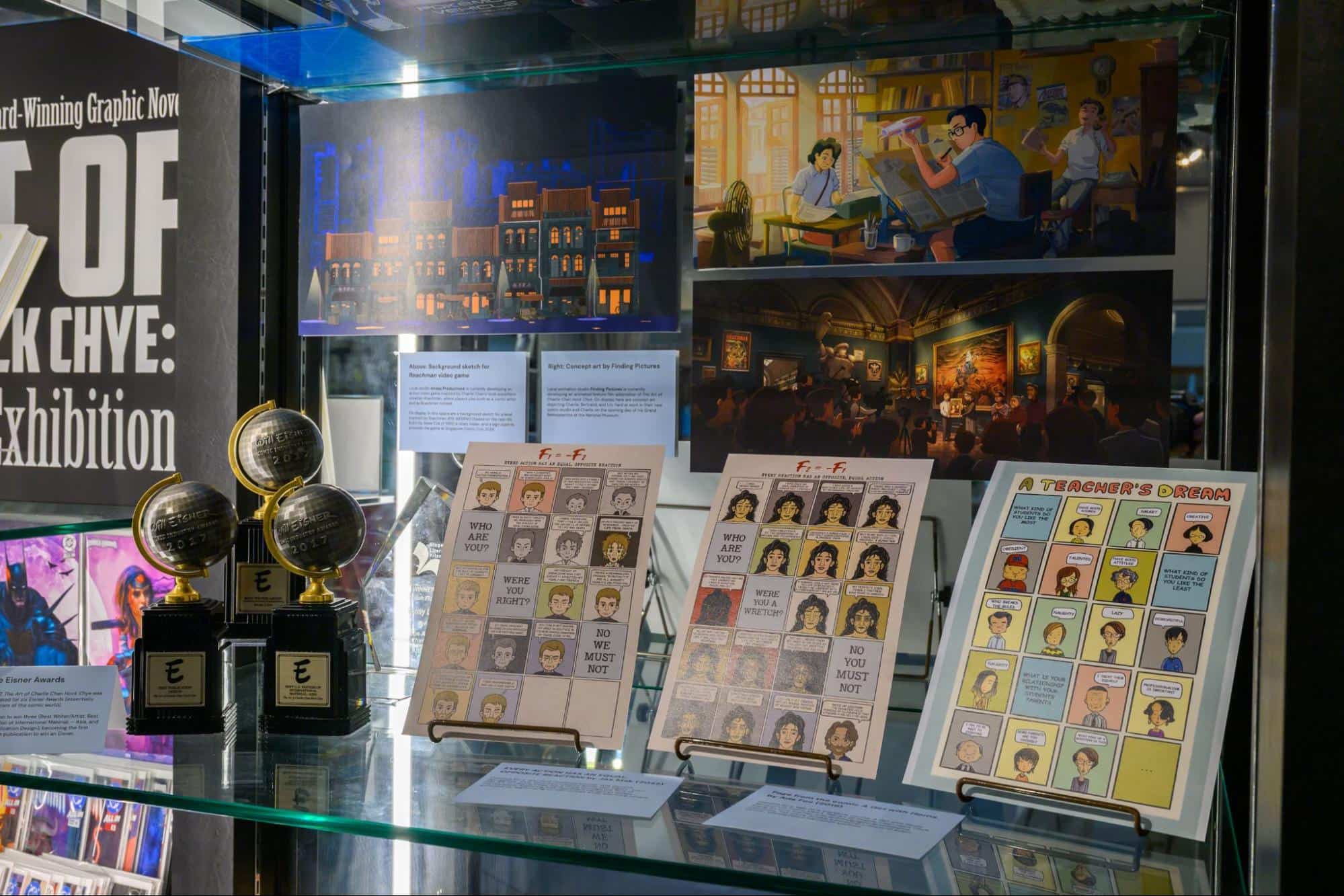
By bringing together early drafts and new responses from contemporary artists, The Art of Charlie Chan Hock Chye: The Exhibition opens up space for fresh conversations about the book and the ideas it raises. Whether viewers are encountering the work for the first time or returning to it with hindsight, the exhibition offers a thoughtful pause for reflection and discussion.
___________________________________
The Art of Charlie Chan Hock Chye: The Exhibition runs at Chaos Gallery, Basheer Graphic Books, and InkInk Collectibles till 28 December 2025. Follow @artofcharlie10 on Instagram to learn more (and for information on holiday closures, public programmes, and other updates).
Header image: Installation view of The Art of Charlie Chan Hock Chye: The Exhibition at Basheer Graphic Books. All images courtesy of Justin Goh.
Support our work on Patreon
Become a memberYou might also like
When the Mekong Flows Into a Michigan Museum