Peering through the Evocative Head: At Last, a New Ng Eng Teng Exhibition at NUS Museum!

It may surprise you to know that the NUS Museum is the institution which holds Singapore’s largest collection of a single artist’s work: that of the late Ng Eng Teng, ‘Grandfather of Singapore Sculpture’ and master manipulator of the human form. The collection comprises over 1,200 works, including sculptures, ceramic pieces, paintings, sketches and maquettes. Arguably, no other collection in Singapore so comprehensively documents a single artist’s career, situated across over four decades of practice.
Much of the collection was donated by Ng Eng Teng in the 1990s and 2000s. As recounted by the man himself, this extraordinary act of generosity was sealed in a day. On 25 July 1995, with some trepidation, Ng phoned the poet Edwin Thumboo, then Chairman and Director of NUS’s Centre for the Arts, to broach the possibility of the donation. Thumboo promised to speak to the Vice-Chancellor at the time, Professor Lim Pin, and revert within three days. But before the day was over, Thumboo had already tried several times to call Ng back to say that the University would be very interested in taking up the offer.
The rest is history.
The current permanent exhibition, Ng Eng Teng: 1+1=1, curated by Kenneth Tay and located in the Ng Eng Teng Gallery of the NUS Museum, opened ten years ago, in April 2016. In retrospect, it seems a missed opportunity that the Museum did not seize upon either the 90th anniversary of Ng’s birth in 2024 or the 30th anniversary of the first donation in 2025 to refresh the Ng Eng Teng Gallery. It could also have been an apt moment to revisit Ng’s artistic legacy and impact, some twenty years after his unexpectedly early passing in 2001. After all, the art historian (and friend of Ng’s) T. K. Sabapathy writing in 1999, noted that Ng had envisaged the collection to be “a dynamic, expanding entity”, one that would offer “fertile material grounds for advancing close-range, connected modes of viewing”.
That’s about to change, and at long last, a new exhibition featuring Ng Eng Teng’s works, ‘The Evocative Head’, will open on 19 May.
Surprisingly, this isn’t located in the Ng Eng Teng Gallery on the third floor, but in the NUS Museum’s Archaeology library on the ground floor, amidst strewn pottery shards and sherds. The curator, Ling Jia Le – who also curated the Museum’s recently-ended revelatory Delia Prvački retrospective (Continuity, Persistence and Line) – notes how this juxtaposition gestures at Ng’s significant ceramic practice. Ng had trained in both industrial and studio pottery in the UK; and after returning to Singapore, he built a kiln in his family’s kitchen. Alongside Iskandar Jalil, Ng should perhaps also be regarded as a ‘Grandfather of Singapore Ceramics’, having trained and inspired artists such as Chua Soo Kim and Tan Tuan Yong through ‘Studio 106’, a collective of ceramicists who would meet at 106 Joo Chiat Place – Ng’s family home and studio.
The exhibition takes its name from Sabapathy’s study of Ng’s deft manipulation of the form of the head across his oeuvre, a concept Sabapathy borrows from the American art historian Albert E. Elsen’s account of modern sculpture. According to Sabapathy, Ng frees the head from its
“portraitist obligations, foregoing reference to individual identities and observing the natural sequence of features… This freedom allows artists to develop fresh, formal vocabulary and grammar: it also enables them to redesign the head… thus we may encounter evocative heads as contemplative objects, as disturbing presences, as playful manifestations…”
All three forms are present in the exhibition, starting from one wall with early realist beginnings such as the sculptural relief Miss Vogue, made in 1957 when he was just 23, alongside portraits and a self-portrait.Two pieces flank this realist core, serving as vital departure points for the rest of the exhibition.
On the left, a stunning piece of botanical surrealism is seen in the painting Flame of the Forest, where a lady with resplendent turquoise eyeliner blooms with the full crown of a flame of the forest, her hair melding into the branches of the tree.

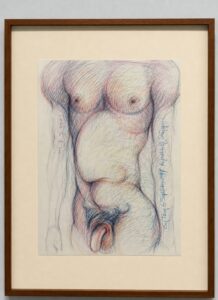
On the right, a colour pencil drawing from the Torso-to-Face series, where parts of the male torso morph into a face: the nipples and hard pecs into the eyes; the midriff into a nose; the penis into a mouth and tongue. (Guess what pubic hair becomes.)
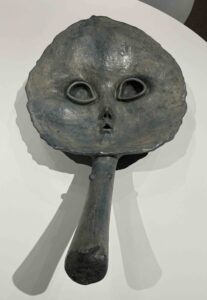
This friskiness leaps off canvas and paper and finds solid form in his ciment fondu and ceramic works, where a small but well-chosen selection showcases Ng’s bewildering range. I found myself charmed by Blue Violet (1973), a leaf-shaped object reminiscent of a frying pan, adorned with a tremulous elfin face.
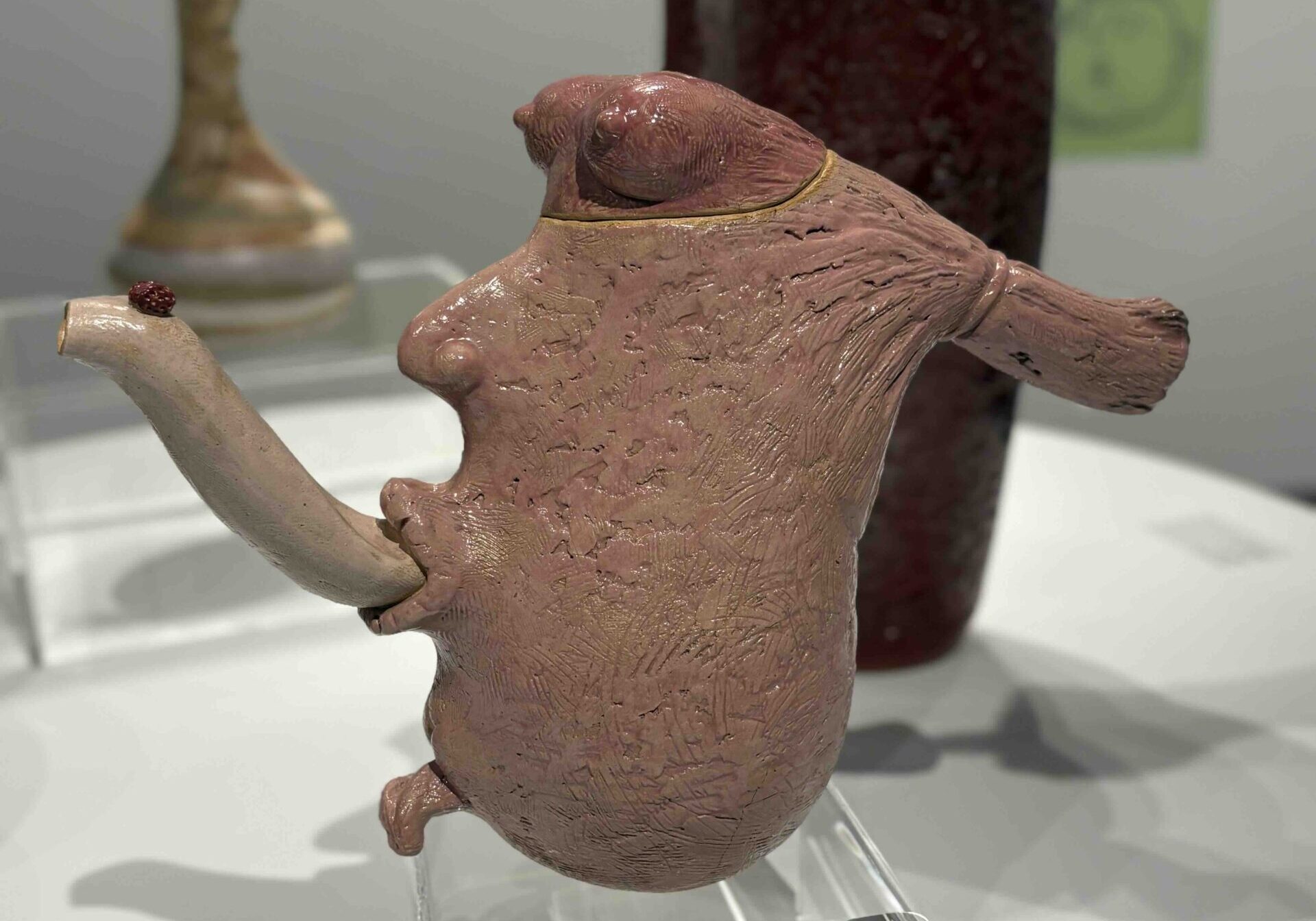
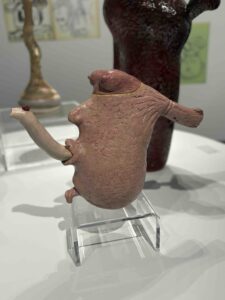
Another highlight is the “Head” Teapot (1962), an audacious piece which pushes the boundaries of the functional: the teapot’s handle’s a ponytail; the spout, a mouth with a freakishly long tongue; two bulging eyes are affixed atop the teapot’s cover, suggesting breasts.
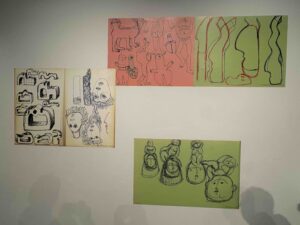
In addition to finished works, ‘The Evocative Head’ pays welcome attention to Ng’s process: alongside finished ceramic works are stoneware pieces Ng intended as studies of the human form. A particularly inspired touch are the blown-up pages from Ng’s sketchbook displayed on the walls, vividly demonstrating how the artist iterated and wrestled with forms.
While Ng Eng Teng was notoriously cagy about his personal life, his work nonetheless pulses with his personality, evident in this exhibition. Despite national accolades like the Cultural Medallion, and the gravity of an entire institutional collection, one never gets the sense that Ng ever stopped having fun. Each encounter with his work is a chance to be rejuvenated by his impish energy, and that desire to do delightful mischief to the human form.
Excitingly, Jia Le tells me that ‘The Evocative Head’ is intended to be a prelude to the planned revamp of the main Ng Eng Teng Gallery. (A trained sculptor – a rarity in Singapore these days – from the Maryland Institute College of Art, Jia Le seems unusually well-suited to reimagine the Museum’s approach to the collection.)
Perhaps one fruitful line of inquiry for the revamp might be to ask what such a unique collection can do for Singapore and its arts scene: in 1999, commenting on Ng’s second donation to the Museum, Professor Lim Pin had asserted that “the Ng Eng Teng Gallery is firmly positioned as a vital centre for the study and appreciation of art”.
One hopes the Museum continues to give generations of NUS students and staff, and the public, new ways to be revitalised by Ng Eng Teng’s work.
__________________________________
Ng Eng Teng’s ‘The Evocative Head’, will open on 19 May at NUS Museum . Admission is free and the Museum is open from Tuesday to Saturday between 10am to 6pm. It is closed on Sundays and public holidays
Support our work on Patreon
Become a memberYou might also like
Fearsome Engines : Gaming, Art and the Worlds We Build
Perhaps We Must Pause, in Order to Go On: The Singapore Pavilion at the 2026 Venice Biennale