Perhaps We Must Pause, in Order to Go On: The Singapore Pavilion at the 2026 Venice Biennale
Venice sits on an upside-down forest. Beneath the stone are millions of trees driven into the sedimentary clay below the waters, their tips pointed downwards. Larch, pine, oak, elm, alder, and spruce are bound together by silt and preserved by salt. Originally, the area was a marshy lagoon. Its first settlers were poor fishermen and refugees fleeing the collapse of the Roman Empire in the 5th century AD. As the population grew, the city expanded from its banks into the water. In what can only be described as a marvel of engineering, battipali (pile-hitters) built the foundations from scratch. Singing ancient songs, they drove wooden piles deep into the earth by hand, laying the ground for what would become La Serenissima Repubblica di Venezia.
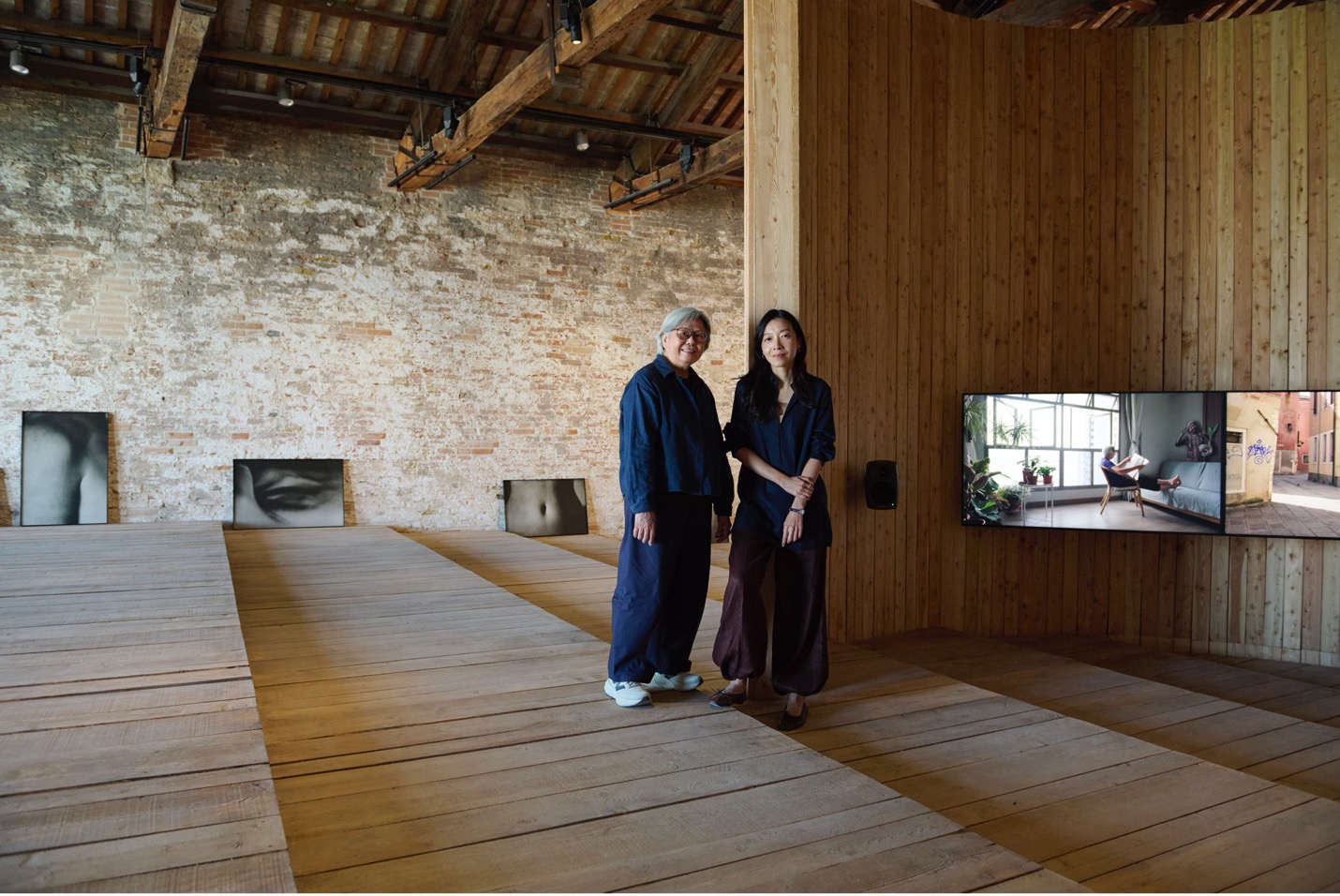
At the 61st International Art Exhibition – La Biennale di Venezia, the Singapore Pavilion raises the ground of the Sale d’Armi like a gentle swell of a wave, meeting the aprons of three large windows facing the Venetian boatyard. Locally sourced and aged larch wood panels—one of the finest woods for marine construction, and the very wood that holds Venice above water—are stacked in parallel layers, each 10cm in height, echoing the original flooring beneath. The result is a series of broad, gradual steps that rise and fall gently through the space.
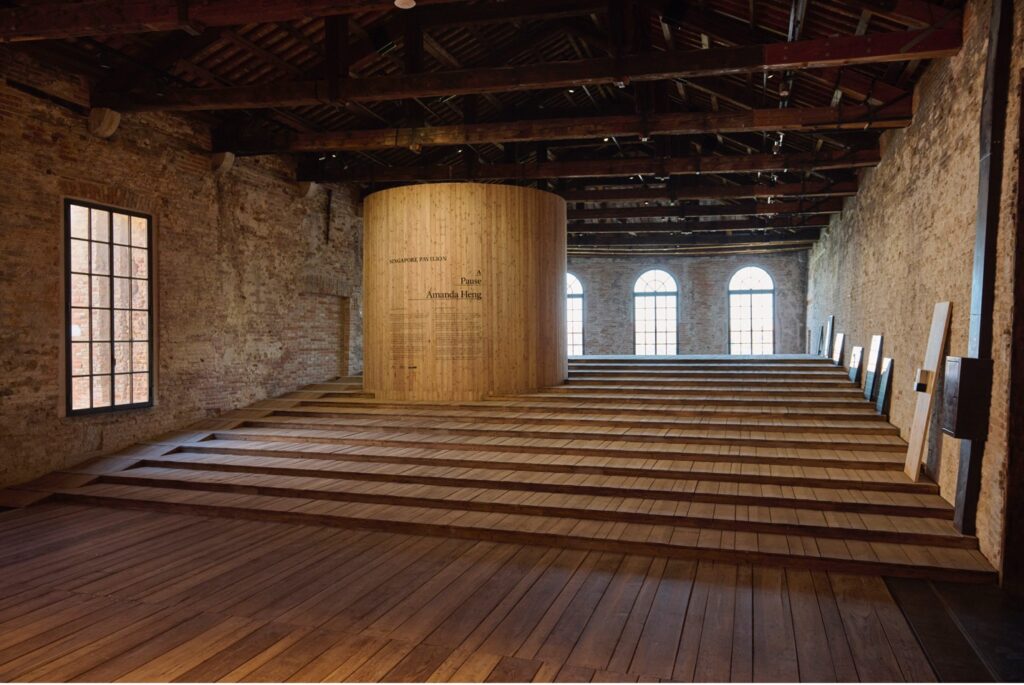 Installation view of A Pause, Singapore Pavilion, Biennale Arte 2026. Image courtesy of Singapore Art Museum.
With the installation of these wide steps, the architecture recalls the majestic Baroque perrons of 17th- and 18th-century palazzi. Closer to Singapore, it evokes void decks beneath public housing, covered walkways leading to shopping centres, and open fields before they are fenced off for development. In the Sale d’Armi, we climb this hill of larch without a prescribed path or function. We move up and down, with an exhalation of breath, receiving a view beyond the cacophony of the art world—a view that takes our breath away.
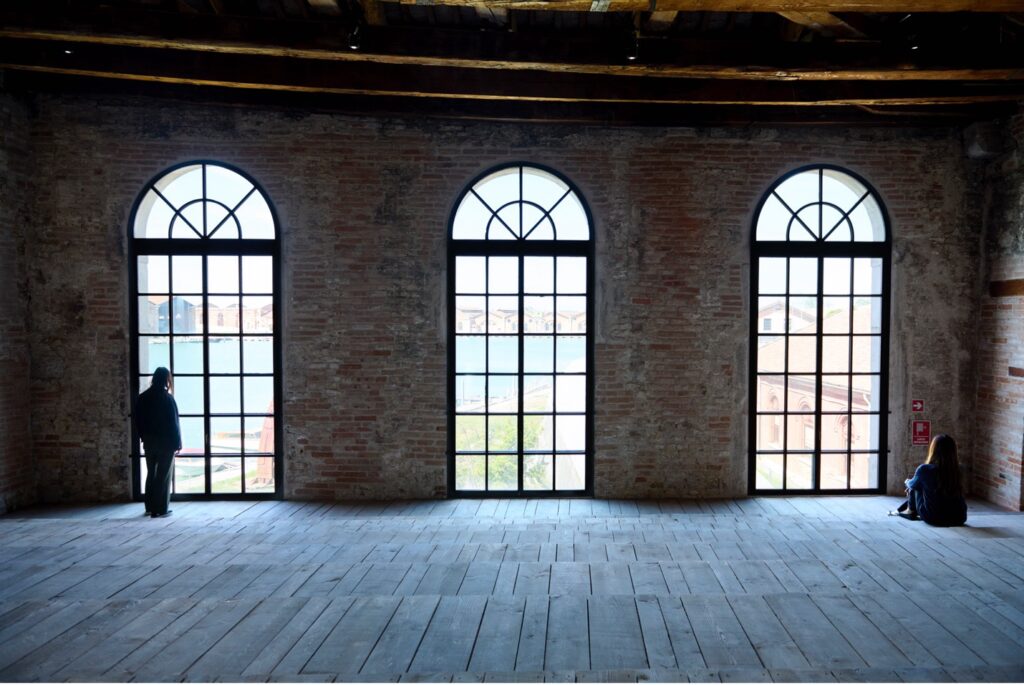
At 76, Amanda Heng Liang Ngim—representing the Singapore Pavilion at the 61st International Art Exhibition – La Biennale di Venezia—remains acutely aware of her body. Low steps are gentler on ageing knees. The softened assimilation of wood into the site offers visual respite and an invitation to view out of the spectacular windows. Large, unobstructed steps allow visitors to sit, stand, lie, or play as they wish. It is space in its most generous form.
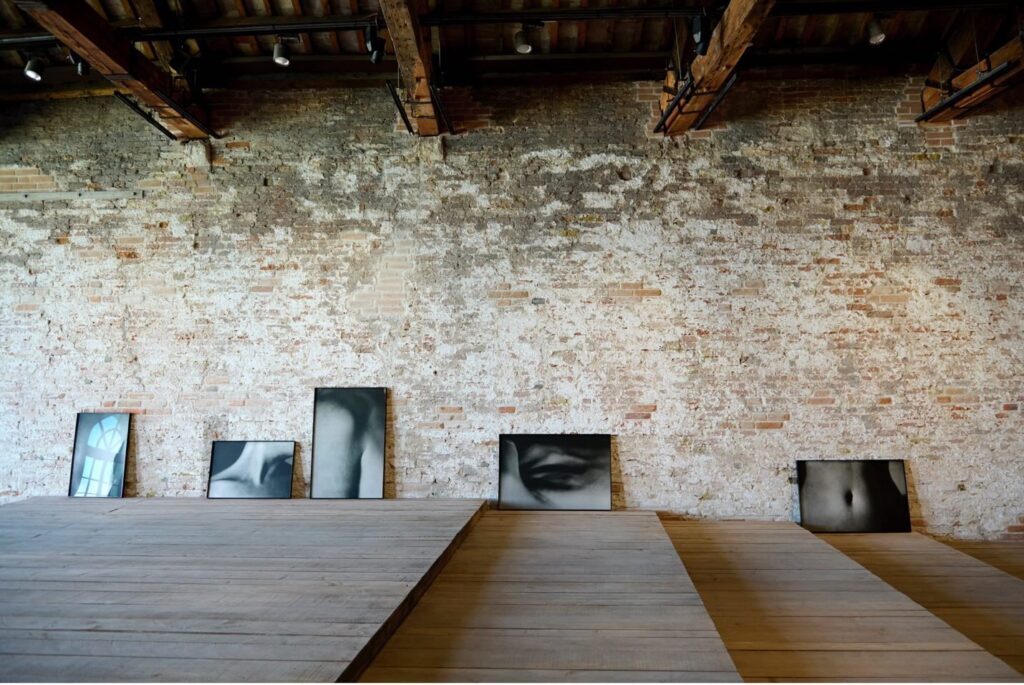
At either end lean reproductions of photographs from Heng’s younger life. Parts of My Body (1990), developed in collaboration with Chen Kunyi, began as black-and-white close-up photographic studies of Heng’s body. Later, these images were interwoven with her live performing body in works such as Narrating Bodies (1998–99), through slide projections and xerographic experiments. In this enlarged 2026 presentation, Heng’s older moving body meets the photographic traces of her younger self through the sensitive architectural design of Irin Siriwattanagul and Nathaphon Phantounarakul of SP/N, and the seamless fabrication by eiletz ortigas | architects and Rebiennale.
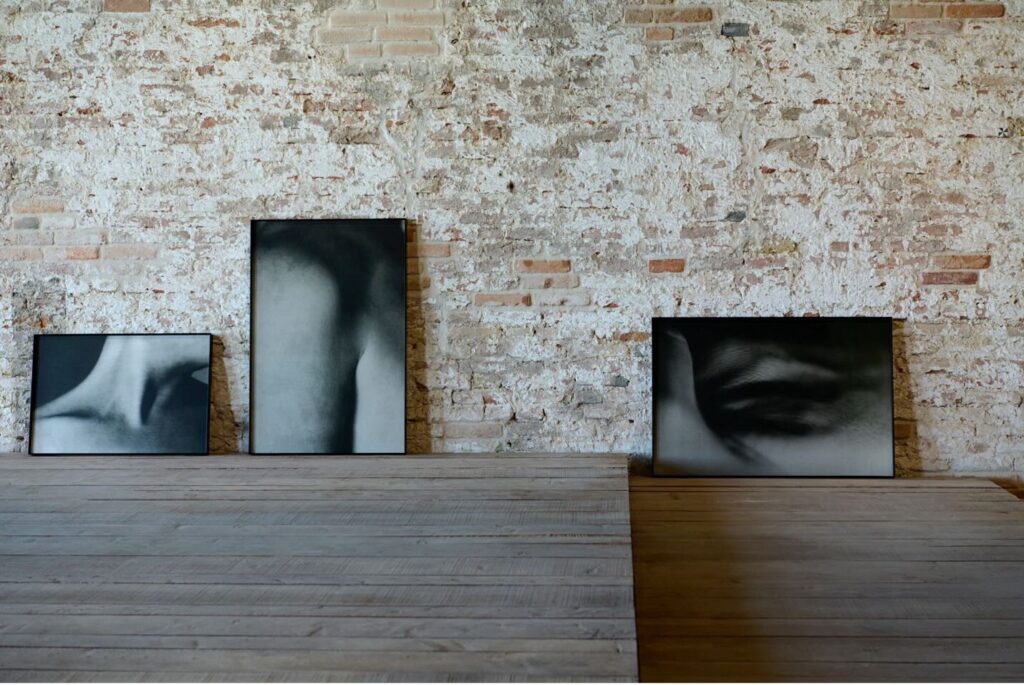
It is deeply moving to encounter these intimate fragments of a Singaporean female body presented so gently, so matter-of-factly, and without theatricality. This nudity is in stark contrast to nude performers in Florentina Holzinger’s Seaworld over at the Austrian Pavilion, or Maja Malou Lyse’s Things To Come at the Danish Pavilion, both of whom powerfully harness starkness, bareness, and performativity which draws audiences into complicity and voyeurism.
Beyond the initial shock, we find ourselves desensitising to their exposed forms and diving deeper into the meanings and universes they serve up. Nudity here is uniform and costume.
Heng’s nudity however asks for neither shock nor confrontation. Her nudity is quiet. Instead, we see her bottom, clavicle, breast, belly, and armpit—as framed and directed by Heng herself. Positioned below standing eye level, these images invite us to sit with them, much as we would sit beside a friend. There is familiarity here, and kindness in that ease.
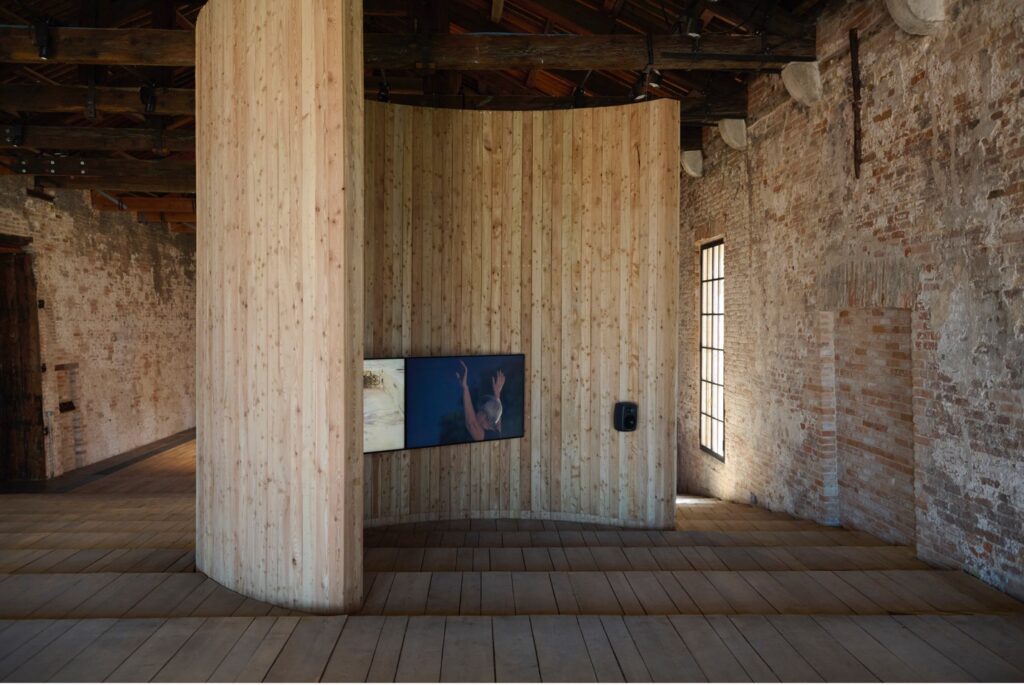
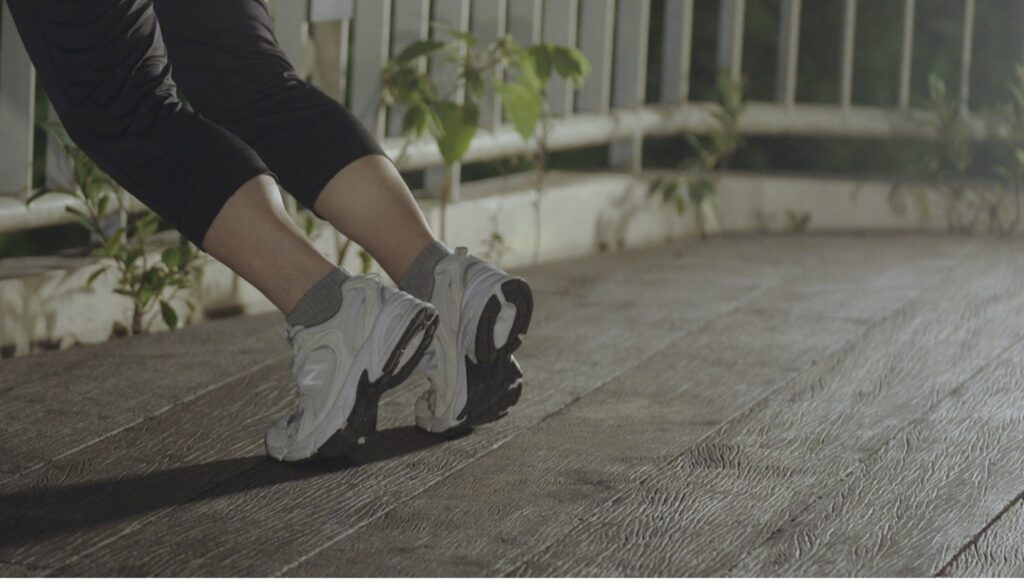
From the ground, our gaze lifts, and our neck stretches. We notice a curved pillar of vertical larch wood panels reaching towards the ceiling. For once, within this shelter, we see the structures that hold up the Sale d’Armi. The ground touches the sky. Behind the pillar sits A Pause (2025–26), a synchronised double-channel video, 29 minutes and 40 seconds in duration, placed low—as if we were watching television back home. Developed across Venice and Singapore, the film follows people in their homes and everyday lives. In its ordinariness, we observe how bodies move through space, find rest, pause. It attunes us to the rhythms of familiar gestures and the slow sensing of time. We watch hands watering plants, Heng reading the Heart Sutra, different people cooking, cleaning, gazing, and resting. The camera often holds at eye level, or tilts gently upwards, lingering for long durations as people move in and out of frame. It sits alongside its subjects—an unassuming, unobtrusive companion witnessing the lives of others.
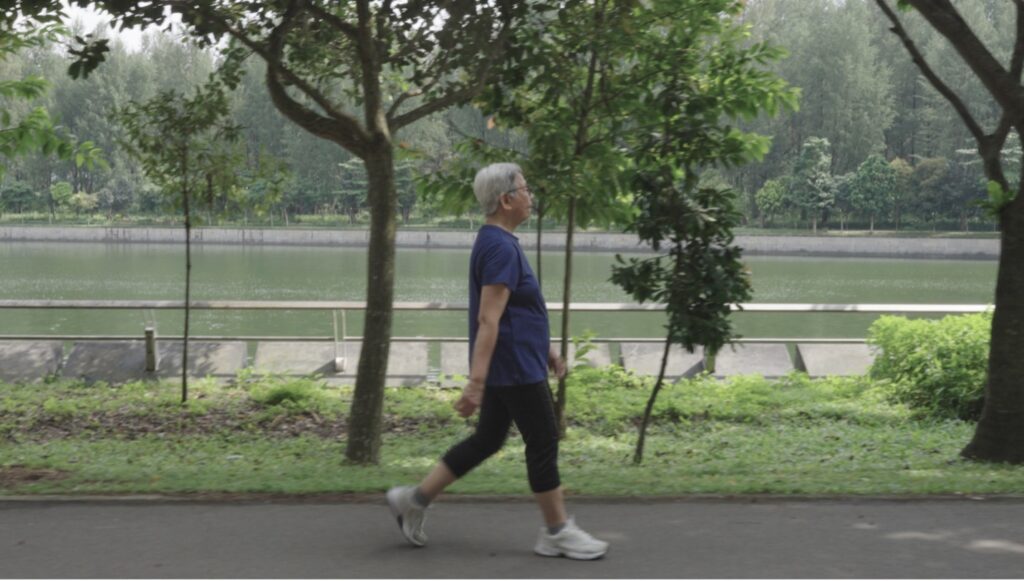
The work recalls the meditative durational cinema of fellow Biennale artist, Malaysian-born, Taiwan-based Tsai Ming-liang, whose Sand (2018) floats above the Gaggiandre nearby. There, we watch Lee Kang-sheng’s slow walk across Taiwan’s Zhuangwei Sand-Dune Visitor Centre.
Without realising it, we have begun moving ourselves in accordance with the atmosphere Heng has created—an extension of her practice rooted in creating conditions for encounter. What drew Singapore Art Museum curator Selene Yap to Amanda Heng’s practice was, as she describes, its “modest actions that re-order attention without spectacle.”
Amanda Heng is the third woman to have represented Singapore at the La Biennale di Venezia, after Shubigi Rao in 2022 and Suzann Victor in 2001. She is a pioneering contemporary artist, widely respected for an interdisciplinary practice that navigates gender roles, social expectations, and embodied gestures. Across performance, installation, photography, and participatory art, and for over four decades, she had repeatedly asked how art may be interwoven with life and living. She is a founding member of The Artist Village (1988) and Women in the Arts (1999), and has been instrumental in shaping feminist discourse within Singapore’s contemporary art history. Heng received Singapore’s Cultural Medallion in 2010, the Benesse Prize in 2020, and was inducted into the Singapore Women’s Hall of Fame in 2023.
Her presence on this international stage feels long overdue. Across four decades, her practice has given rise to works that are both critically significant and deeply beloved.
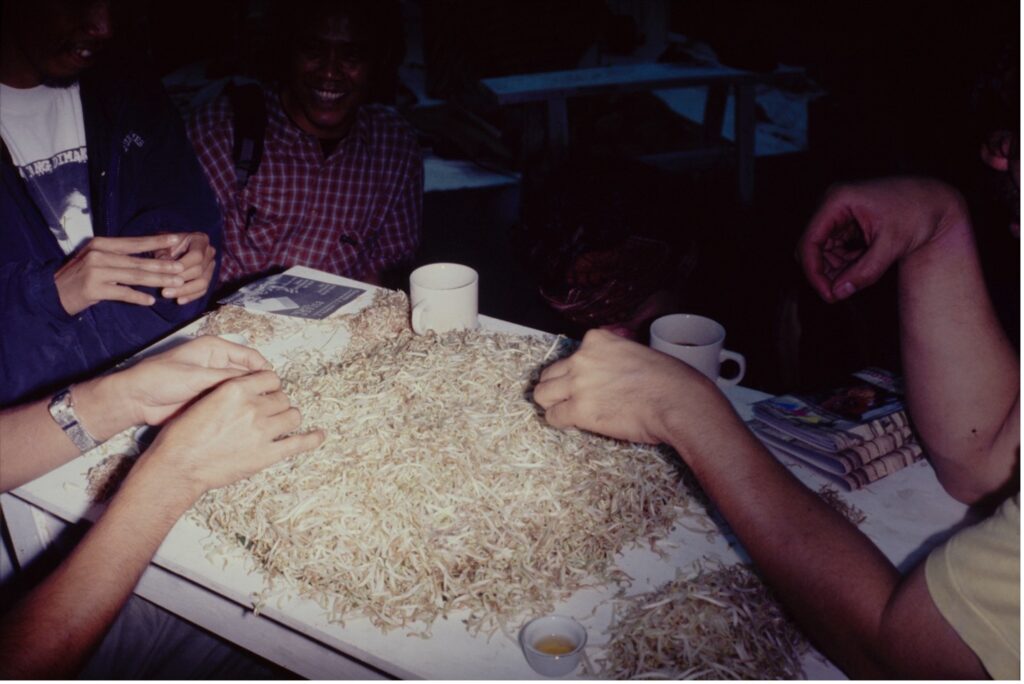
In Let’s Chat (1996–ongoing), the simple act of plucking the tails of bean sprouts across communal tables becomes an occasion for intimacy, labour, and conversation. In Another Woman (1996, 2014, 2023), repeated portraits with her mother trace the shifting intimacies of intergenerational relationships across time. The most recent iteration of this work is currently presented in Flesh and Bones: The Art of Anatomy at the ArtScience Museum in Singapore.
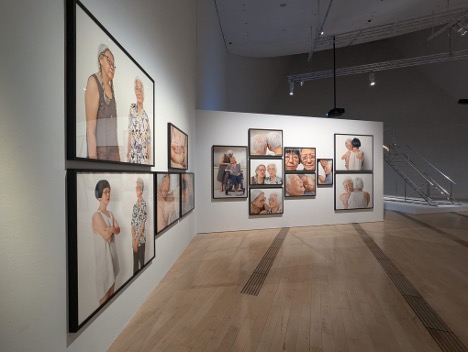
Heng’s presentations offers a site for respite, but one does wonder if it is even possible to afford to rest in times like these. Just beyond the understated generosity of the Singapore Pavilion, the 61st International Art Exhibition – La Biennale di Venezia has unfolded amid no shortage of controversy. Following the sudden passing of Cameroonian-Swiss curator Koyo Kouoh in May 2025, the Biennale opened under an atmosphere of instability and political tension. The five members of the international jury—Solange Oliveira Farkas, Elvira Dyangani Ose, Zoe Butt, Marta Kuzma, and Giovanna Zapperi—announced the exclusion of countries from Golden Lion Prize consideration whose heads of state were undergoing proceedings at the International Criminal Court for crimes against humanity. The Biennale Foundation publicly distanced itself from the jury. Soon after, the jury resigned en masse. The European Commission threatened to revoke two million euros in funding. Iran withdrew. Israel’s permanent pavilion remained shuttered for 2026 and moved to a temporary site at the Arsenale.
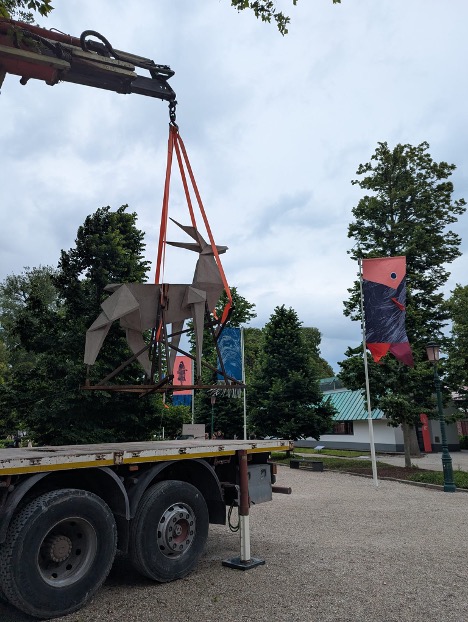
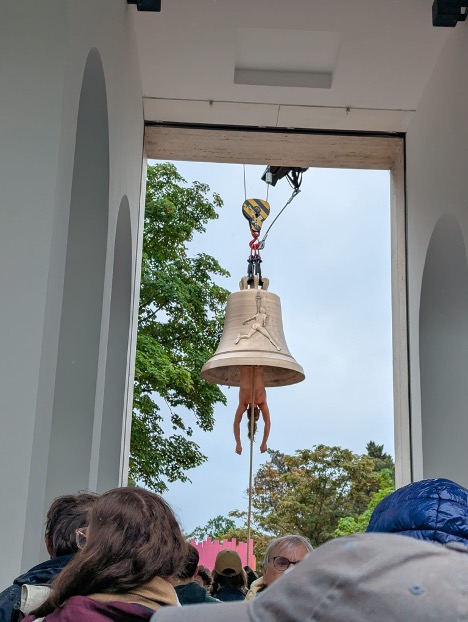
Just across the resituated Israeli Pavilion at Sale d’Armi, one encounters the Ukrainian Pavilion showing the documentation of the cultural evacuation of The Origami Deer by Zhanna Kadyrova from Yuvileynyi Park in Pokrovsk, Donetsk Oblast, to the Giardini della Biennale, where it now hangs suspended from the crane of a truck, awaiting to land. Elsewhere, Pussy Riot led a sizeable protest against Russia’s inclusion in the Biennale, prompting riot police to station themselves outside the pavilion and resulting in its temporary closure. On the final day of the preview, the Art Not Genocide Alliance (ANGA) called for a strike in protest of Israel’s inclusion. In solidarity, artists and pavilions—including Belgium, the Netherlands, Austria, Japan, and Korea—closed in part, or for the entire day.
All of this within the span of a few weeks. The art world has scarcely had time to catch its breath. Meanwhile, not far beyond these national pavilions and curated debates, families continue to lose their lives to the political, economic, and environmental catastrophes of our time.
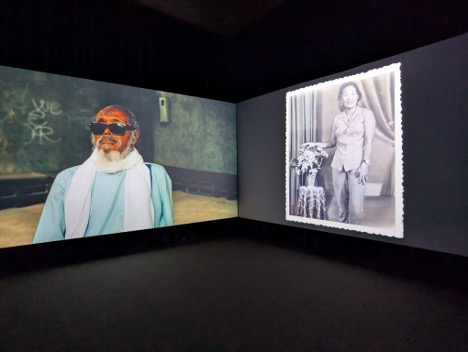
Within the Central Pavilion, artists confront the residues of past conflicts and the urgencies of present crises with clarity and force. Alfredo Jaar’s The End of the World (2023-2024), developed with human geographer and political geologist Adam Bobbette, draws attention to ten strategic metals—materials essential to our technological age, increasingly central to global conflict. Tuan Andrew Nguyen’s Ñi demoon ñoo dellusi (2026), a two-channel video installation, follows an elderly Bouba—a former robber and bandit, remembered as a working-class folk hero—whose father was among the Senegalese soldiers deployed to Indochina by the French colonial army, and whose mother was Vietnamese
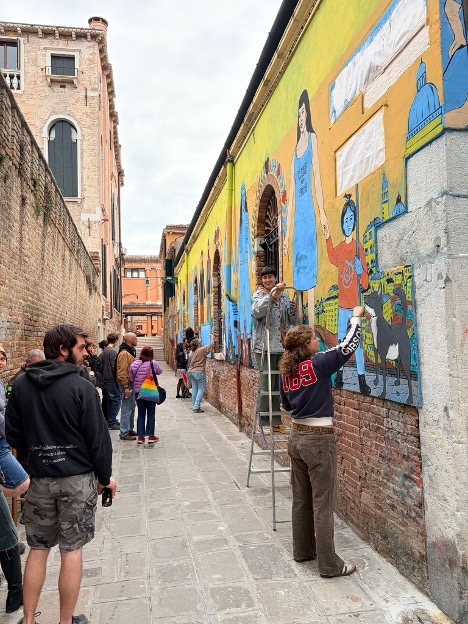
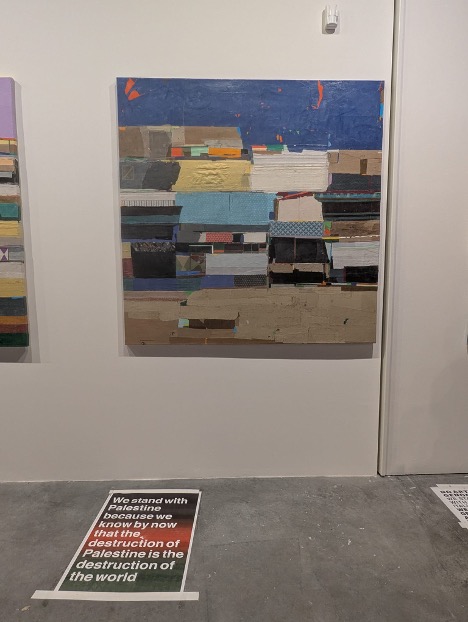
Beyond the Giardini and Arsenale, political urgency continues elsewhere in the city. Yogyakarta-based art collective Taring Padi, whose works were covered up and later removed from Documenta 15 at Kassel in 2022, presents People’s Liberation Collective Banners 2023–2026, a series of large-scale banners produced through political education, propaganda, and collective mobilisation, in collaboration with progressive organisations, collectives, and individuals across four continents. This exhibition also shows the recent works by Gaza artist Mosaab Abusal who responds to the ongoing emergency in Palestine. Across Venice, artists continue to build images, actions, and spaces that insist art cannot detach itself from the conditions of the world.
With global politics playing out writ large during this season of La Biennale di Venezia, perhaps we must pause, in order to go on.
In the introduction to the Biennale, the late Koyo Kouoh asks us to breathe.
[Take a deep breath]
[Exhale]
[Drop your shoulders]
[Close your eyes]
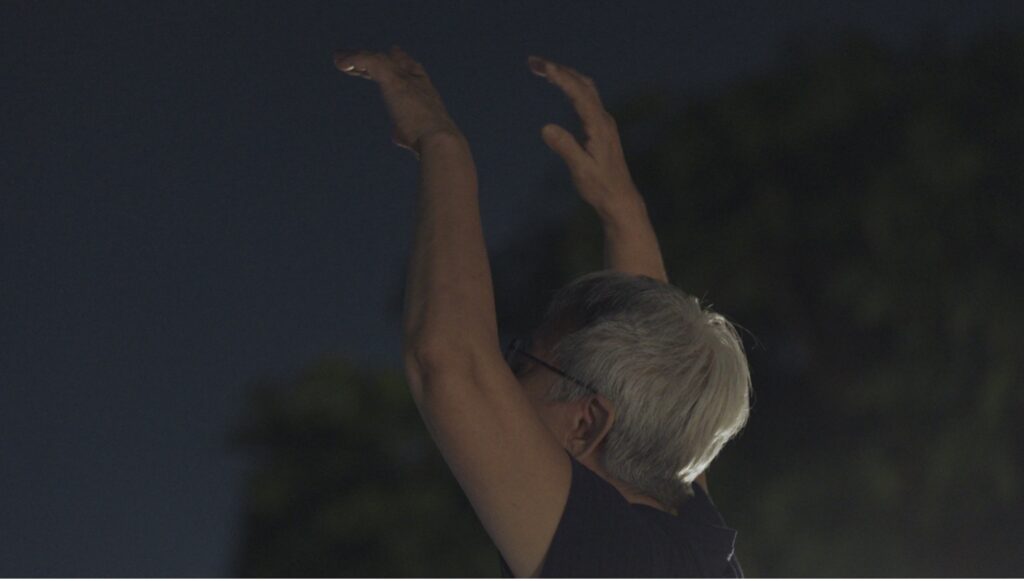
We often forget that to breathe and live with ease is an inalienable right. Kouoh reminds us that “opening oneself to the ineffable is tuning one’s senses to the minor keys.”
In terrible times, serenity becomes radical. To hear its song, one must pause—listen deeply within, contemplate our actions, our responsibilities, our loves, our spirit, and our communities.
Throughout the Central Pavilion, cavernous spaces invite us to wander through and between works, through complexities and complicities that trouble our temporal waters and ask us to find alternate vocabularies, alternate perspectives. Scattered throughout are contemplative sites of seating and stillness, spaces where the eye may drift, where the body may soften, where one may rest. The curatorial team offers the proposition that “poetics liberate and people make beauty together.”
For this to happen, one is asked to attune to lower registers, shift into a slower gear, receive the respite and sustenance offered through the hospitality of artists, curators, cultural workers, and the wider ecology of their practices. This is a curation that listens deeply, and more importantly, one that is felt in the body.
All we must do is slow down, listen, and listen before we speak.
In all beginnings there are words. Words are bridges to the other. Words are a revelation to oneself. Words hang in the air, move from tongues to ears au gré des vents, words penetrate the soil as clandestine fertiliser, their sounds, rhythms and melodies perfuming the air.
–Koyo Kouoh, 2000
The Singapore Pavilion aligns tenderly with this spirit of attunement. Turning away from spectacle, Amanda Heng locates our attention on the body of the host city, and on the bodies of its visitors. Beneath our feet still lies that upside-down forest. This forest has held centuries of culture, commerce, and memory—wood slowly softened by water, salt, and bacteria. Venice floats, and Venice sinks.
Heng asks us not to conquer it, but to move with it.
Upon it, tread gently.
____________________________________________
A Pause (2026) by Amanda Heng Liang Ngim and curated by Selene Yap is commissioned by the National Arts Council, supported by the Ministry of Culture, Community and Youth, and organised by Singapore Art Museum (SAM). This year marks Singapore’s 12th participation in the International Art Exhibition of La Biennale di Venezia. The exhibition opens to the public from 9 May to 22 November 2026.
Heng’s work will travel to Singapore in January 2027, where it will be reimagined for a second iteration at SAM at Tanjong Pagar Distripark.
The writer received a travel subsidy from SAM for the coverage of this event.
Support our work on Patreon
Become a memberYou might also like
Fearsome Engines : Gaming, Art and the Worlds We Build
Peering through the Evocative Head: At Last, a New Ng Eng Teng Exhibition at NUS Museum!