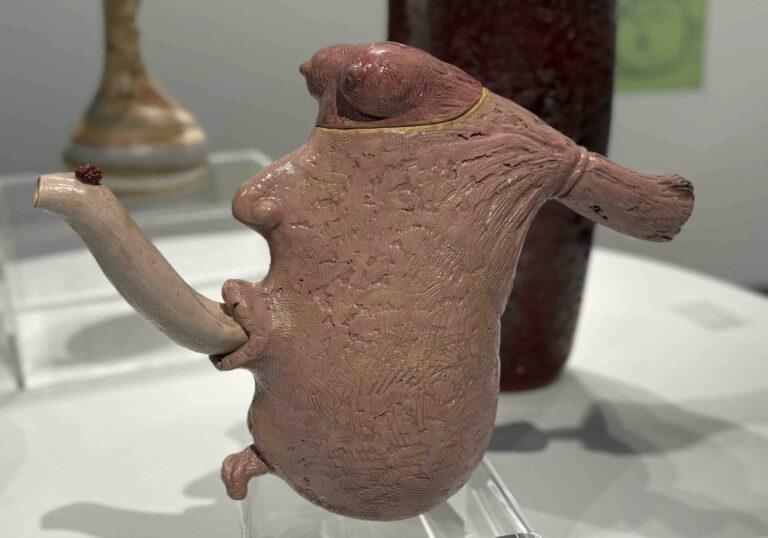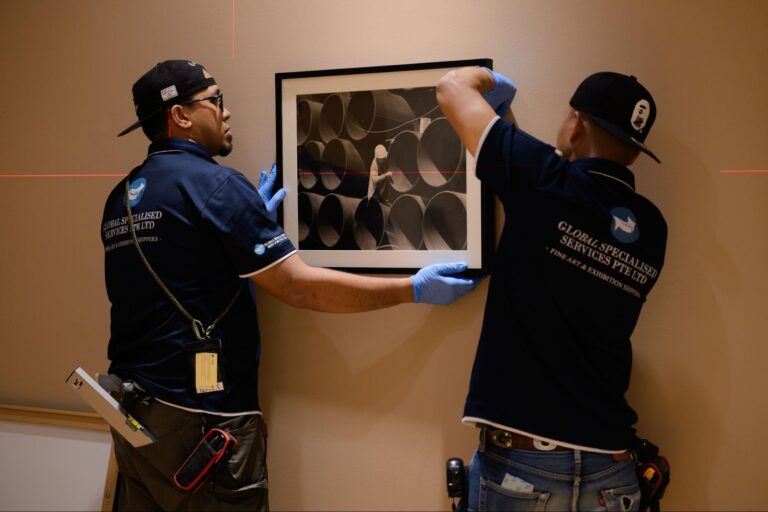

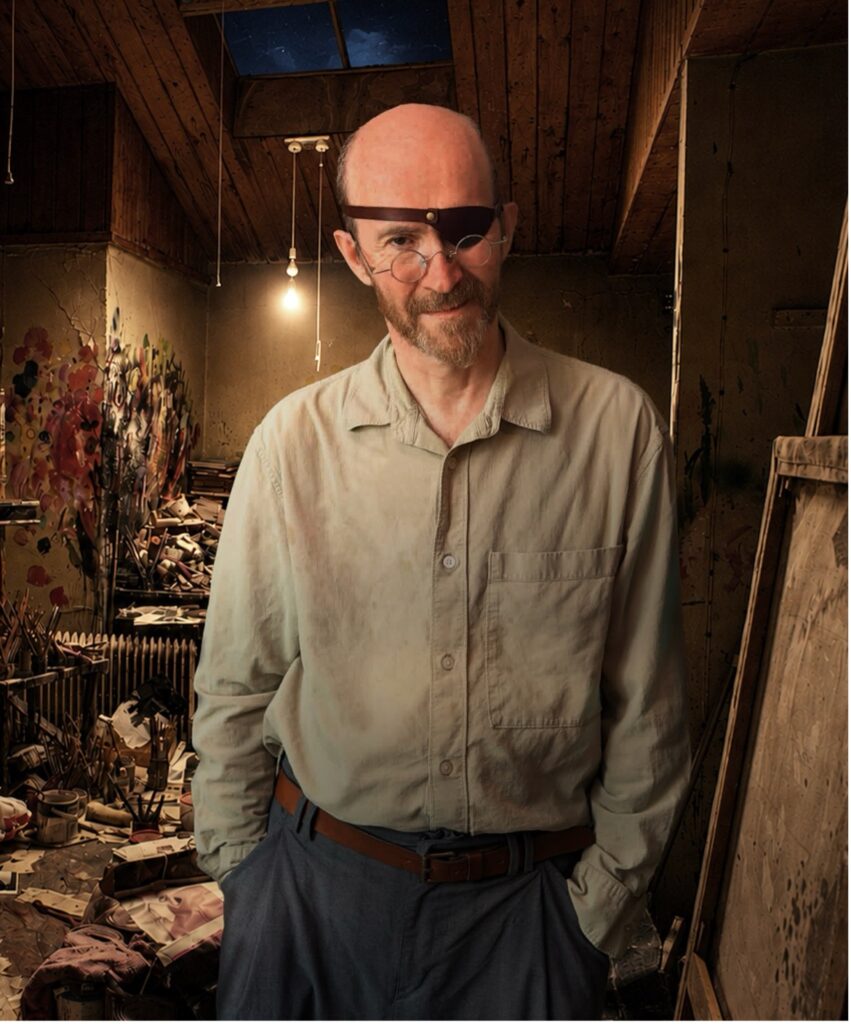
It’s the end of May, and I am in Yeo Workshop in Gillman Barracks, caught in the middle of the set up for the show Fearsome Engines. Cables and plugs are strewn all over and intermittent drilling interrupts my conversation with Martin Constable, the curator of the show, who’s visiting from Saigon, where he teaches visual effects at RMIT Vietnam. With his leather eyepatch (he lost his left eye some time back), and the surrounding sprawling hardware, I’m reminded of a steampunk engineer tinkering away in the guts of some mechanical behemoth.
There’s an air of delightful mischief when he speaks, and I imagine him – though he doesn’t fulfil this expectation – rubbing his hands with glee.
This impishness stalks the exhibition: for an exhibition ostensibly about the aesthetics of video games, there is hardly anything to be played. That’s despite two of the artists, Debbie Ding (Singapore) and Hà Ninh Pham (Vietnam), having developed playable games – perversely showcased in purely physical form in the exhibition.
As a gamer, I felt thwarted; as an art writer, I guess I was intrigued.
I’d encountered Debbie’s New Village (and played it! hah!) some time back in a residency she did in Goethe Institut in 2024. In the game, she’s recreated a version of the ‘New Village’ or 新村 her father grew up in, in Sitiawan, Perak. The New Villages were essentially resettlement camps devised by the British in Malaya during the Malayan Emergency of the 1950s, to cut the Communist guerillas off from their rural base of support. Yet despite these fraught and violent origins, the game comes from a place of tender memory: Debbie’s father had begun to obsessively sketch his New Village from childhood memory, depicting it as a carefree rural haven.
This first transformation from internment to idyll is itself intriguing, and through the game, Debbie reconstitutes her father’s now-erased village into an open-ended space of spectral exploration. One fitfully ambles through the spaces, haunted by an inexplicable nostalgia – for the Singaporean, perhaps some residuum of the kelong or the kampong – in search of an epiphany. There is no objective; nor is there a way to win. Neither is this a faithful recreation: one of the most striking visuals from the game are shrine portals that transport the player to parallel villages.
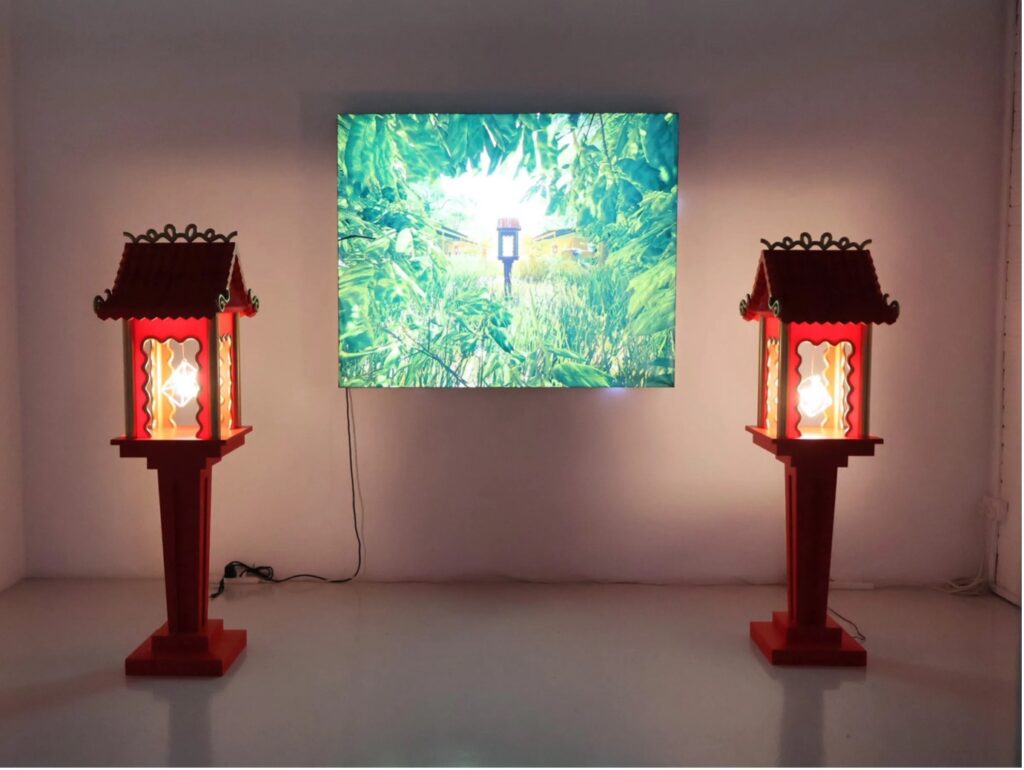
In the exhibition, two shrine portals are brought into the real world as 3D-printed bright red lamps, flanking a light box-mounted digital print of a scene of the game. The effect is both interstitial and deflationary (or at least, I couldn’t find a way to activate the shrines’ teleportation function, nor leap into the game). I was looking at a copy of a copy of a copy. Debbie seems to have derived the shrines’ design from a trip to Sitiawan in 2013, where similar red shrines were everywhere: her father remarked that he remembered the shrines from his childhood. The physical represents the virtual represents the physical.
Yet I found myself wondering whether these shrines were really exactly the same as those from Debbie’s dad’s childhood: for one, it seems unlikely they would have been made of plastic, like the modern ones. The shrine portal’s now a slippery, floating signifier, its original import irretrievable. The same could be said of this New Village located in an art gallery.
A more frustrating form of irretrievability presents itself in Hà Ninh’s work. He’d created the game Institute of Distance as an emanation of his long-running project, My Land. It’s a project that grew out of unbelonging: a refusal in a politicised era to bend to easy categories of left and right or to expectations of Vietnamese art.
My Land became Hà Ninh’s expression of autonomy and sovereignty. He also describes his projects as attempts to “prove” that My Land exists, to our world. Thus from My Land come dispatches: alien artefacts, intricately-drawn and illustrated maps, objects, and finally, games, such as Institute of Distance. It’s a role-playing game, presumably set in a version of My Land, where the player is a “soul-atom”, which can choose its body parts and fate for its next life.
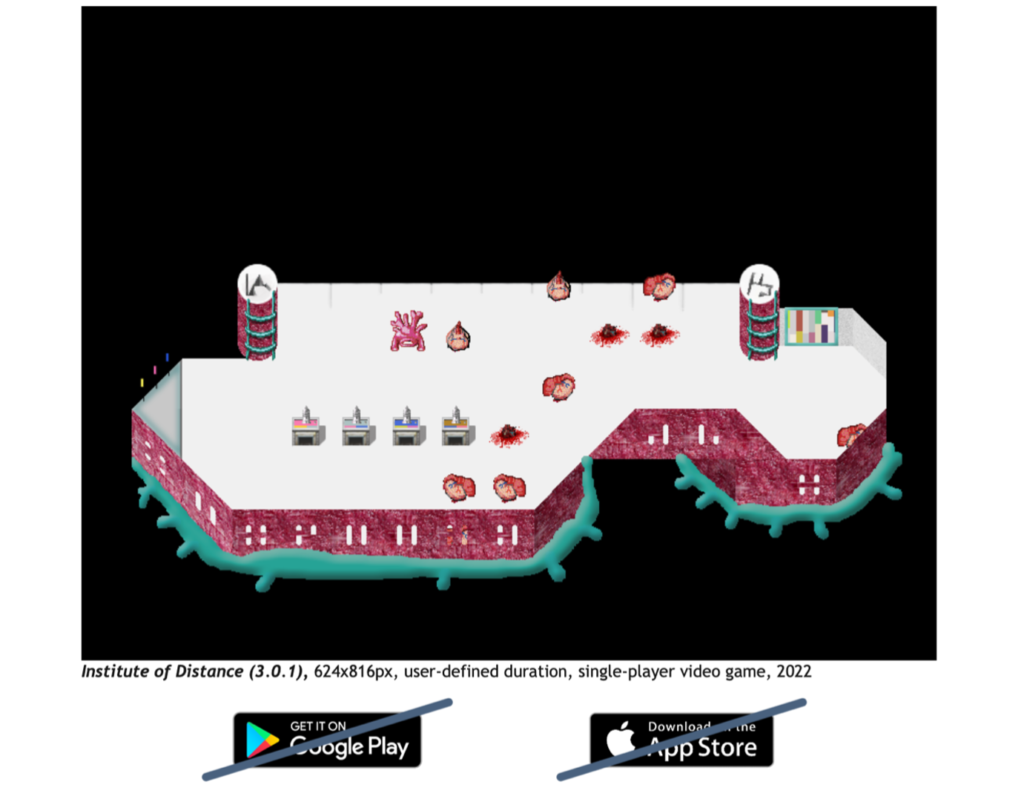
The irony of Institute of Distance isn’t just that one can’t play it in Yeo Workshop. One also can’t download it from the Apple app store, nor the Android store. (Hà Ninh pulled them due to prohibitive costs.) It may be possible to play it on the browser, on Hà Ninh’s website, though it doesn’t quite work for Macs, like mine. (I can load the game and move the soul-atom around, but nothing else seems to work.) Hà Ninh then very generously tried to send me a version specifically exported for Mac. (“The files are old so I needed to downgrade my system to export them again,” he said.)
Predictably, I can’t get this one to work either (and I haven’t had the heart to tell him yet). Aptly, one of the artifacts Martin has chosen to display in the show is a print-out from the game that simply says “Loading Error”, with the soul-atom figure above it.

Martin’s curation romanticises the near-obsolescence of the game. It also surfaces a persistent question I had while listening to Hà Ninh: why would a place like My Land, which Hà Ninh has described as “existing outside our perception of reality”, have anything to say to our world? And what would it say? In an age of constant connection, this disjuncture seems almost defiant, and perhaps a vivid illustration of Hà Ninh’s own ambivalence in relating to the art world and its postures. Side by side, it stands in stark contrast to the invitation presented by Debbie’s open world.
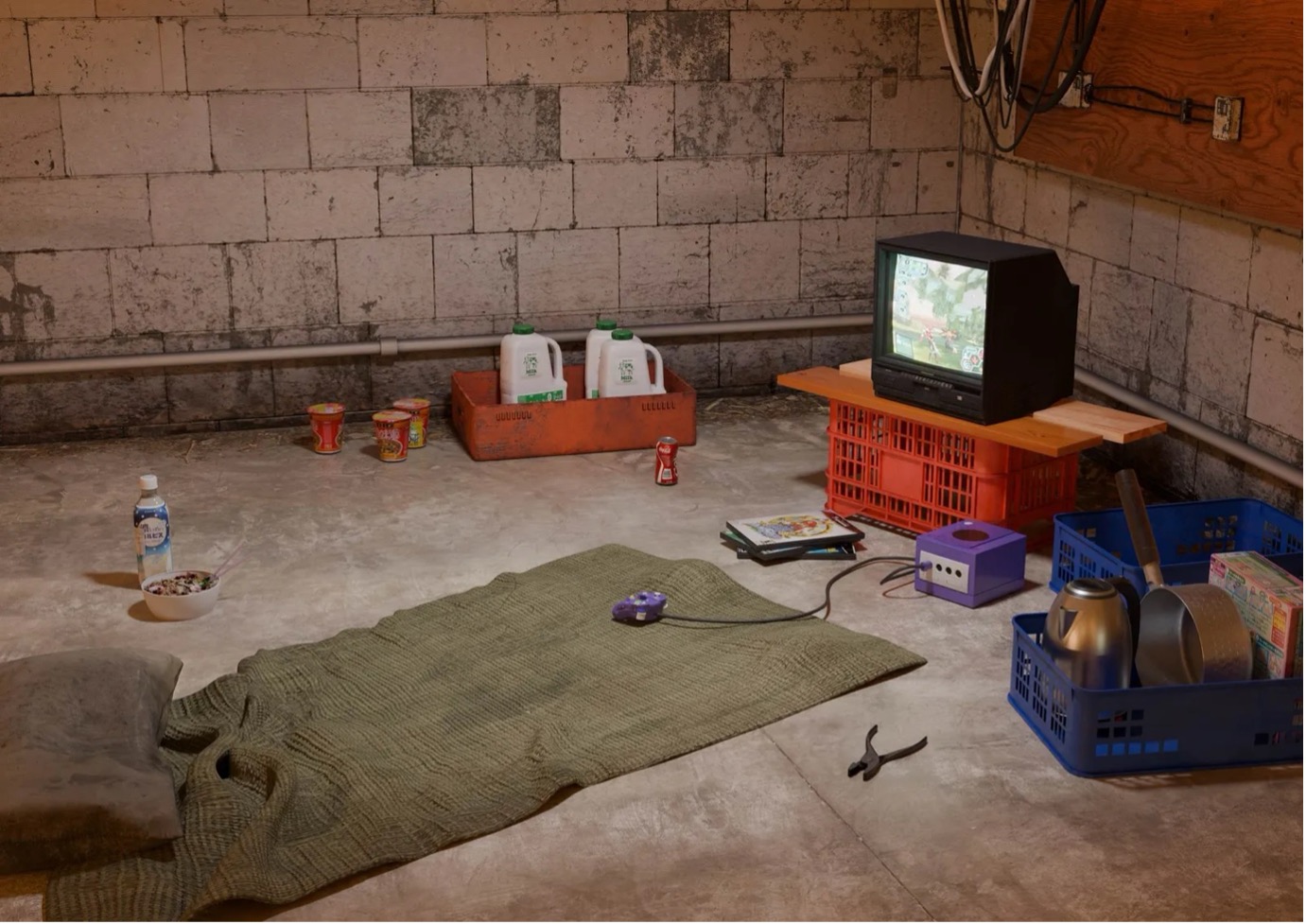
Martin’s own work in the show is perhaps the most visually striking and visceral. Inspired by threads on “battlestations” on the internet imageboard 4chan, where users post photos of their gaming setups and environments, Martin has rendered three gaming set ups through 3D-modelling, in a series titled The Philosopher’s Paradise. They are exercises in liminal horror: each detail I noticed accentuated my sense of dread.
My favourite’s a TV attached to a console, mounted on what appears to be a milk crate. In the centre lies the gamer’s squalid throne: a rolled out green tartan blanket and a pillow. It’s impossible to figure out what space this is supposed to be: the walls are cracked and mouldy, a thin (gas?) pipe runs close to the ground, and there’s a wooden circuit board in the background. A basement of some non-home. Around the gamer (perhaps fortunately, not pictured) are the real sites of terror: tubs and crates that contain supplies. A saucepan and a kettle lie in a blue milk crate, and disconcertingly, three large plastic containers of milk are in another splotchy red tub.
That there is a sense of organisation amidst all this only heightens the grotesquerie. Then, finally, the coup de grace: a pair of rusted pliers, a maddening detail that burrowed deeper into my brain as I stared at it. Alarmingly, Martin assures me this is based on a real photograph.
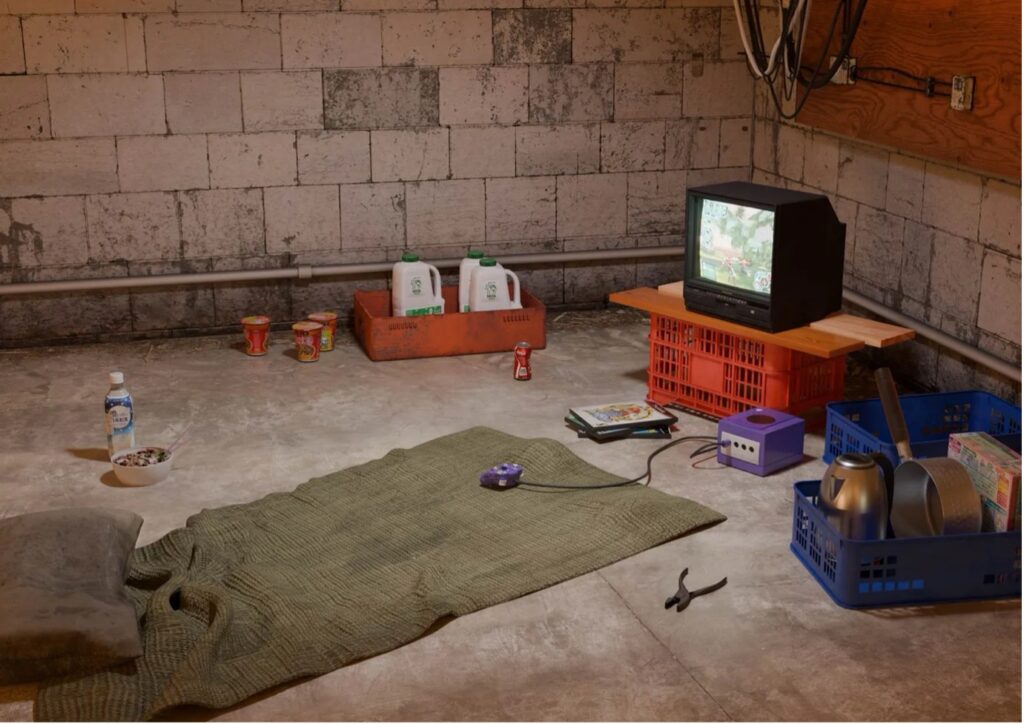
Besides aestheticising “male failure”, in the words of Martin, these visualisations of gaming rigs also serve to make visible the physicality of gaming, a theme that threads the exhibition.
At last, in Charles Lim’s Switch, you can play a game.
Sort of.
There’s a laptop on a table and in the room beyond, a pair of work lights, which flash brightly now and then. On the laptop, one can explore a virtual model of Yeo Workshop, rendered using a game engine. One notices almost immediately that the work lights in the virtual model are out of sync with the real world lights.
Switch repurposes Charles’ graduation project from Central Saint Martin’s in London – where Martin was Charles’ painting tutor. In the original conception, Charles says that the room is intended to be pitch black: the bright lights blind and stun the viewer, who is then inevitably drawn to the small glowing laptop screen when the rest of the room returns to darkness. (This effect is unfortunately a little lost in this iteration, due to the physical constraints of the space.)
Yet again, the mischief presents itself, like a gremlin giggling in a corner.
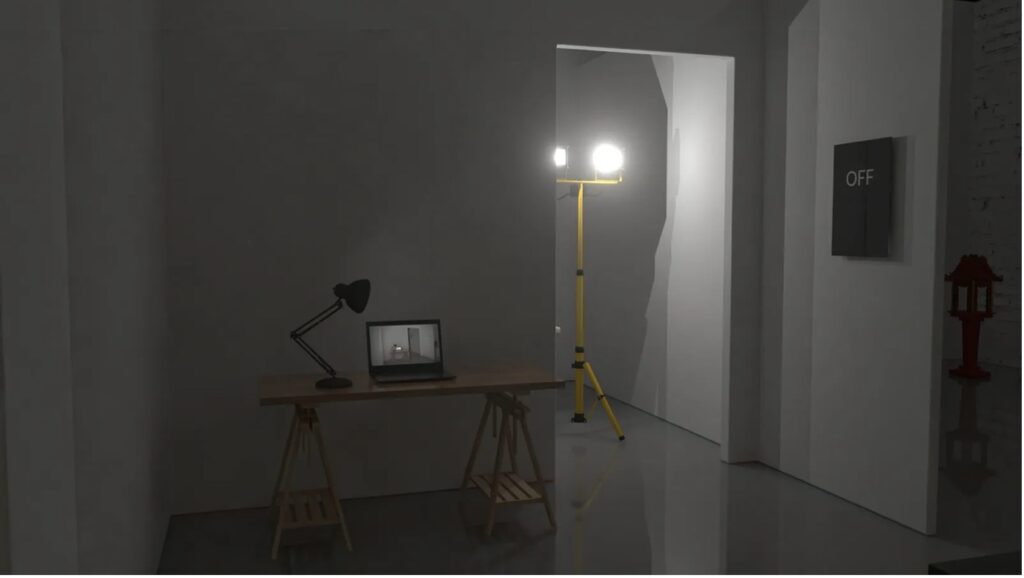 Switch, 2026. Work light, laptop, light sensitive activator and game executable. Dimensions variable. Image courtesy of the artist
I was surprised when I first learnt of Charles’ involvement in the show. After all, Charles is perhaps best known for his SEA STATE works, commissioned for the Singapore Pavilion at the Venice Biennale in 2015, which explore the biophysical and psychogeographical contours of Singapore through the rich cauldron that is the sea. Speaking to Charles, I’m astonished to find out that halfway through his degree, he’d abandoned painting (to Martin’s dismay) to work on new media, culminating in this graduation piece.
What’s even more fascinating is the catalyst for all this.
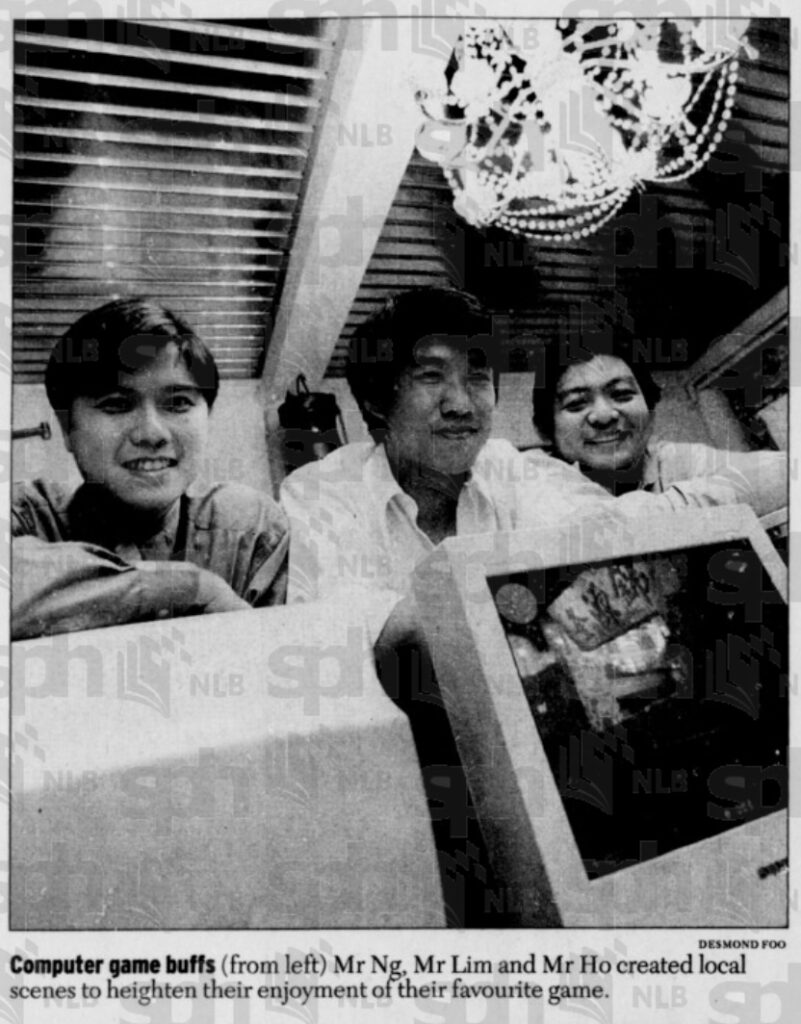
Close to the turn of the millennium, Charles took a year out of Central Saint Martin’s. Back in Singapore, he gamed. A lot. In particular, he played Counter-Strike or CS, a first-person shooter game that was then all the rage, especially in LAN shops across Singapore. Soon, he began to modify (or “mod”) CS maps, adding local flavour and context. Together with two other gamers, he created two maps: one of them called Towkay, complete with Singlish voice-acting (or “sound packs” as they’re called). (He says he got his friends drunk and told them to shout things.)
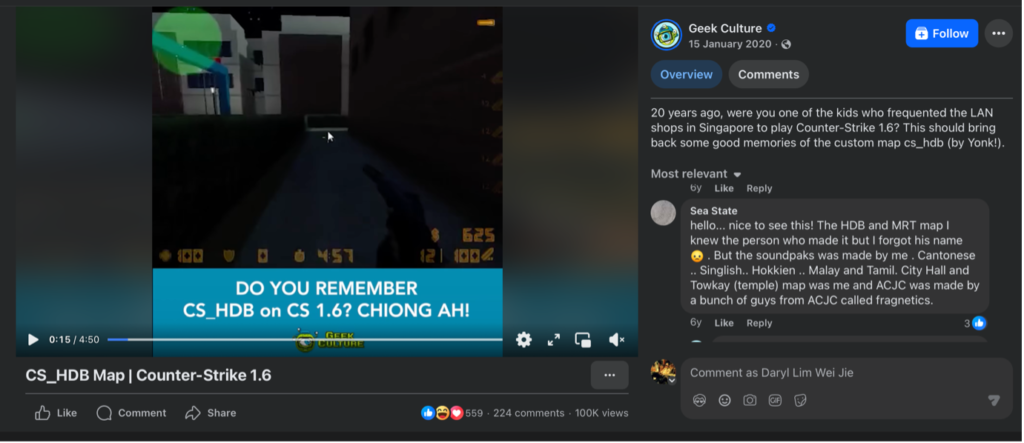
Charles also did the sound packs for a well-known Singapore CS map: cs_hdb, set in a Choa Chu Kang HDB estate, made by a user named Yonk! (or Lim Yeong Chun, who would go on to co-found the online portal Geek Culture).

Gaming and the internet also led to a seminal post-graduation collaboration, a media art collective named tsunamii.net (comprising Charles, Woon Tien Wei and Melvin Phua), which pursued institutional critique of the internet through a series of works titled the ‘alpha series’. (In a breakthrough for Singapore art, one of the alpha projects, alpha 3.4, was featured as part of documenta 11, in 2002.) At that time, the internet was seen as a positive, liberating force, but tsunamii.net interrogated the inequalities and politics of the internet – a move that now seems profoundly prescient. Gaming again was a source of revelation here: Charles realised connection speeds were determined by physical infrastructure such as undersea cables. It was following this train of thought that provoked Charles to think more deeply about the sea, leading to SEA STATE.
For the longest time I had assumed that Charles’ SEA STATE projects were driven by his affinity for the sea, as a former Olympic sailor. It turns out gaming was just as, if not more, pivotal. Charles credits gaming not just for fomenting specific projects, but also for helping him grapple with the conceptual complexities of art-making. He may indeed be one of Singapore’s first prominent gamer-artists. (Curiously, the write-up of the exhibition disclaims that “none of them [the artists] are gamers”, which somewhat obscures Charles’ incredible formation.) Through his career, one catches a glimpse of Singapore’s role in the history of video games – and specifically, video games as art. One suspects video games may have had a surprisingly outsize impact on the formation of many other Singaporean creatives.
Fearsome Engines is a remarkable and unusual exhibition, if one is willing to sit a while with its provocations, and burrow down some rabbit holes. Gaming is now so ubiquitous it is almost invisible: observe commuters on the train, and an eclectic array of people play on their phones, from retirees to schoolboys.
Through the exhibition, Yeo Workshop has transformed itself into a threshold between the physical and virtual worlds, providing a space for the viewer to interrogate the relationships between the two. With all that’s going on, it seems a relationship that will only become more strange and volatile.
I left the gallery, hiding from the gleaming sun to preserve my pale gamer glow, and shuffled back home to my battle station, my deferred desire for gaming by now burning.
___________________________________
Fearsome Engines runs at Yeo Workshop at Gillman Barracks till 28 June.
Support our work on Patreon
Become a memberYou might also like
Perhaps We Must Pause, in Order to Go On: The Singapore Pavilion at the 2026 Venice Biennale
Peering through the Evocative Head: At Last, a New Ng Eng Teng Exhibition at NUS Museum!