Resurrecting Our Past Selves: Likenesses at the Goethe-Institut New York
At 12, Charmaine Poh was thrust into the limelight. On the Singapore television series We Are R.E.M., she played E-Ching, part of a trio of junior sleuths that investigated everything from a dognapping to a dead magician.
But childhood stardom had its dark side. On the show’s dedicated web forum, Poh was stunned by comments about her body — that she had a “peanut head,” that her breasts were too small — presumably posted by boys “lurking around to get to know this body,” as she puts it.
“Basically, I was ugly,” E-Ching reflects two decades on, in the video piece GOOD MORNING YOUNG BODY (2021–23). Through AI deepfakery, Poh reinhabits her 12-year-old self and proceeds to analyse the situation with precocious wisdom and the power of hindsight.
GOOD MORNING YOUNG BODY is the first work that greets visitors at Likenesses: Speaking with the Selves, a joint exhibition between Charmaine Poh and Li-Ming Hu that was held at the Goethe-Institut in New York from 24 September to 11 December 2025. The throughline that connects their pieces is their tangled past as television actors: Poh as a minor in Singapore, Hu as a person of minority ethnicity in New Zealand.
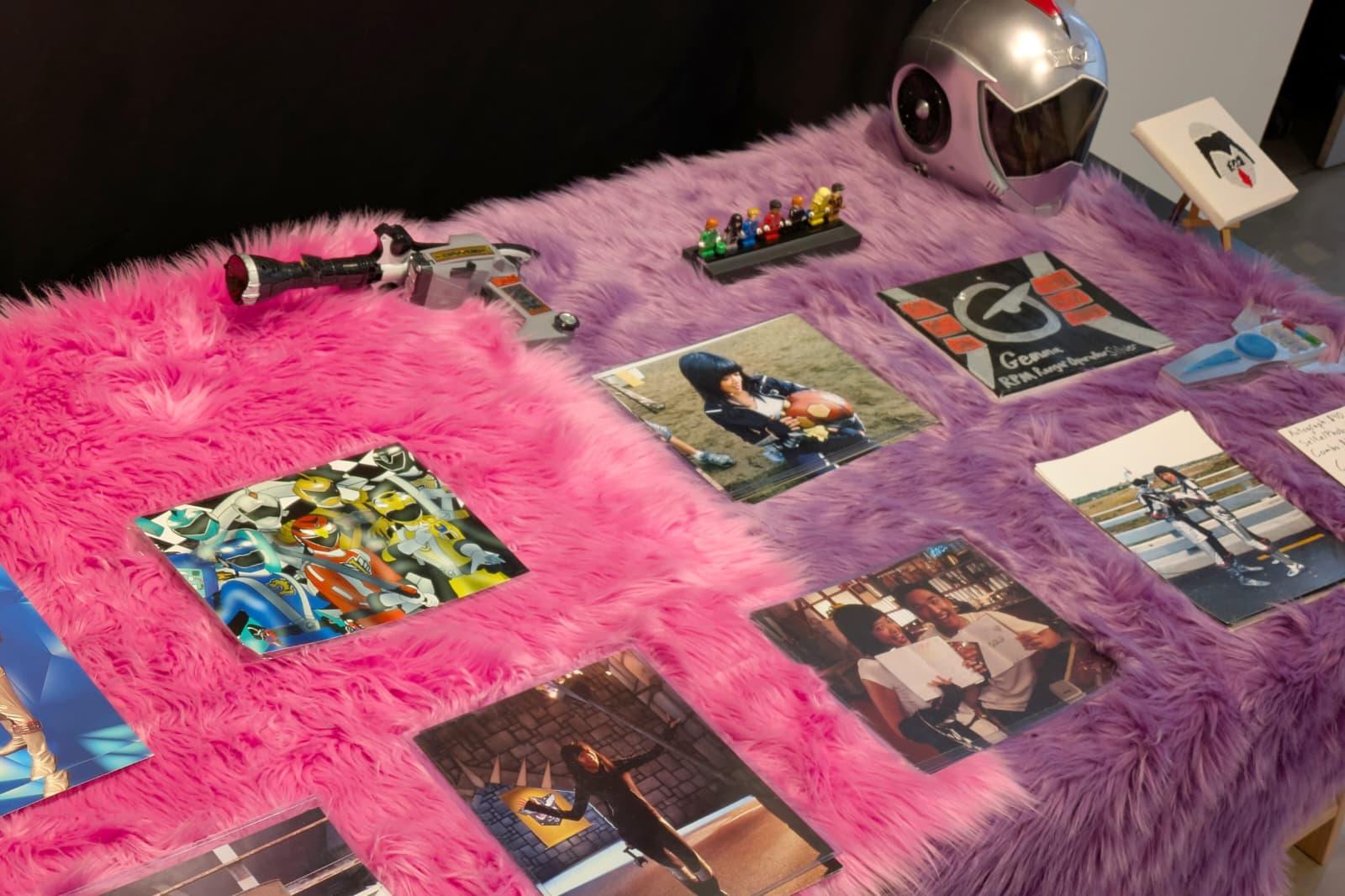
There are aesthetic cues that signal the throwback. On one table sits a first-generation teal iMac, where the hockey-puck mouse may be used to browse episodes of We Are R.E.M.. Arrayed on another table, lined with pink and purple fur, are photographs and plasticky paraphernalia from Hu’s days as the Silver Ranger in Power Rangers RPM. At one point in GOOD MORNING YOUNG BODY, you hear the see-sawing modem noises of the dial-up era.
The strong parallels between the two bodies of work surprised even the artists themselves when they connected for the exhibition, curated by Zachary Feldman. Both have left acting careers behind and now use performance to make art. Both repurpose the medium that caused them distress to reestablish a sense of self — video is both the source of mortification and means of resurrection.
Another surprise was their diasporic Singaporean connection: Poh grew up in Singapore, as did Hu’s mother. In an evening of performances at the Center for Performance Research (CPR) in Brooklyn, they explored this aspect of their identities in a final collaborative piece.
Glitching towards clarity
Poh began as a photographic artist, but working on the YOUNG BODY series during the pandemic opened up new modes of incorporating acting and performance into her practice. Currently based in Berlin and Singapore, she is also co-founder and head of visuals at the online magazine Jom.
Poh finds clarity by peering through the lenses of politics, philosophy, and pop culture. In GOOD MORNING YOUNG BODY, E-Ching laments that she “didn’t have the words” to fight back, that Singapore’s anti-harassment laws didn’t take effect until 2014. She brings up Britney Spears as an egregious example of how female bodies are exploited: the media industry generated over $100 million from her mental breakdown in 2007, with paparazzi constantly hovering and jostling for a piece of her flesh.
E-Ching, who resides in a cosmic realm of digital distortion, also cites the idea of “glitch feminism,” formulated by writer and curator Legacy Russell. According to Russell, a glitch is not an error but an outlier that serves to correct a broken social system. Glitching is refusing to be smoothed over. Glitching is finding the words to speak out. “To all the little girls,” E-Ching proclaims, “I am happy to be a glitch. Let it all short circuit.”

Is this Asian enough for you?
Li-Ming Hu, who is based in New York, was in her twenties when she landed a breakout role on Shortland Street, New Zealand’s longest-running soap opera. As a rare Asian face on television, she sometimes had to perform her ethnicity in limiting ways — for instance, speaking Mandarin despite her lack of fluency.
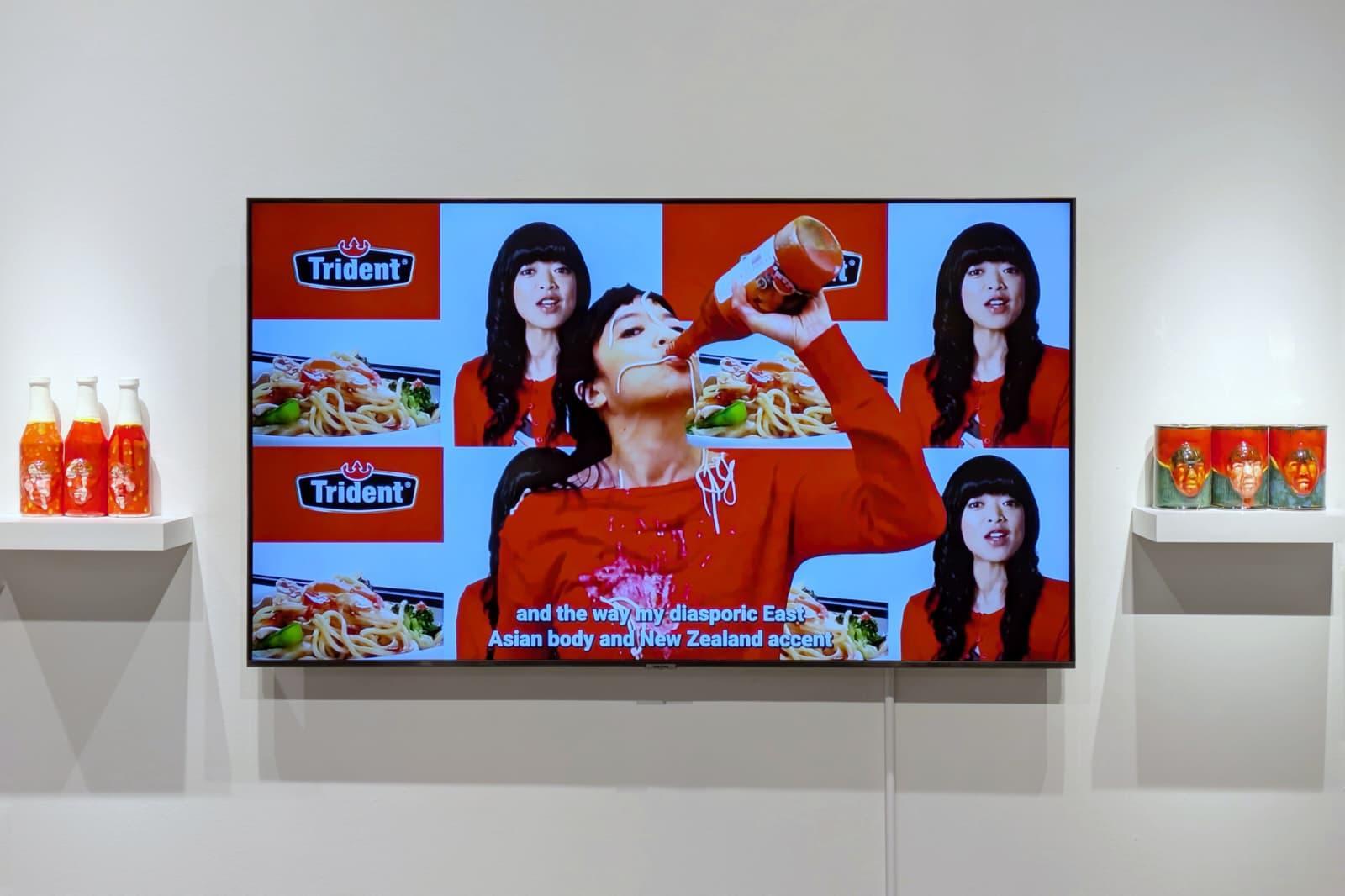
Years later, Hu featured in a series of ads for Trident, the Australian maker of Asian food products. She excavates this experience in Deliciously Authentic (2024), which is titled after the brand’s tagline. In the video, Hu reflects that her New Zealand accent offered an anchor of familiarity, while her Asian skin conveyed the promise of exoticism.
Whereas Poh seeks to make sense of the past, Hu is often more interested in making fun of it. Her recreations are parodies that involve exaggerated cosplay, puncturing seriousness with humour and soiling prettiness with the grotesque.
Over juddery footage of her plastered smile, Hu recounts criticism of her Trident audition as “jiggly” and “jerky” and requests for her to “just be yourself.” It’s a send-up of the client’s directions and her failure to fulfil them. Then we see Hu, with great relish, hawking food products along with her Chineseness: slapping herself with limp noodles, glugging chilli sauce, and dousing her face with coconut cream.
Flanking the screen in the exhibition are ceramic pieces that replicate images from the video. Hu’s visage, bulging out of coconut cream cans and chilli sauce bottles, seem to call out from the shelves: Is this Asian enough for you?
Peeling back the veneer
Something both artists underscore is the disjunction between the polish of what the public consumes and the emotion that roils beneath the hood — in other words, the gap between how the actor looks and how they feel.
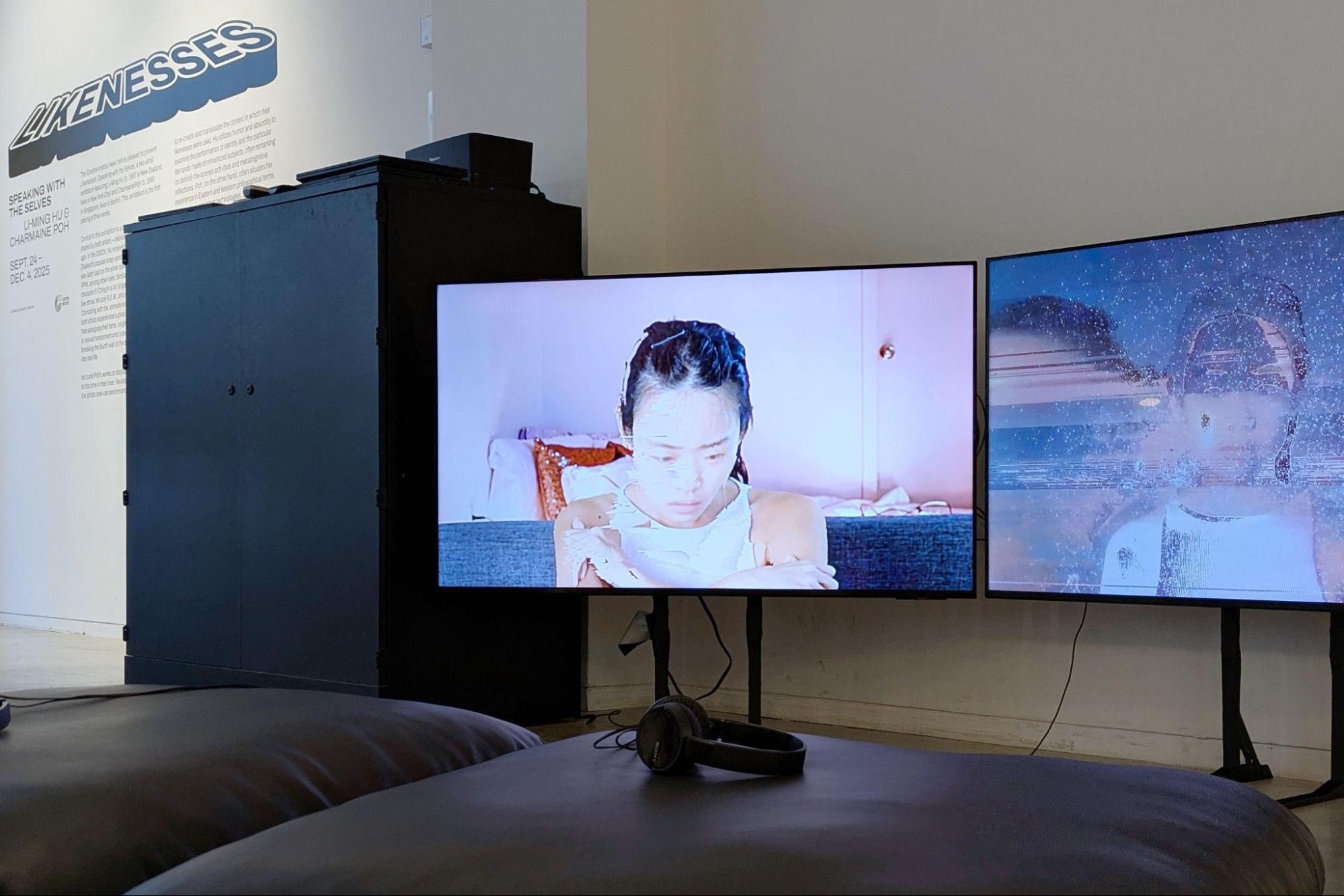
In Poh’s public solitude (2022), two screens present distinct versions of her 12-year-old self. On the left is Charmaine crouching in her bedroom, and on the right is E-Ching floating in the cosmos, repeating in a high-pitched tween voice, “I am pixel-flesh. Code-bone. 12. And immortal.”
At first, all is at ease. But as we continue to stare, both identities start to fray. The images warp. E-Ching’s mantra sounds garbled. Charmaine crumples, rocking back and forth. The title of the work refers to a concept in the Stanislavski method of acting, where performers strive to forget the presence of the audience. Here, however, solitude isn’t a freedom from but a crushing by the gaze of the masses.
In Three Interviews (2020), Hu peels back the veneer of media and takes us behind the scenes of being interviewed on camera. With regard to a video promoting the School of the Art Institute of Chicago (SAIC), where she obtained an MFA, she narrates, “I was not in the best frame of mind about my life and had tried to cut my bangs that morning with limited success.”
Hu is made to repeat a response ad nauseum: to expand it, to shorten it, to smoothen it. Just the first question takes an eternal five minutes. The interviewer uses repetition to erase the undesirable. Hu, in splicing together the awkward outtakes, uses repetition to amplify the artifice.
At a Power Rangers convention in Anaheim, she appears on That Hashtag Show, an online series that covers pop culture geekdom. “I was not in the best frame of mind about Power Rangers and still had not found a good hairdresser,” she says. For a “How well do you know your season?” quiz, we see Hu being fed the answers beforehand, so that she can later deliver them with feigned spontaneity.
During the main conversation with the host, a live notepad app at the bottom of the screen reveals Hu’s true thoughts. Above, she says: “It was great.” Below, she types: “It was difficult. It really challenged my sense of self.” Above, she says: “Just a great bunch of people.” Below, she types: “One of the cast members told me they wanted to fuck me in the ass. I told them to get in line.”
By resurrecting their younger selves, Poh and Hu are picking apart and shaking off the claims and demands accumulated on their bodies, their images, and their identities. By donning AI or costumed likenesses and repositioning themselves in front of the camera, they get to be seen — and see themselves — anew.
___________________________________
Likenesses: Speaking with the Selves was presented at the Goethe-Institut New York from 24 September to 11 December 2025.
Header image: Installation view of Charmaine Poh’s public solitude (2022), two-channel video, 4 min.
Support our work on Patreon
Become a memberYou might also like
When the Mekong Flows Into a Michigan Museum
Seven Ways to Spend Your Singapore Art Week 2026