Sentul Biennale: To Our Friends was a small but ambitious exhibition organised by A+ Works of Art in Kuala Lumpur (KL) in December 2025. Bringing together more than sixty artists from across the region, the exhibition playfully adopted the language of the biennale while reflecting on the role of friendship and community in contemporary art. In this conversation, critic Lee Weng Choy speaks with curator Hay Wu about the making of the exhibition and the possibilities that biennales continue to offer today
Weng: Greetings Plural readers! It’s been a minute. Some of you may recall my column from back in the day, “Ask a Critic”.
Today’s topic is biennales, though not Singapore’s pure intention, which concluded at the end of March this year. Instead, we turn to look at a tiny one that took place in Malaysia last December. Let me introduce Hay Wu from Hong Kong, who was the Artistic Director of Sentul Biennale. Hay is currently doing their MPhil in digital humanities in Cambridge.
Hay, I’d like to start our conversation by offering some background to the exhibition, which was organised by A+ Works of Art Gallery, based in the in Sentul neighbourhood in Kuala Lumpur. Early in 2025, Joshua Lim of A+ approached me, his part-time consultant, for advice about an end-of-the-year group exhibition he was planning. He wanted to showcase several artists, with all the works hung salon-style, and all priced the same. I suggested we frame the event as a biennale and invite an international artistic director. That’s how we got to you, Hay.
In your curatorial brief to artists, you wrote:
“Audaciously calling itself a biennale, Sentul Biennale gently pokes fun of the biennale as an institution and its own ambitions in the face of spatial, financial, and structural limitations—while being earnestly committed to the idea that biennales still have something to offer. In response to recent attempts to examine the foundational roles of friendship, kinship, and community in contemporary art, Sentul Biennale: to Our Friends turns its attention to the moment of introduction between friends as a point of consideration.”
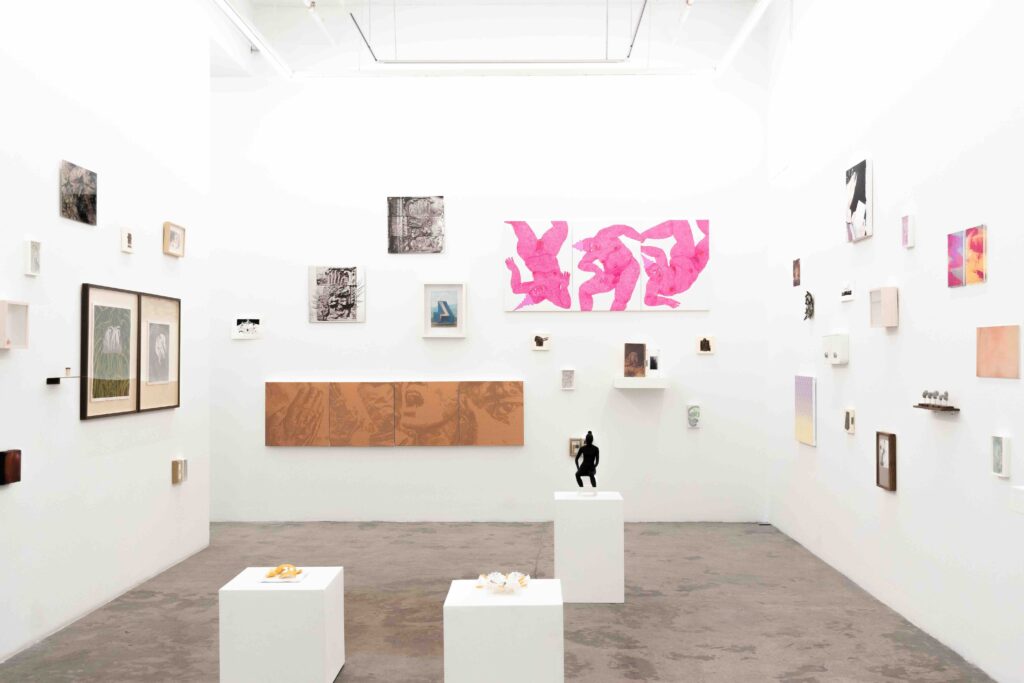
Sentul Biennale presented over 60 artists from across the region and around 150 works in the small gallery space. The process of putting it together was kinda chaotic and very last minute—not unlike many a biennale. But unlike other such projects, Hay, because of budget constraints, you only got the chance to come to KL and see the venue on the day of installation, just in time for the launch.
Hay: I’m thinking back to the opening of Sentul Biennale: To Our Friends, and the ways in which the hang and the people—both the artists and the folks from the KL art scene —came together to make the exhibition. This is true for all exhibitions, but I think this is even more true for us, given that Sentul Biennale is so much about the moment of encounter between an artwork and its audiences, and the possibilities that emerge from that moment.

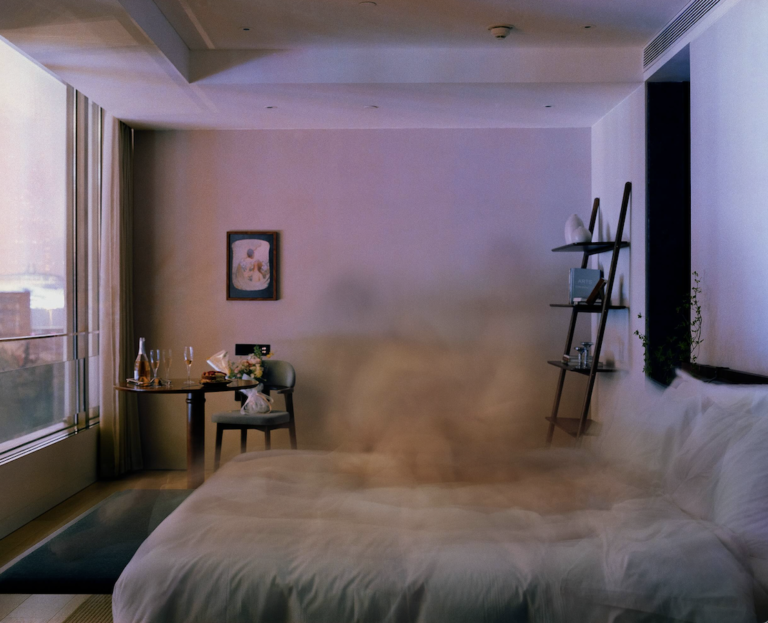
My favourite experiences at openings are the ones in which the space facilitates opportunities for looking at the works and looking at one another, and I think that definitely happened at Sentul Biennale. Part of this has to do with the magic of the hang itself, which was lovingly done by Hariz Raof, with help from Tasha Saminjo, our colleagues at A+. For example, I think of the clever placements of Your Place and My Place, by the artist 0, which consists of photographs of everyday elements in a room—a drain, the meeting point between two walls, a subtle crack—these were placed in-situ throughout the space. Watching people stumble upon the work and delight in it, alone or with friends, was such a pleasure for me, because it is precisely this experience of “stumbling across” something that I hoped to create with the exhibition.

Also important for me was speaking with the artists —about their work, but also about other aspects of their lives: about the dynamics of the KL art scene and how it differs from the rest of Malaysia; the fact that the nasi lemak at the opening came from a famous local chain; about community initiatives in Sentul; and, naturally, some gossiping and sharing of grievances about the precarity of working in the arts. As someone who wasn’t familiar with the KL art scene before, I have with me now a set of references through which I can start to understand the city better.
I’m also excited about the Hong Kong artists who took part in this exhibition, and how they illustrate some of the registers of contemporary art that exist in my hometown. Among them are Winsome Wong Dumalagan—who was there for the opening!—whose mixed media installations depict the dogs and boars who wander along the outskirts of our city. There’s also Winki Cho’s linocut prints, made especially for Sentul Biennale, which explores different types of pair activities as an evocation of the theme To Our Friends.

Weng, we’ve spoken about your turn towards the anecdotal—and perhaps by extension, the epistolary. How does this shape the way you’re looking at art, including in Sentul Biennale as well as other recent encounters?
Weng: I often describe my penchant for the anecdote in terms of taking a walk in the woods. I move slowly, my eyes wander, without a plan so much as I respond to where paths take me. Contrast this with a surveyor, who wants to cover territory effectively and efficiently, and might use a drone with a high-res camera, capturing everything in sight, zipping around and mapping the forest below. The walk on the ground privileges the anecdotal: moments of ad hoc encounters with individual trees, whereas the view from above doesn’t. What it can give us is lots of information and it can reveal patterns and a larger narrative.
My interest is to return to the same woods, to my favourite trees, again and again. It’s not just that first moment of encounter but repeated encounters over stretches of time that I seek——an extended relationship; a long, open-ended conversation.
Biennales, which usually span months, afford the opportunity for repeated views, especially for local audiences, yet the artworld media doesn’t really acknowledge how important that mode of engagement can be.
Over the decades, I’ve written a lot about these expansive projects, though recently not so much. Yet I rarely wrote your typical review. Before, I wanted to theorise art and biennales, but these days I’m more interested in having conversations with friends, new and old, which sometimes result in co-written texts for publication.
Hay, it’s interesting that you bring up the epistolary. Having studied English literature, I remember how the novel emerged in the 18th century, and an early form of storytelling was the anecdotal, serial letters written by the characters to each other.
Back then, letters had to be delivered by post, which took time. Today, we connect instantly. The epistolary not only evokes a highly personal register of communication but also the waiting. Maybe there’s a lesson there that conversation can benefit from delay and anticipation. To get back to Sentul Biennale. It was a learning experience, to be sure, and for the next edition, hopefully we’ll fix some of our mistakes– everything from being better with publicity and logistics, to scheduling more time for the show.
The point of doing a biennale is to attempt something big, but at stake is less size than scale. With scale, which is comparative, what’s interesting are the tensions between large and small moments or things. What’s been surprising is how for me, this little exhibition, with the audacity to claim the name “biennale,” has revived an enthusiasm for thinking on the topic.
As you said in your brief, Hay, “biennales still have something to offer”. Indeed, they can be good for thinking—about our contemporary art and times.
Hay: They still have much to offer, if not in the ability to actually capture the state of contemporary art and our times, then in the attempt to do so, often in ways that are more directed to the regional specificities of each place. I’ve been inspired by what I’ve heard about the Kochi -Muziuris Biennale, particularly the Students’ Biennale. They put a real emphasis on dismantling the cultural hegemony of the “top” art schools through their selection of student artists, as exemplified by this most recent edition, which features works from over 175 art institutions in India.
These attempts at reframing the scope of what we pay attention to in contemporary art are where biennales still have transformative potential. They form the bases for new artists and audiences to meaningfully encounter one another which may, with time, result in the friendships that are so important for holding (some of) the art world together. At the same time, I think it’s also important for us to think of neither the biennale nor friendship in “pure”, utopic terms. Think of what is getting cut from our current biennales. South Africa withdrew their upcoming Venice Pavilion, because of a work by artist Gabrielle Goliath and curator Ingrid Masondo that memorialises the deaths in Gaza. This is part of a recent wave of silencing art that touches on the ongoing genocide of Palestinians, all of which troubles me deeply.
Through their act of solidarity with Palestinians, I see Goliath and Masondo’s work as a gesture of friendship, which understands that it is not solely an interpersonal relation but can also hold political force and intent. If biennales are to remain relevant, I think it’s vital for them to practice these acts of solidarity too, and to refuse the normalisation of violent acts of erasure. I believe that this is possible—and that these gestures, minor as they may be, hold weight in envisioning the kind of world we want to live in.
____________________________________________
For more on Sentul Biennale, check out Hay and Weng on BFM radio
Read the catalogue essay here.
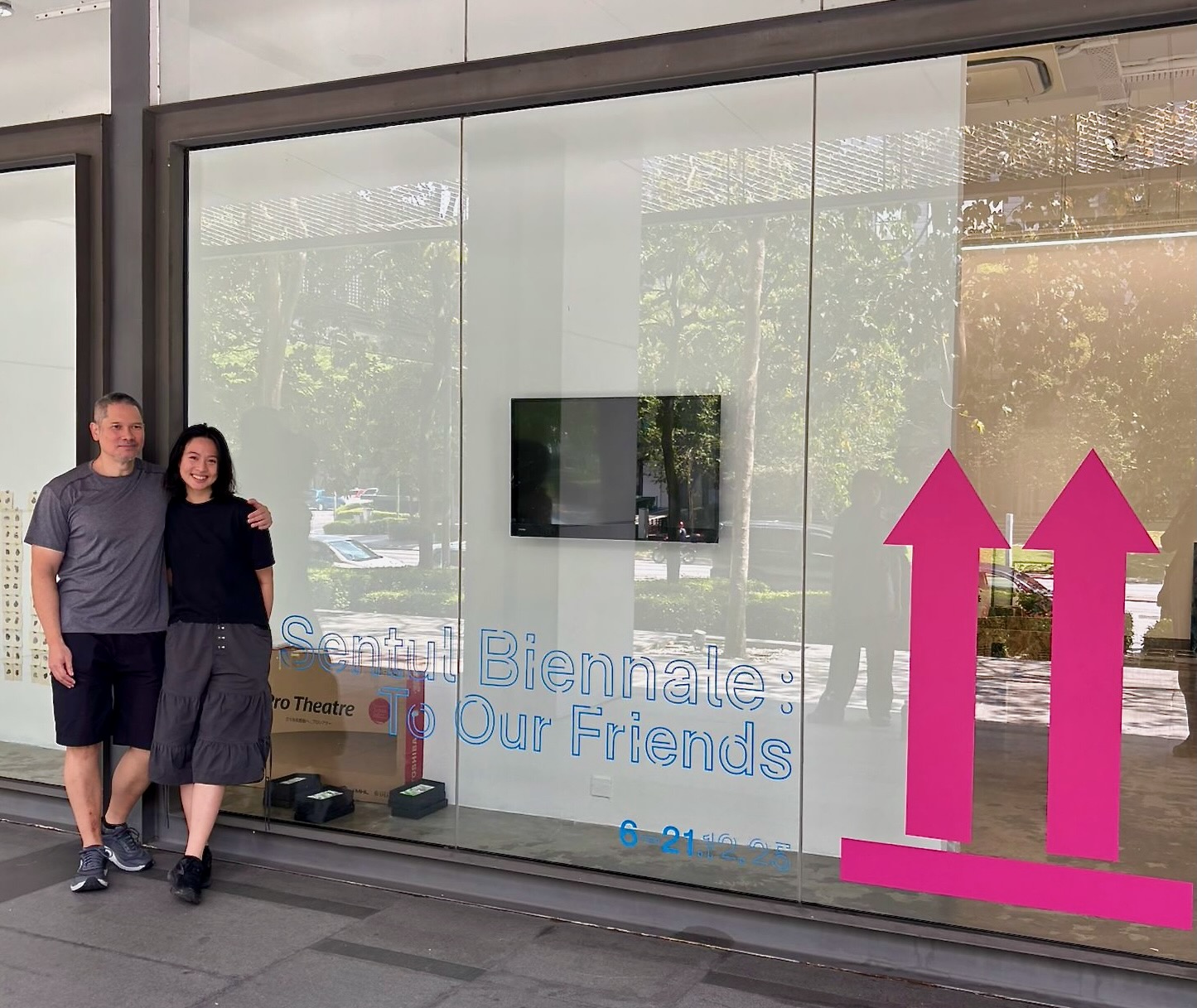
Feature image :Weng and Hay, at A+ Works of Art in KL. Image credit: Aaditya Sathish.All other images courtesy of A+ Works of Art.
Support our work on Patreon
Become a memberYou might also like
National Gallery Singapore’s First R18-Rated Exhibition Is Less About Sex Than You Think
Affordable Art Fair Hong Kong 2026: Why the Under- US$50,000 Market Matters