
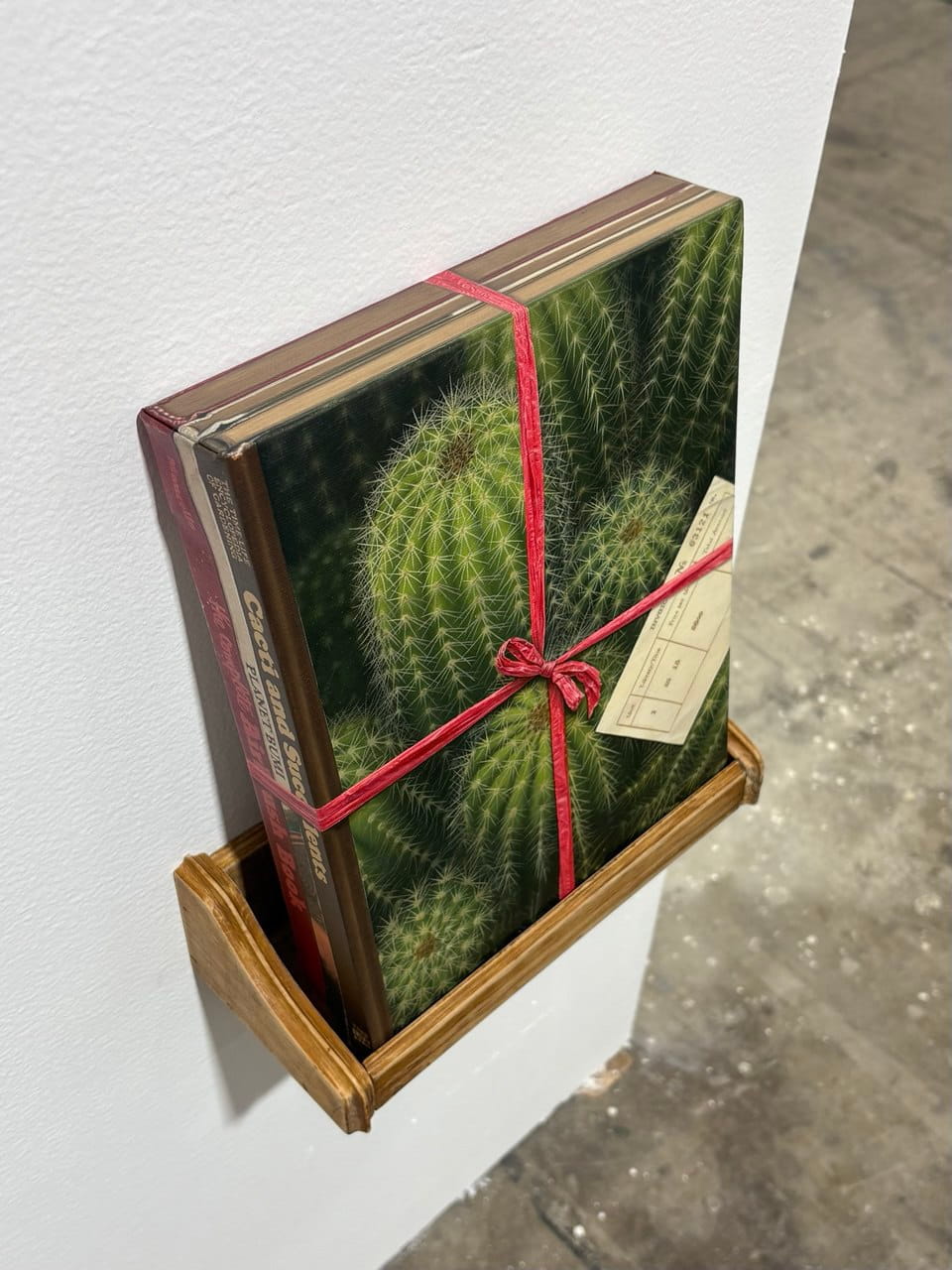
Over the past two days I had seen: A life-size space rover with moving parts. Cardboard “boxes” and hardback “books” tied with raffia string, which upon closer look were really just clever oil paintings. A giant sculpture of a chicken, taller than a human man, with six-pack abs and polka-dotted underwear. I’d had a conversation with a fellow journalist while a masked and wigged performer creepily play-strummed a mock guitar not two metres from us, and neither of us had batted an eye.
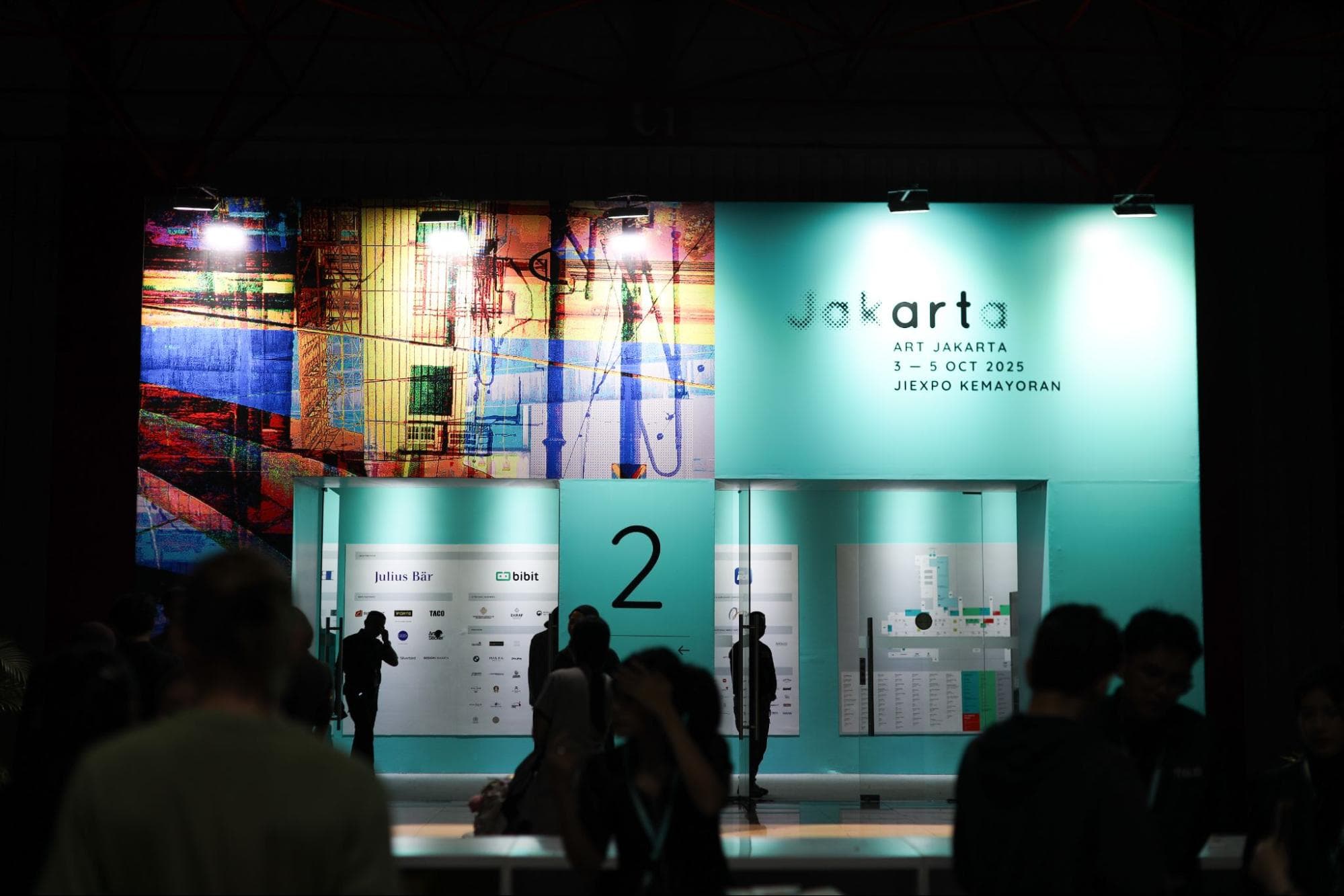
These things don’t happen every day. But they certainly happen at art fairs, which, since some canny German art dealers put their heads together in the ’60s, have become mainstays of the international art scene. And they happen specifically at Art Jakarta, which in October last year descended upon the Indonesian capital for the 15th time, occupying the halls of the Jakarta International Expo (or JIExpo) for just a few days, like a mushroom springing up and vanishing overnight. Anti-government protests had erupted across the city just weeks before. But here, in these air-conditioned, cacophonic convention halls, stuffed to the gills with thousands of gallerists, collectors, press, and lookers-on from around the globe, people still seemed optimistic. The show was very much still going on.
What is an art fair?
Over the past several months, I’ve spent some time pondering this strange, fabulous beast we call an art fair. What is it, really? Where does it come from? Why do we do it at all? How can I describe one to someone who’s never been?
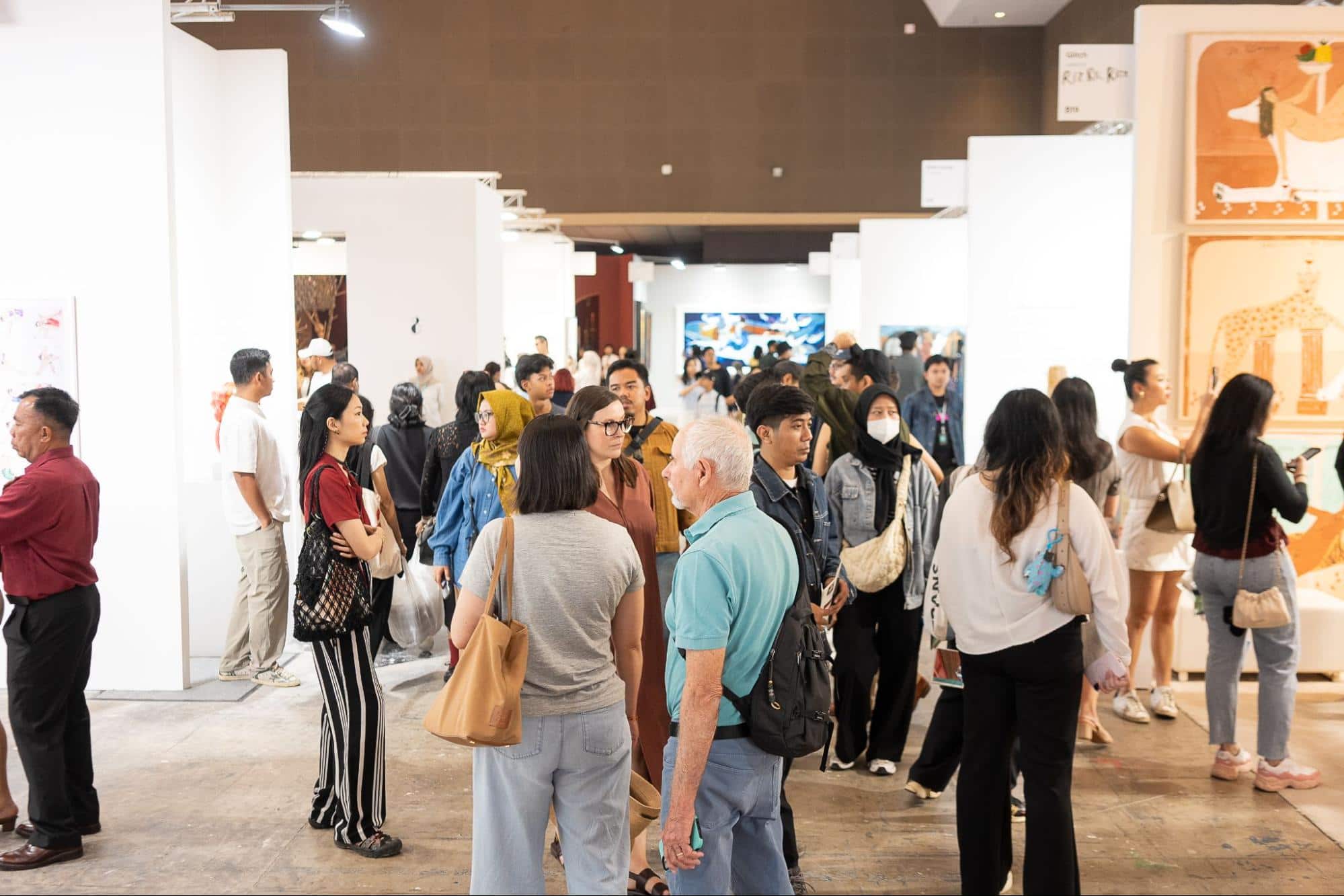
Sure, I can say it’s like Comic-Con for art people, or the art world’s equivalent of a trade fair — somewhere you can buy giant wall hangings and to-scale zebra sculptures instead of chemical products or cars. But none of this comes close to capturing the total effect of more art than you’d otherwise see all year, crammed into just a couple of days, in a kind of crazy alphabet soup — a movie-trailer, car-window feeling of having objects hurtling past you at high speeds.
Like anything else, the art fair has a history. Some critics identify progenitors in the seasonal fairs of the Middle Ages, or, more directly, the massive “world’s fairs” of the 19th and 20th centuries, which showcased the fruits of industry from countries and colonies across the globe.
Specialised art and book fairs also occurred across Europe from the Renaissance on, with antiquarian fairs such as London’s Grosvenor House Arts & Antiques fair taking place throughout the 20th century. But for the direct ascendant of today’s contemporary art fairs we look to 1967’s Kölner Kunstmarkt, put together by German art dealers Rudolf Zwirner (yes, father of that David Zwirner, a ubiquitous presence on art-world power lists) and Hein Stünke.
Kunstmarkt 1967 was projected to welcome nearly two thousand visitors — sixteen thousand showed up instead. By all accounts the Cologne Art Market (known today as Art Cologne) had been a smashing success, injecting new vigour into a languishing German art scene. In Zwirner’s telling, the participating dealers greeted him and Stünke on the fair’s last day with a fervent round of applause.
Three years later Art Basel, one of today’s most important fairs, followed hot on the Kunstmarkt’s heels. Since then, the art world has gone all in on fairs and only rarely looked back.
Ostensibly, an art fair’s primary purpose is to sell art. And undoubtedly sales happen, often at eye-watering prices. But as a senior journalist on the press trip tells me, galleries frequently take up booths with no guarantee of selling out or, for that matter, breaking even. For younger, less established galleries, especially, gains take less quantifiable forms. It’s a chance to get your name out there, join the conversation, connect with potential buyers, see, be seen. “Exposure” may seem a tenuous reason to sink thousands of dollars into rent, but my new friend explains that in some sense it boils down to simple FOMO — the fear of missing out.
When you’re at the fair, it does sort of feel like anyone who’s anyone is there — and also knows everybody else. At every corner people are shaking hands, kissing cheeks, exchanging business cards, and giving hugs to, apparently, dozens of long-lost friends. One reporter jokingly complained to me about getting stopped every few metres by someone he knew. “It’s more about saying hi to people,” he observed, “than seeing the art itself.”
And what about the rest of us, not in the business of buying or selling art? Well, it’s fun. Fun of a very particular, slightly masochistic type, perhaps — as your overtired mind and step counter at the end of the day will attest — but fun nevertheless.
Sense and non-sense
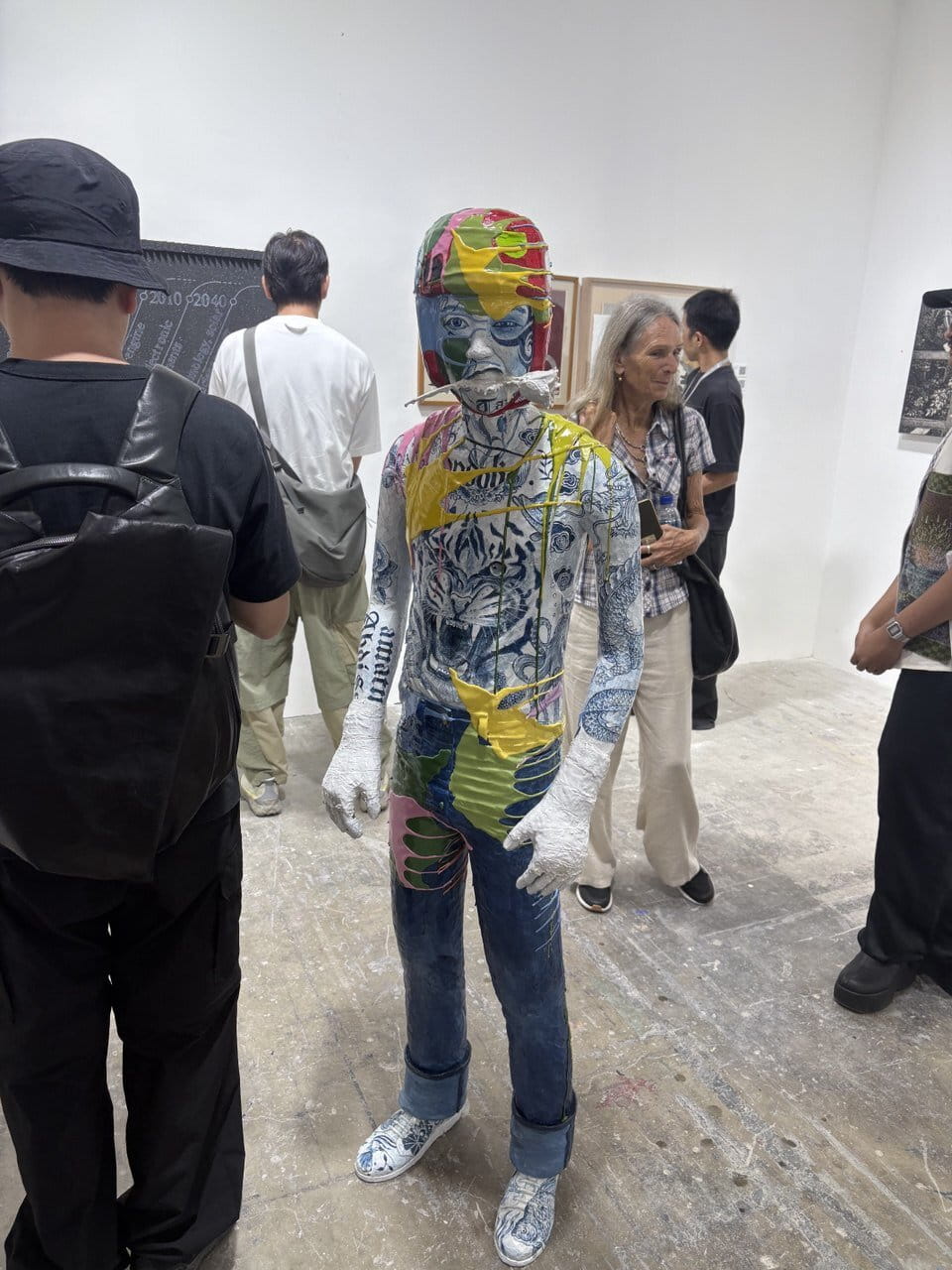
Walk around a big art fair long enough, and you’ll start to feel a bit insane. Art viewed in such vast quantities tends to have mind-melting effects; at one point I nearly ran into a life-size sculpture of a man covered in paint and tattoos — subconsciously registering him, I think, as a real person moving out of the way — and at another I saw someone almost trip over the knee-high barrier blocking off an installation. Which seemed about right for how we were all feeling.
To make matters worse, none of the art you’re seeing seems connected at all — galleries are, of course, showing what they like, with no consideration for what you’ll see at their neighbours. You’ve long left the realm of tidy little exhibitions put together by natty curators, with helpful labels and works grouped sensibly by theme. It’s the Wild West out here, uncharted waters, death by drowning, not by thirst.
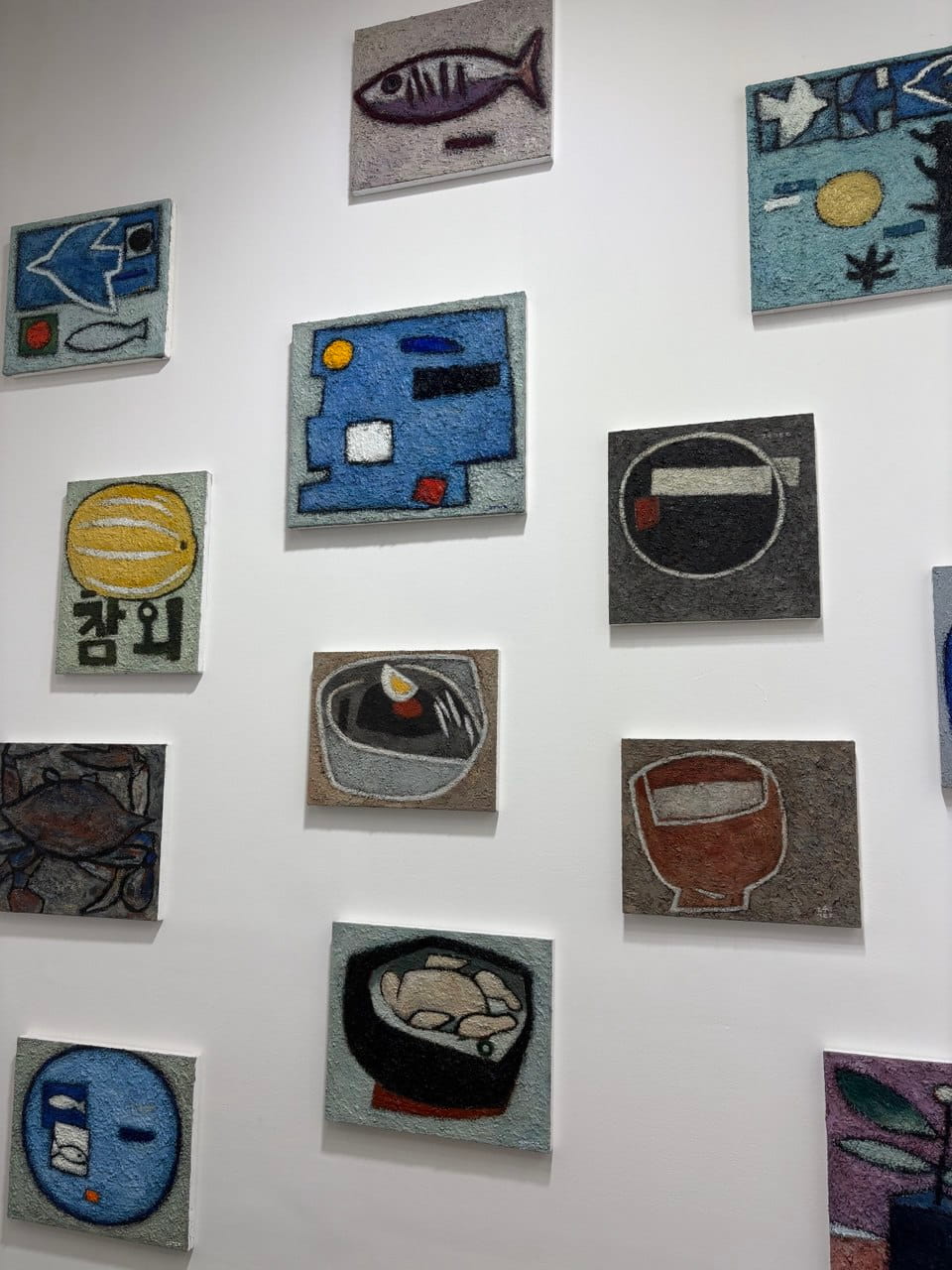
Perhaps cottoning on to this, fairs and galleries employ a number of novel strategies — the former to restore peace, the latter to stand out. Chief among these is that much-abused term, the “curated presentation”: a small island of order in the chaos of the fair. I saw a few of these that year, including a preview of Art Jakarta Papers, a new fair promoting paper-based contemporary art, and Arus Baru (Rising Currents), a government-supported showcase of emerging voices in Indonesian art. But what really seemed to make waves was “Korea Focus,” a suite of 12 galleries and an official collaboration with the East’s latest soft-power juggernaut.
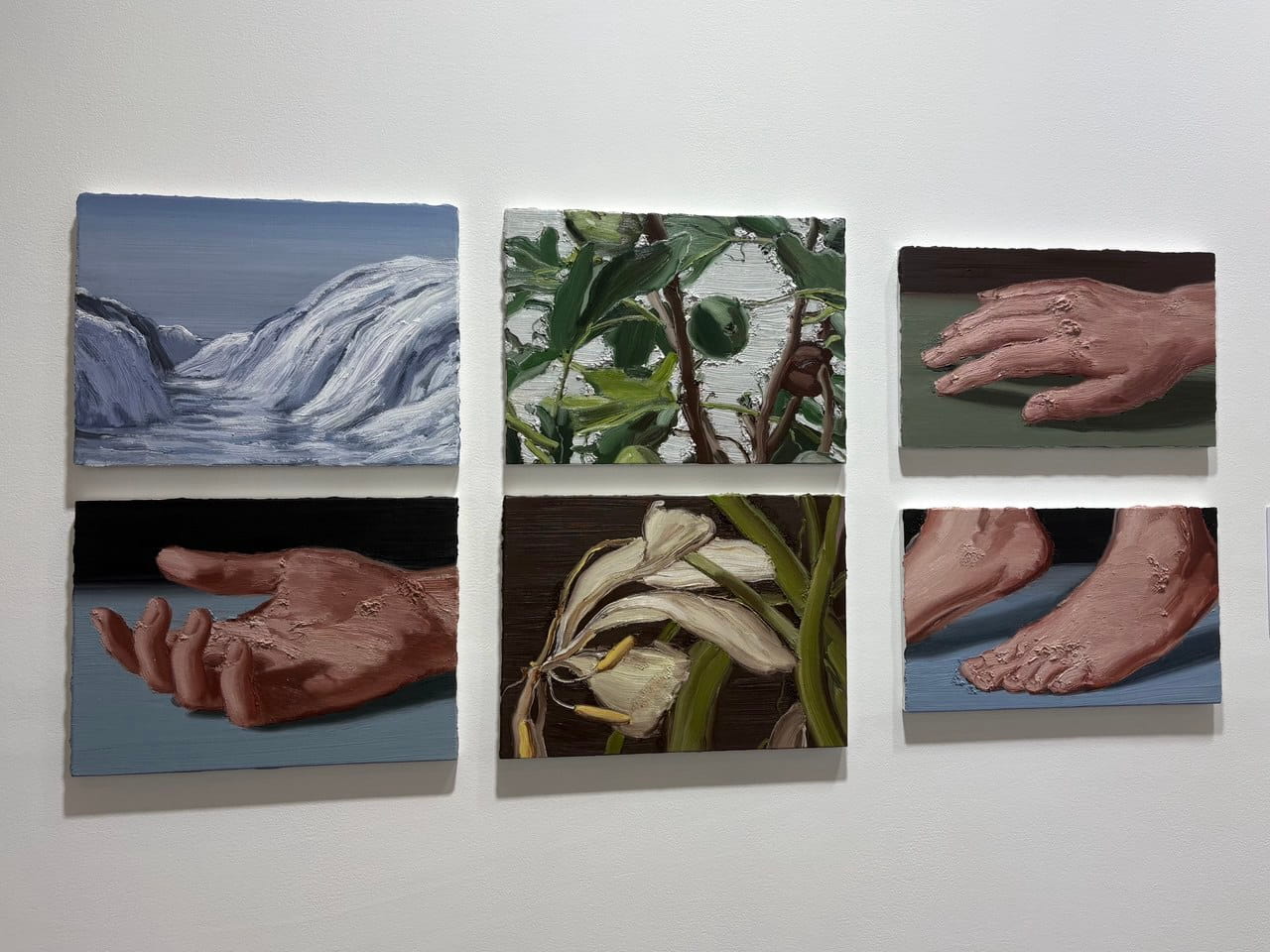
The galleries selected were largely young and energetic, a few having launched as recently as 2024. Across the board, the works exuded a sense of understated playfulness, lightness, and levity. Multiple galleries opted for single-artist rather than group presentations, with Pipe Gallery showing Chansong Kim’s warm, intimate oil paintings of faces, feet, and hands, and PS CENTER’s booth erupting with Jiyoung Kwon’s looping, tubular clay forms.
Four-year-old CDA Gallery pulled the singularly daring move of showing an artist whose works were all very similar: Duri Baek, whose canvases depicted light-dappled treescapes in an unvarying palette of yellow and green. Against the confusion of the fair, this unity seemed to have a magnetic effect — lurking at the nearby APOproject booth, where gallerists dramatically swung apart the hinged panels of a Miju Lee tableau, I watched as visitor after visitor stopped to pose for photos or speak with the director Hyuncheol Moon. One set foot in the booth and asked for the price of a work almost immediately. Against the cacophonic, complicated setting of the fair, it seemed to be the booth’s simplicity, a fearless willingness to pare things down, that stood out.
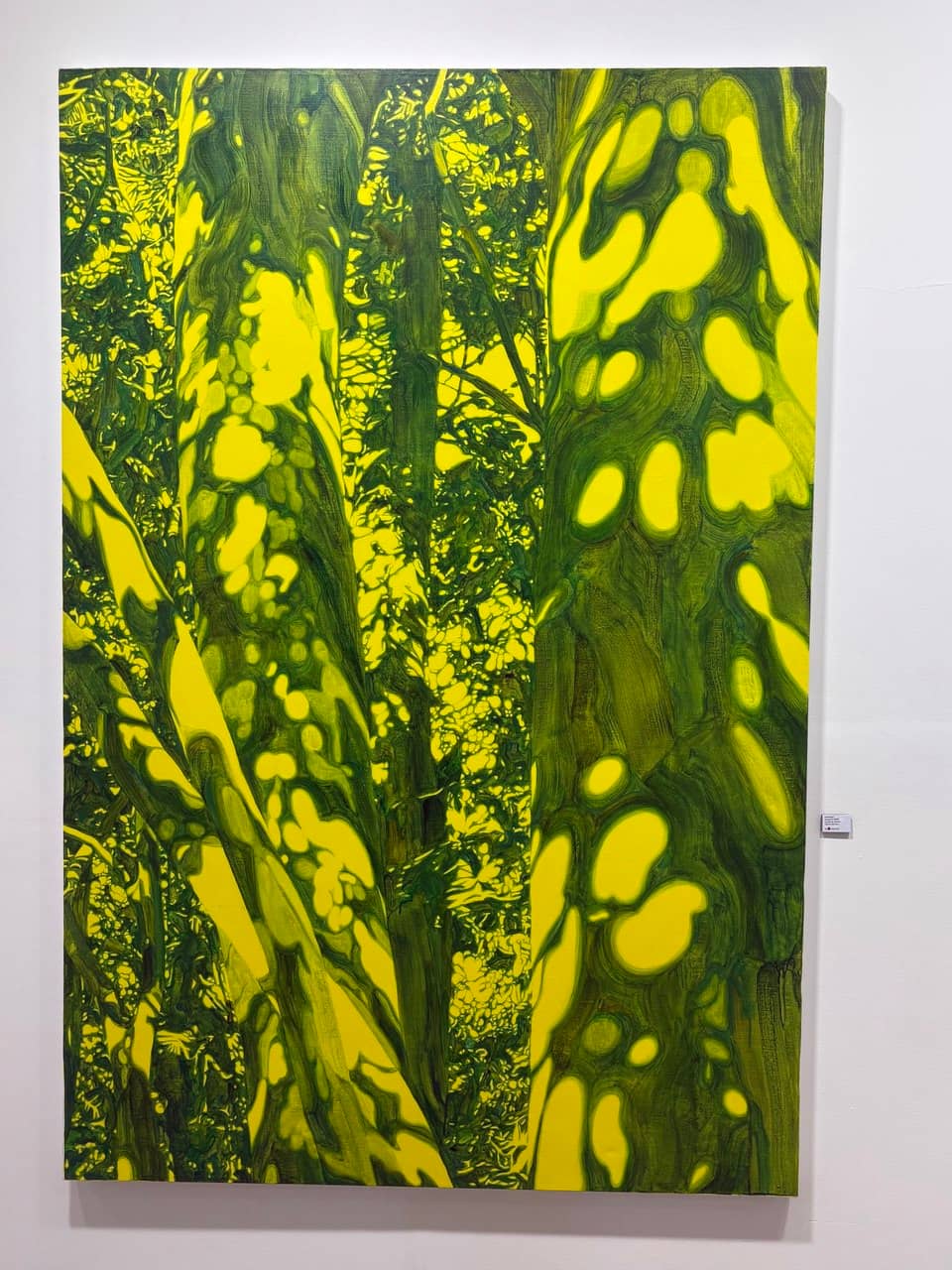
When I finally got hold of him, Moon told me that it was the gallery’s first time at Art Jakarta, and first time showing Baek’s work in Indonesia. Sure, maybe they could have made more new collectors if they’d brought all three of the gallery’s artists. But, “deeper is better,” he said. They’d already sold the biggest work, to a collector from Singapore, by the first day of the fair.
Baek’s works, he explained, relied on a single pairing: green and yellow, shadow and light, always coexisting. “That is a very simple thing, but this is our life.”
Maybe the art fair itself is a bit like life. Nothing really makes sense, so we treasure what does — what is graspable, sensible — all the more.
Money talks (but what does it say?)
Sometimes, the over-the-top surreality of an art fair reaches a point of comedic absurdity. Once, retrieving my bag from the cloakroom, I saw a realistic mannequin head — brown hair, long lashes — resting on the counter. I wasn’t sure if it was an art thing or not.
Take the sponsor tie-ins. One of the art fair’s many peculiarities: it’s an art event where commerce, unabashedly, incontrovertibly, takes centre stage. Sometimes it’s nice to live in a shiny bubble where art is ideologically pure, independent of any tawdry market concerns — and sometimes you just have to pop it.
If you’re tempted to forget art’s strange bedfellows for even a moment, the giant logos emblazoned on lounges, special commissions, and booth walls will soon bring you back to your senses. Often these corporate sponsors and brand partners are themselves tied to the world of wealth: at Art Jakarta, they included Julius Baer, a Swiss wealth management firm, and Treasury and Bibit, local investment apps.
You may find yourself bemused and perplexed by these shrines to commerce, trying to camouflage themselves in the tangle of the art fair — some more successfully than others. There was one booth which seemed completely empty of visitors every time I passed; I even saw one of the staff members yawn.
And then there was the bewildering presentation from Toshiba, the Japanese electronics brand. A washer-dryer stack sat on a bed of pebbles, a clump of dried vegetation cascading down from the drum. A microwave and two rice cookers were artfully arranged like stones in the sand of a Japanese Zen garden.
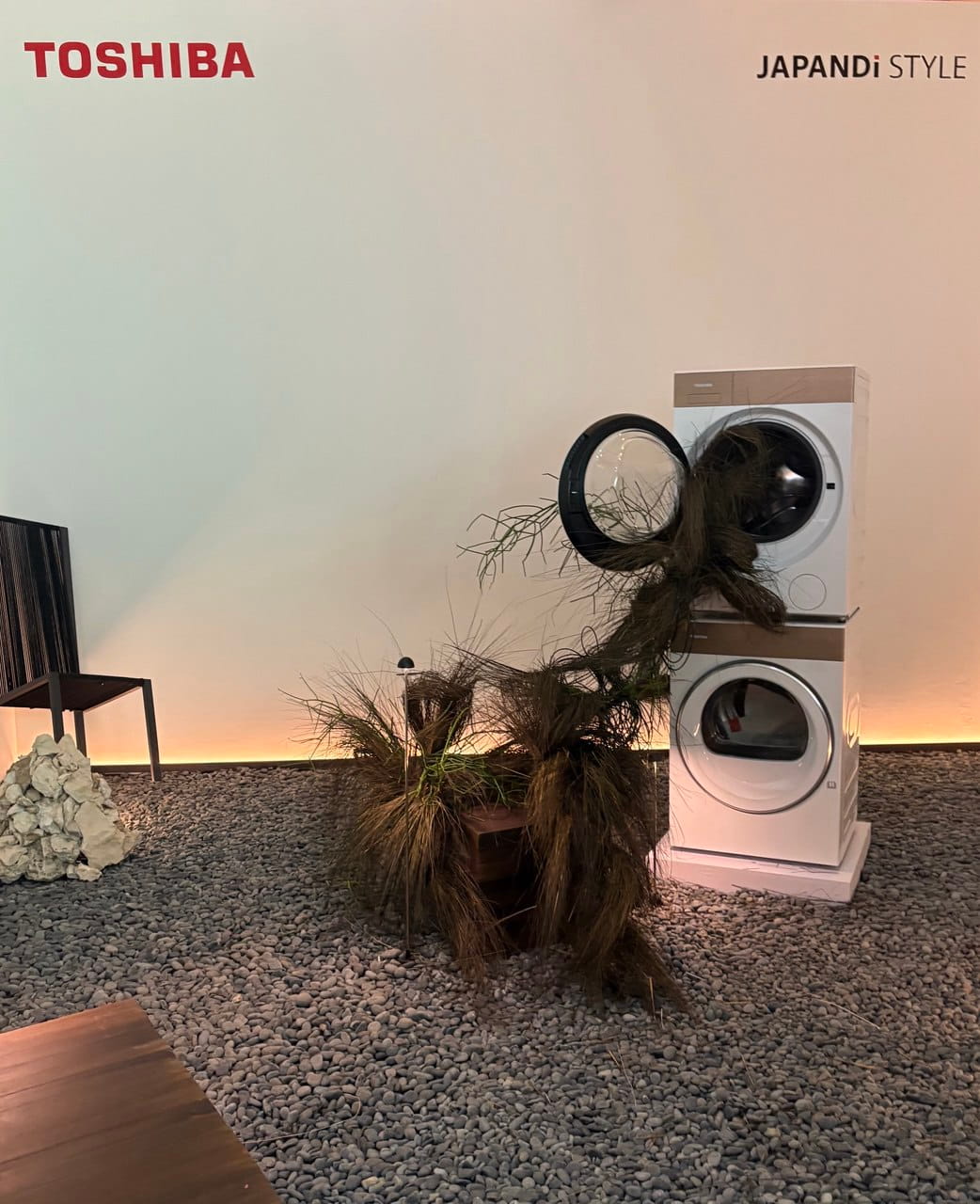
Fair play: why not take inspiration from Japan’s age-old gardening traditions for your advertising stratagems? All while calling to mind, perhaps, the long tradition of the “readymade,” and the work of that great technological artist Nam June Paik, particularly his “TV gardens” of cathode-ray tube televisions, nestled among jungly leaves? Was this an obvious case of avant-garde art trickling down to influence visual culture, or, more cynically, mere aesthetic aping, hollowing out all artistic meaning to sell washing machines?
Later, I discovered a quote from one critic of that first fateful Kunstmarkt in Cologne: “Paintings and sculptures are being traded like refrigerators and sewing machines in a household fair … Can one do that — put art on the market like any old household article?”
It seemed we had somehow evolved so far that we were now doing the opposite.
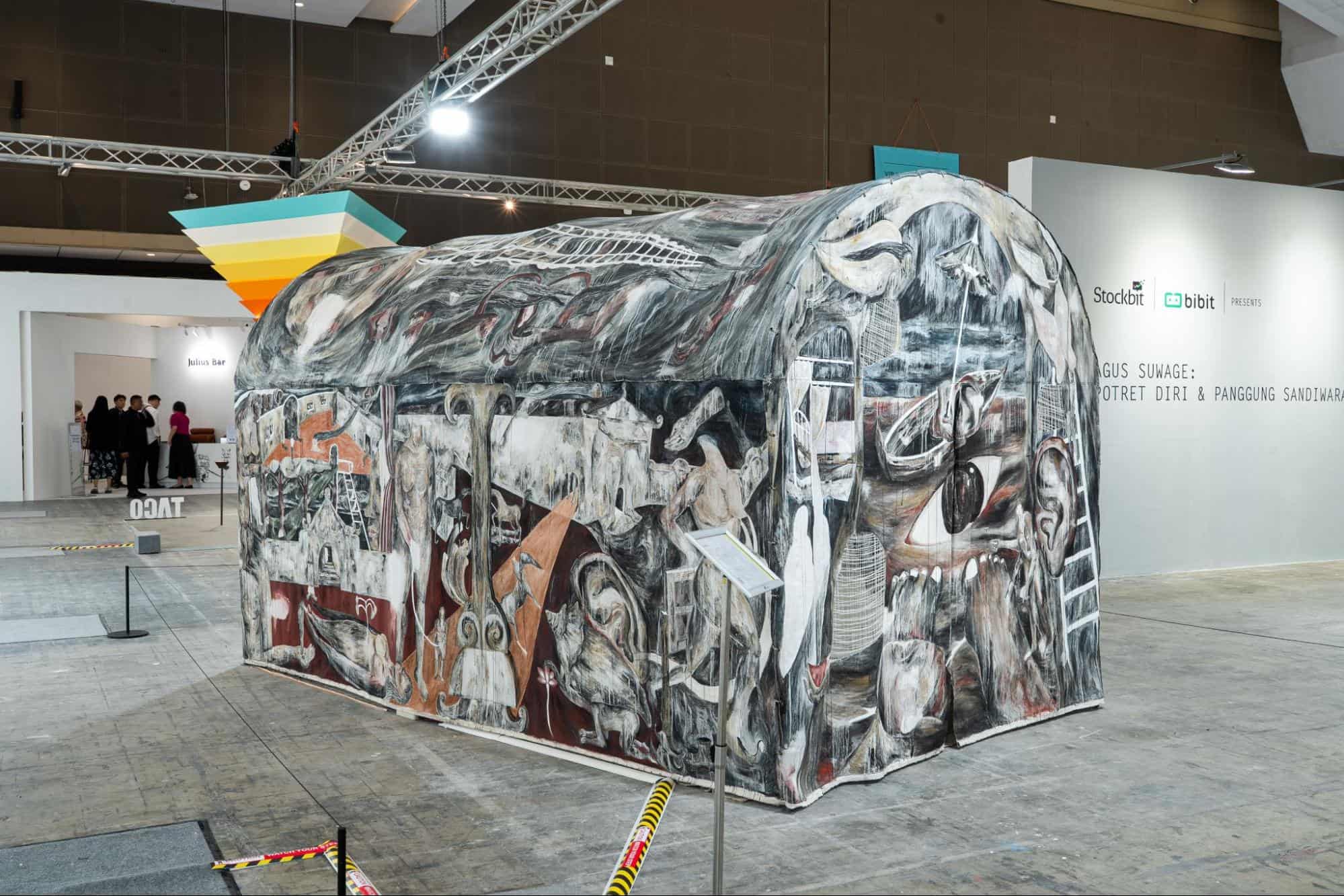
I’ve seen this issue at art fairs across the board. Somehow, the same bodies providing the vast amounts of capital that make fairs possible can’t seem to come up with presentations that don’t stick out, inelegantly, among the other booths. But occasionally one of these corpos strikes gold, as with Bibit’s tie-in with the Indonesian artist Agus Suwage.
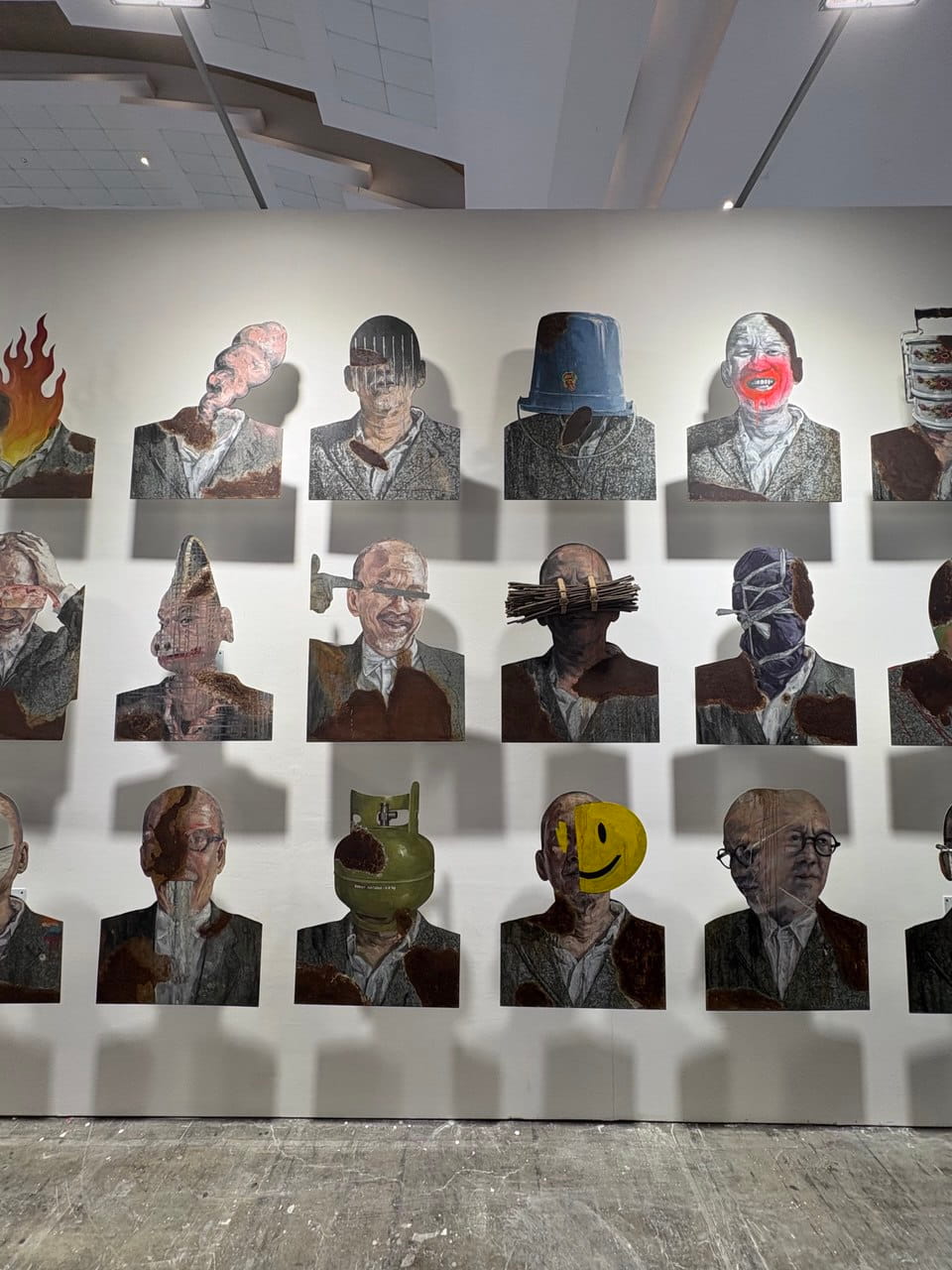
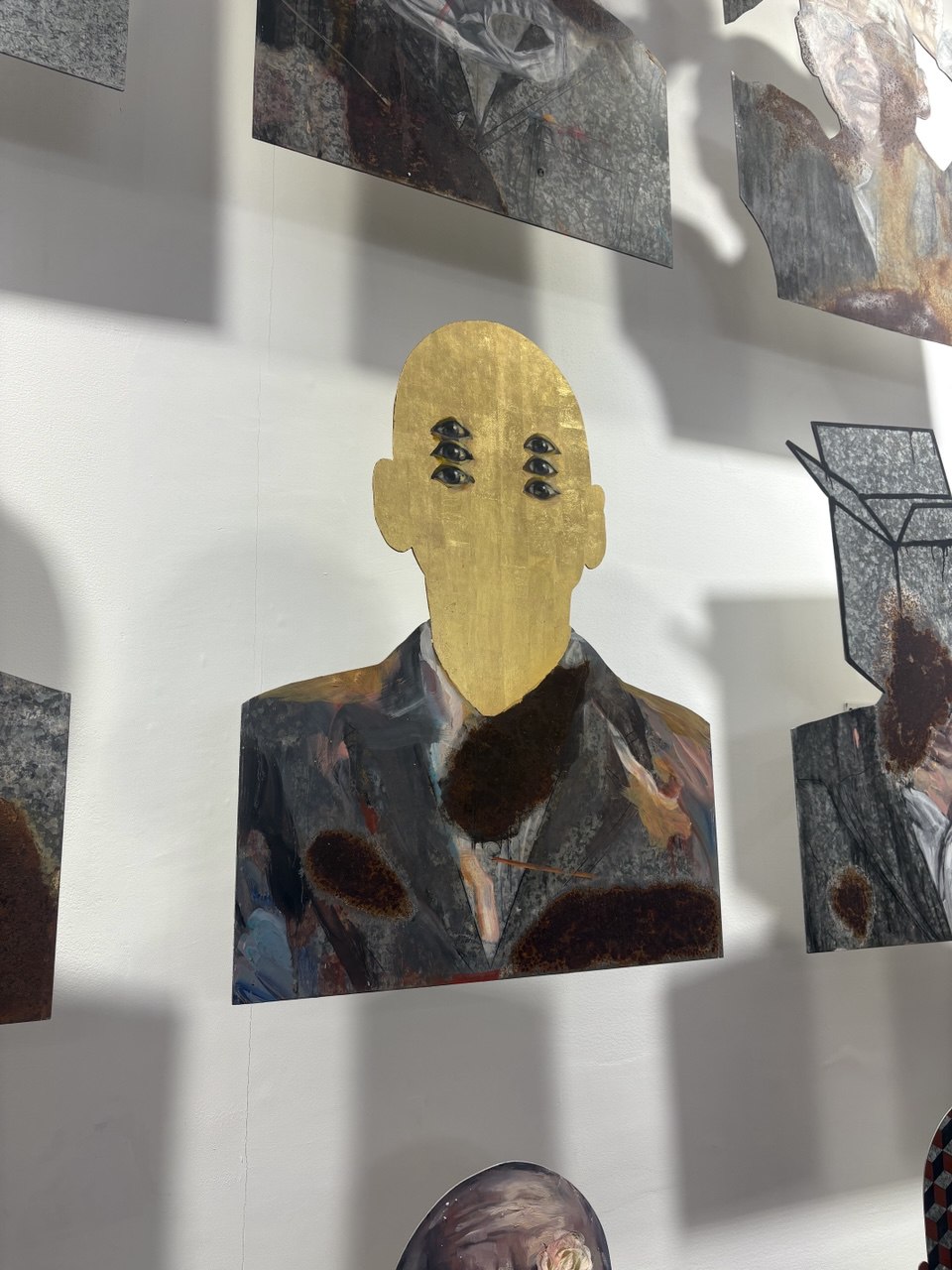
60 flat metal self-portraits, each overlaid with some bizarre object or effect, were arrayed in three rows along a large L-shaped wall. In place of the artist’s face: a leopard’s head, a painted target, a charred tiffin food carrier, a bundle of sticks, a pile of cartoon poo … It was nearly impossible to get a proper look, especially in the middle corner, the primo photo-taking spot.
Again proving, perhaps, that the art fair’s appeal lies as much in being seen seeing art as seeing it! Still, among the corporate booths Bibit’s/Suwage’s was undoubtedly the best of the lot. Visually fabulous, conceptually meaningful, crowd-pleasingly photogenic, and, with cards for visitors to draw their own self-portraits — or rather to “FRAME THE LIFE AND WEALTH YOU WANT TO LIVE” — interactive, too.
A friendlier fair?
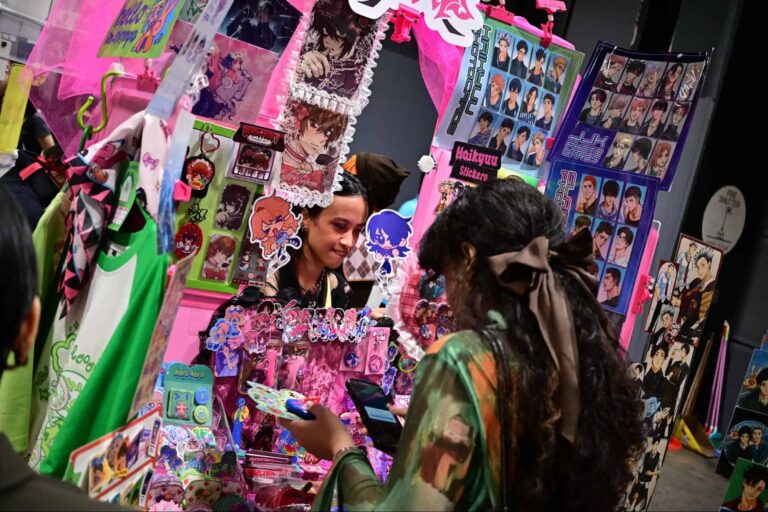
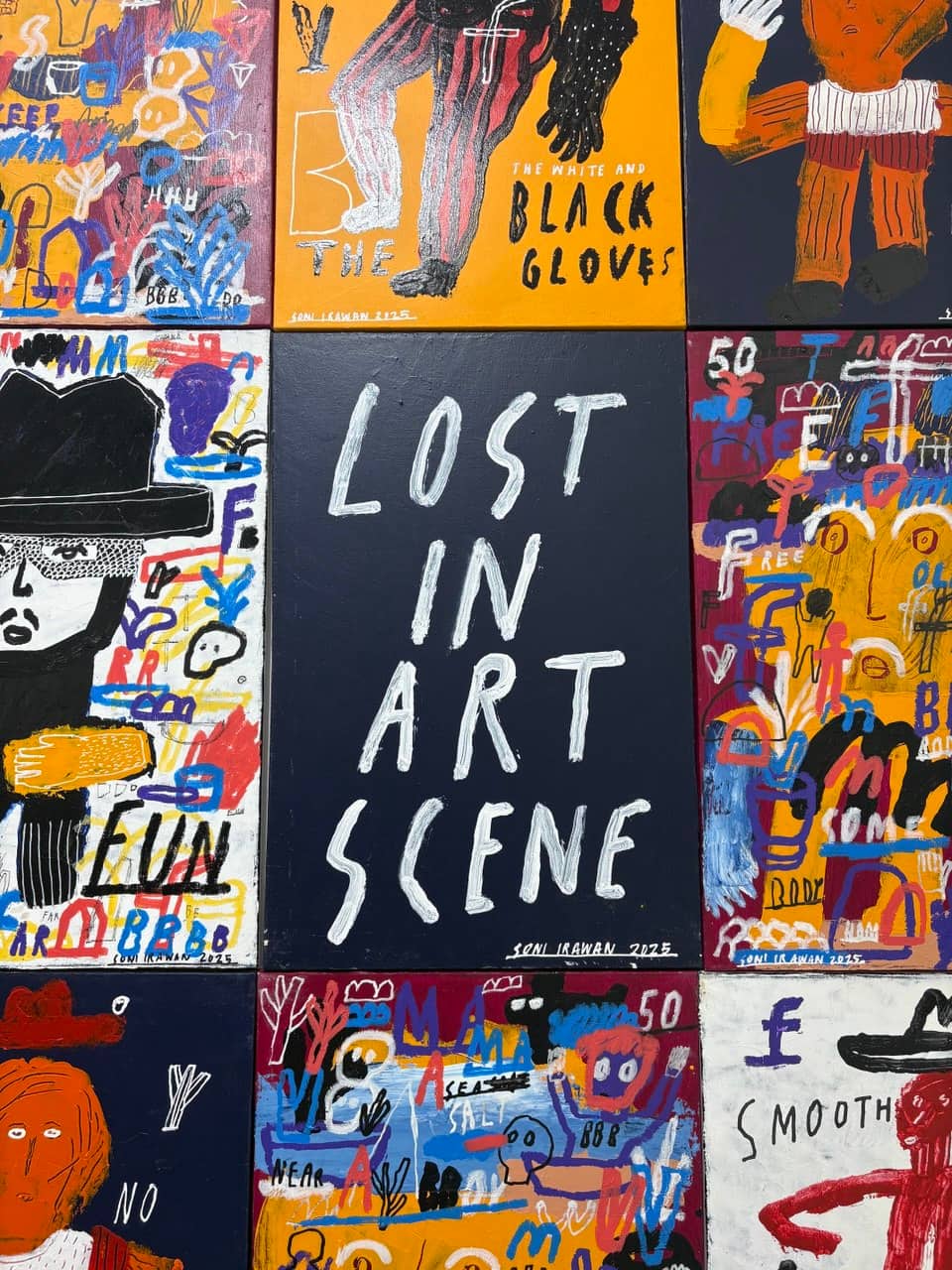
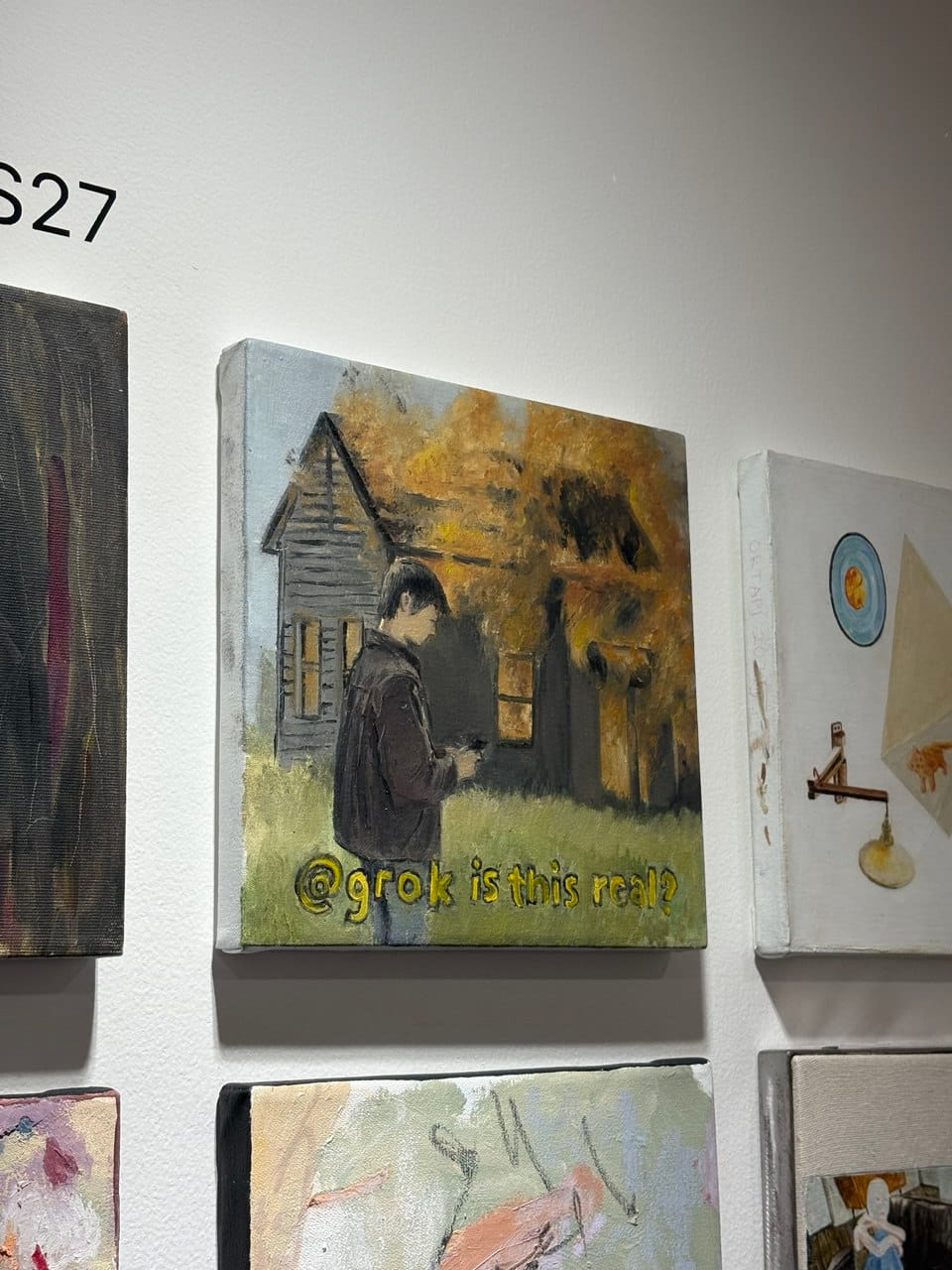
Art Jakarta has a feature that sets it apart from other fairs I’ve attended: the “Scene” section, a platform for collectives and artist groups to sell smaller-scale, modestly priced works, things like prints, ceramics, and handpainted jackets. I stopped at one booth designed to look like an Instagram page, with rows of uniformly sized square canvases forming the “grid,” and zoomed in on a painting of a flaming house with a man standing in front of it, typing into his phone: “@grok is this real?”
I learnt from the artist at the booth — which belonged to READYSPACE, an artist-run space in Yogyakarta — that none of the works on display cost more than 400 SGD. And also, interestingly, that some of the Scene artists were also showing larger works in the main section of the fair.
I’d just been to the Jakarta Illustration + Creative Arts Fair (JICAF), a comparable fair happening around the same time, a day before. And while JICAF — very much its own thing, a multiple-week affair with over 80 artists — was certainly more impressive, I still felt glad Scene was part of the fair. I couldn’t imagine the same thing taking place at swankier examples of the genre I’d attended, which seemed a pity. There are broke art college students, curious members of the public, and general hangers-on at every art fair — why not give us something to take home too?
Sure, it wasn’t all highbrow stuff, but who’s to say some of the young people, drawn in now by the attractions of art books and cool accessories, wouldn’t be the ones buying the big-ticket items ten years on? Maybe Scene was actually a farsighted investment in the fair’s future, and the rest of us — intent on preserving the art world’s snooty, champagne-scented atmosphere of privilege at all costs — had got it all wrong?
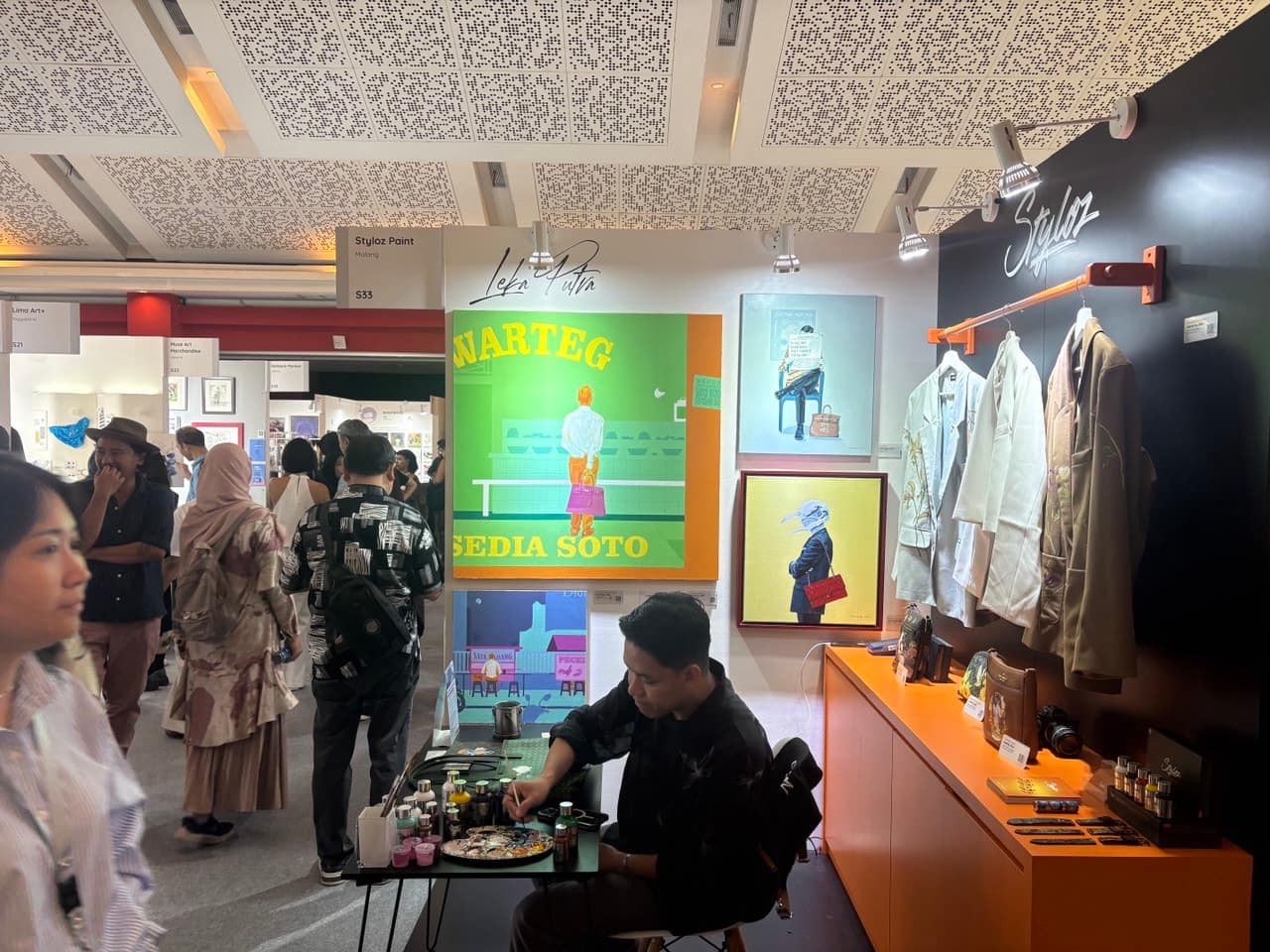
And then there was the food market next door, selling such elaborate concoctions as key lime pie donuts, loaded fries, and blackberry wine. Not everyday fare by any means, but still far more encouraging sustenance than the typical offerings of frilly strawberry pastries (stale) and canned Coca-Colas (eight dollars a pop). I couldn’t even be really upset that the area was dimly lit and a little stuffy, I was so charmed. I left clutching a cream coffee and passing a booth inscribed with the words: “WHY NOT ART IN THIS ECONOMY?” Well, plenty of reasons — but still, Scene put it within much closer reach.
Matters of taste
In the end, there’s nothing quite like attending an art fair for understanding your own taste, which is why I recommend it to every art enthusiast at least once. Its pick-n-mix character almost guarantees you will see something you love, and also something you hate — which is equally part of the fun.
At fairs across the years, I’ve consistently found myself drawn to minute, restrained artworks — loving depictions of banal, ordinary things like window frames or half-drunk coffee cups. Partly, perhaps, as a reaction against the showiness of the fair at large, but this is in line with my aesthetic preferences outside it too — I always admire artists who can transform trivial everyday experience into genuine loveliness.
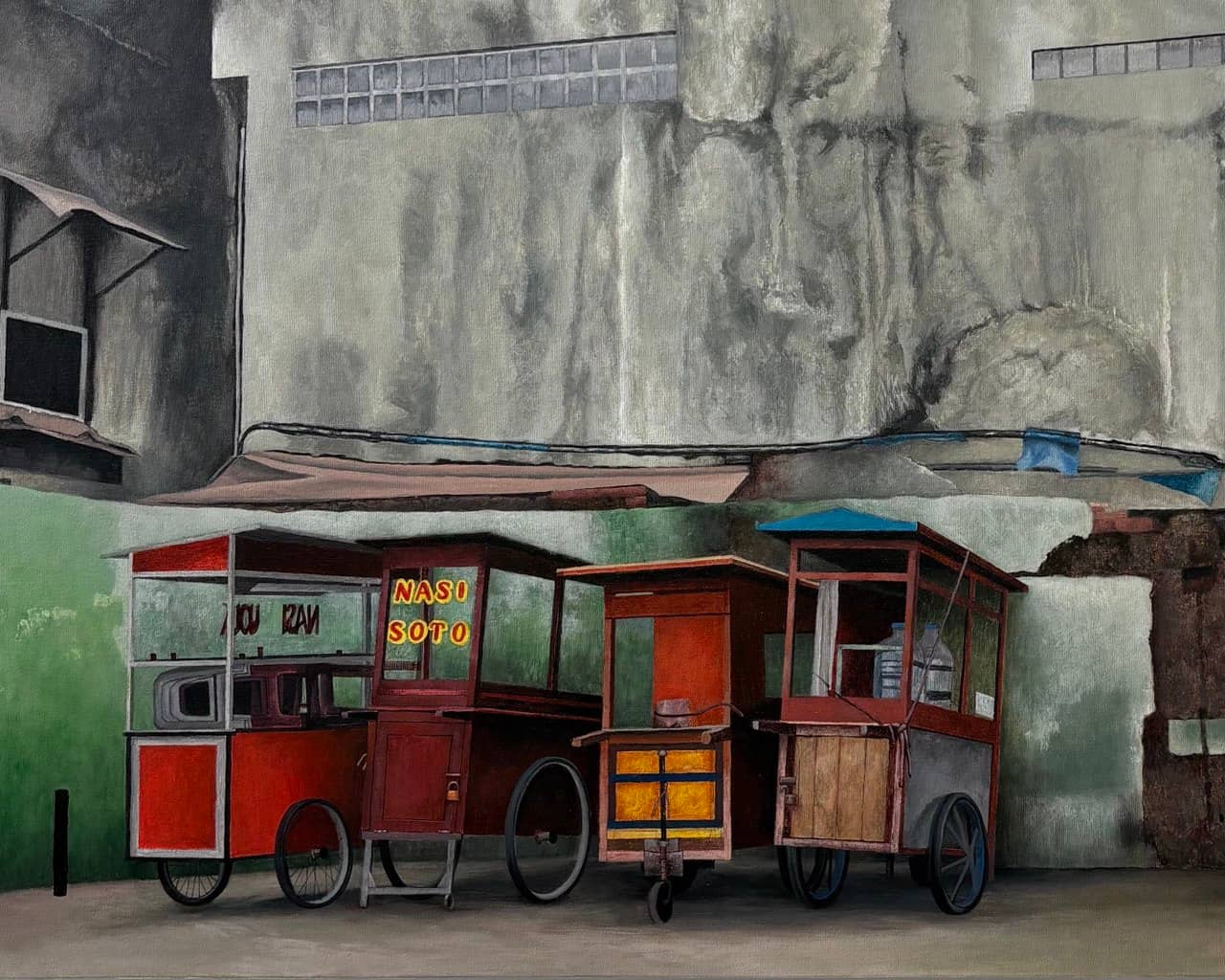
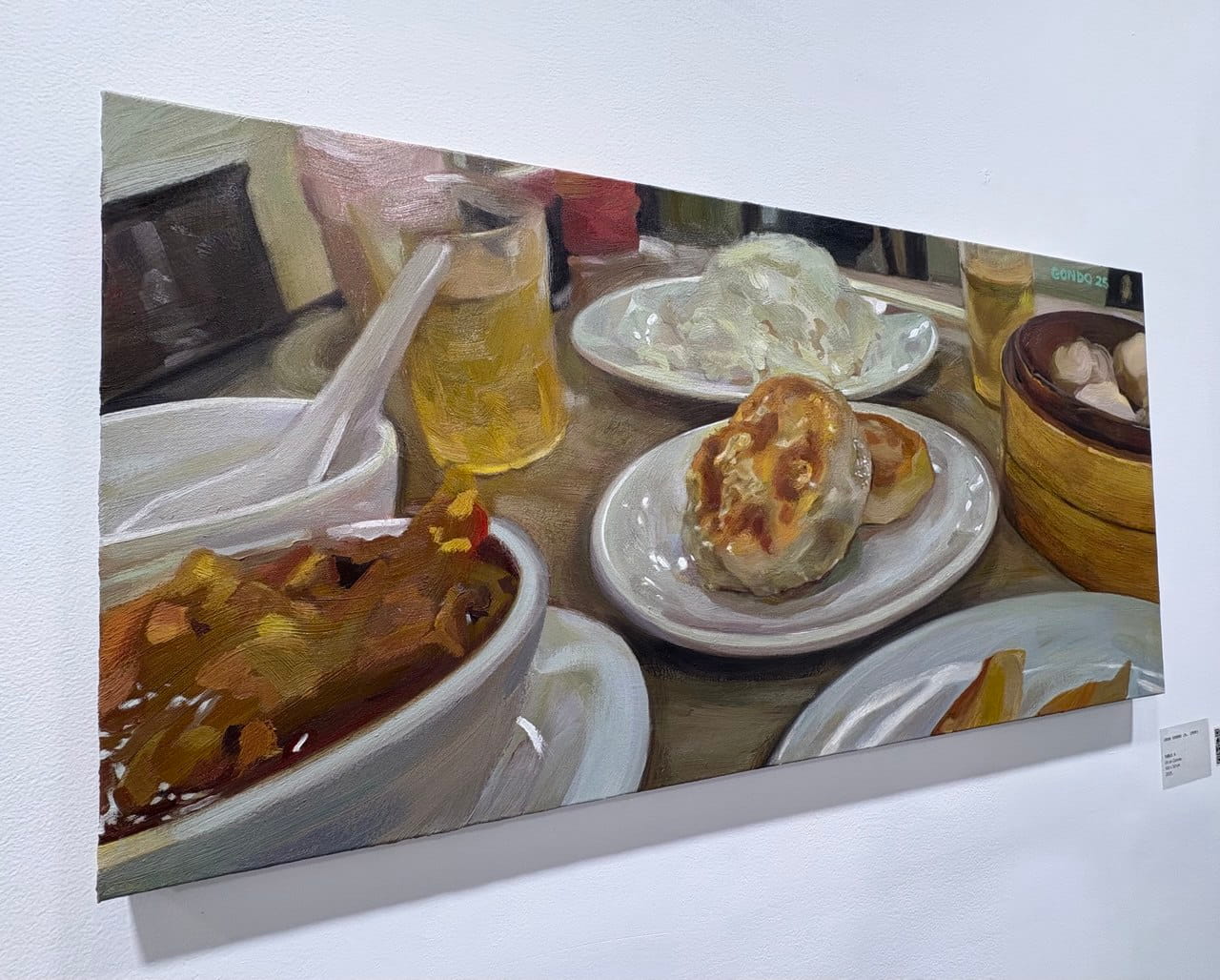
Here too I gravitated towards such works, which often tended towards the geographically specific or local, like Endro Rukmono’s melancholic painting of the gerobak (food carts) so ubiquitous in the city, or Naela Ali’s naturalistic depictions of her experiences in Japan. Amidst the fair’s plenitude I was awestruck by, of all things, a metre-long closeup of a table laden with food: a bamboo steamer of dim sum, cool glasses of tea. Somehow the loose, impressionistic treatment, the light glinting off the white plates, perfectly evoked the sound and sizzle of an actual restaurant, full of the chatter and clatter of spoons and chopsticks. Maybe I was just hungry, or maybe it was a reminder of the world outside the fair — reality reasserting itself in this peculiar, insulated, all-consuming, wholly unnatural realm.
But that’s just me. The bizarre beauty of the art fair is that there’s a work for every viewer, and a viewer for every work. I had to soften to even that chicken sculpture, which I hated so much, which so offended my delicate aesthetic sensibilities, when I saw someone joyously pose with it for pictures. There’s also something to be said for the way the barrage of images flung at you from every direction makes you react on instinct, forces the cream to the top. In some ways an art fair is almost the least conducive setting to feel truly moved by art. So if in spite of everything an artwork manages to truly, deeply move you — to reach inside your overloaded psyche and actually leave a mark — then maybe there’s something special there.
So yes. If you want to understand your own taste, what you like and what you don’t, try visiting an art fair.
But the other fun thing about an art fair is tapping into the grapevine, comparing notes with other fairgoers, trying to figure out if there’s a consensus on what’s especially good or especially bad that year. That weekend, the name on everybody’s lips seemed to be ara contemporary — a newly debuted gallery whose three founders had prestigious pedigrees from Mizuma Gallery, Sullivan + Strumpf, and Art Jakarta itself.
The gallery was presenting a judiciously chosen selection of new works from their stable of emerging and mid-career Southeast Asian artists. Most obviously provocative was Agan Harahap’s Happy Days (2025), named by one outlet as “one of the few politically charged works at the event”: a mock movie poster for a lost pornographic film, apparently fabricated by the USA’s Central Intelligence Agency in the 1950s in an attempt to discredit President Sukarno. Ipeh Nur’s The Waves Haven’t Slept (2024), presented as part of the SPOT section of large-scale installations, had also been snapped up by a private foundation by the second day of the fair.
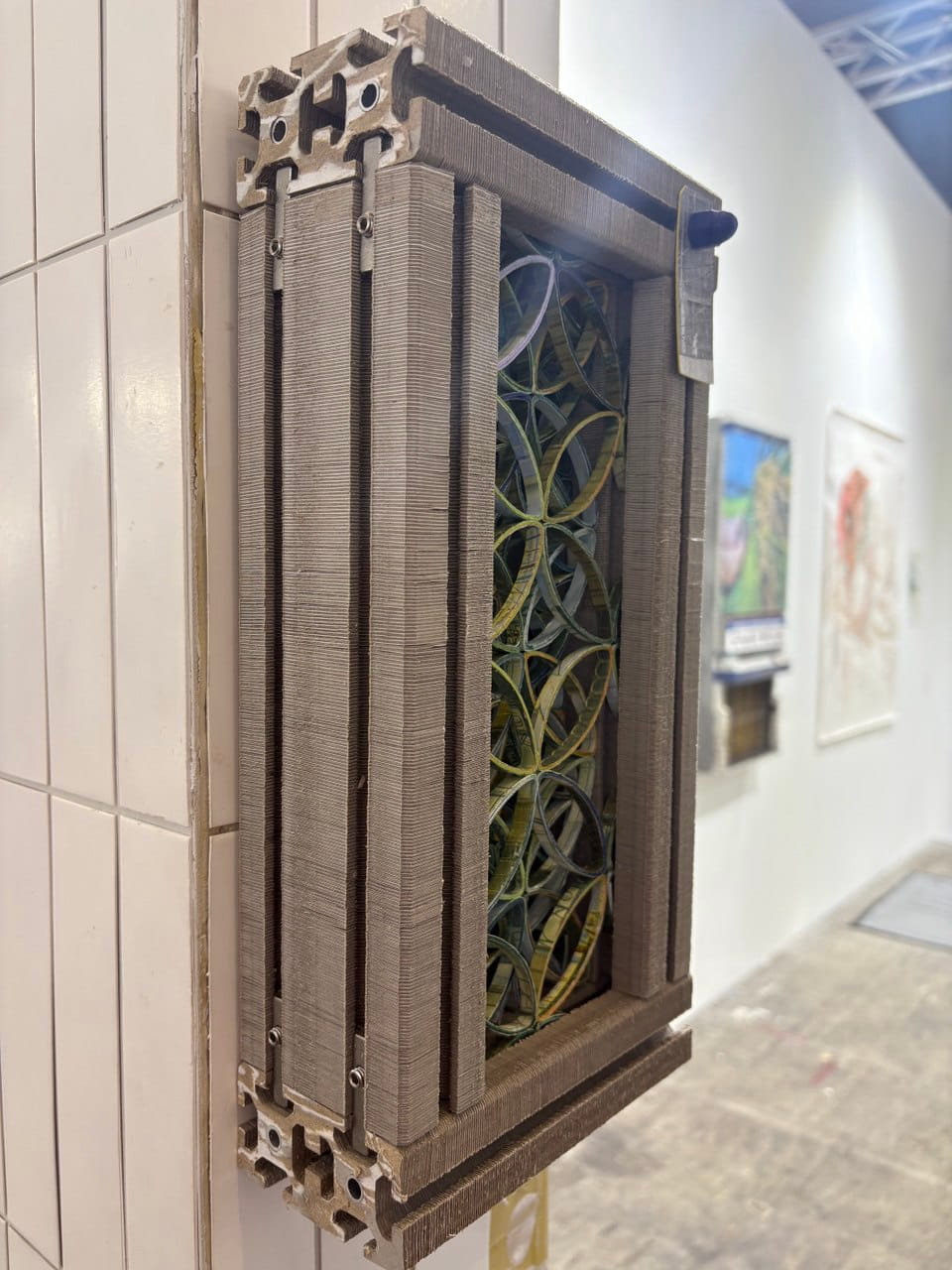
Yet, Bandung-based artist Irfan Hendrian’s “Chinatown window” works quietly stole the show. Across the years, Irfan — whose massive Dodecagon Corrugated Metal Fences (2024) also formed an attention-grabbing centrepiece for the fair’s Art Jakarta Papers preview — has expanded and broadened his practice with paper: designing and printing other artists’ publications, pushing the material’s limits through thick, multilayered wall hangings, and, currently, exploring its legal, societal, and historical uses and contexts.
In these works, Irfan had coaxed strips of patterned paper into the twirling vegetal and geometric forms of metal window grilles, instantly recognisable to anyone from this part of the world. One was even embedded in a freestanding wall like a real window. Getting up from a bench made of screwed-together cardboard topped with reams of copy paper (another Irfan special), the gallerist explained to me that the works referenced the deadly lootings and riots of 1998, which took place across multiple cities and targeted Chinese Indonesians in particular. To protect themselves, the Chinese added metal grilles to their shophouse windows, stacking them four or five layers deep.
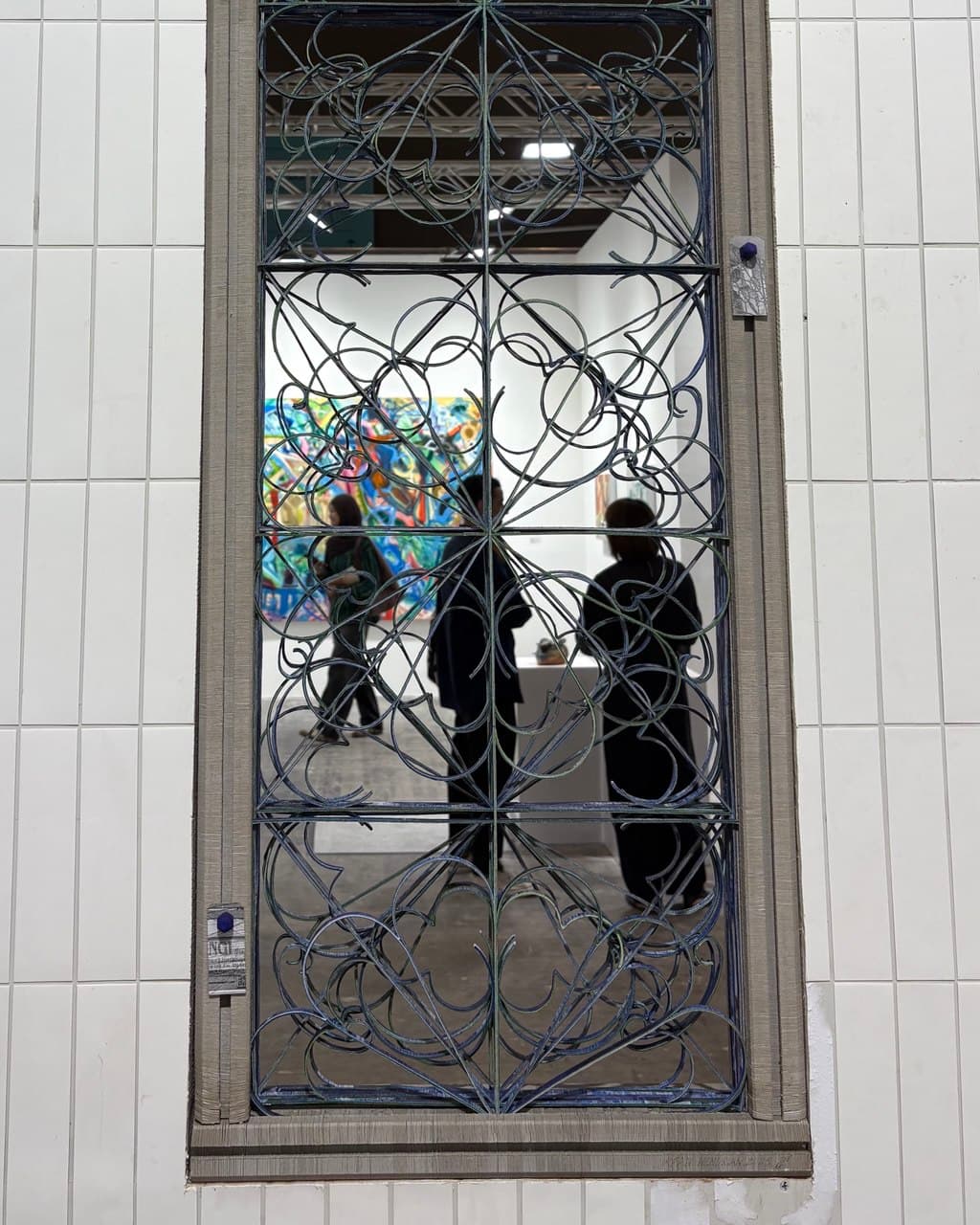
Substituting fragile paper for stiff iron, Irfan’s trompe-l’oeil paper sculptures felt like protective runes, testaments to trauma, described by the artist himself as part of an “architecture of fear.” A small catalogue of his photographic research depicted contemporary shophouses with the same blocked-off windows. The gallerist said, “[I]t’s still happening until now. Even [in] the new generation of houses, you can still see layers upon layers in the windows.”
Here, I felt, was an example of contemporary art at its most compelling: visually interesting, materially inventive, conceptually meaty, in conversation with culture and society at large.
Human interest
That’s the art fair for you — overstuffed, carnivalesque, ridiculous, incredible. It takes all the glorious, unabashed weirdness of contemporary art and boils it down into this thick, potent, utterly unique experience, so that for just a couple of days, even the most cavernous convention hall feels packed to its limits, like something simmering, sizzling, threatening to explode.
Love it or hate it, the fair seems here to stay. But even for those of us not in the market (or tax bracket) for fine art, the art fair remains simultaneously, and paradoxically, one of the worst and best settings in which to experience contemporary art. It’s no place for quiet contemplation, but in terms of sheer quantity, diversity, and recency, it’s difficult to beat.
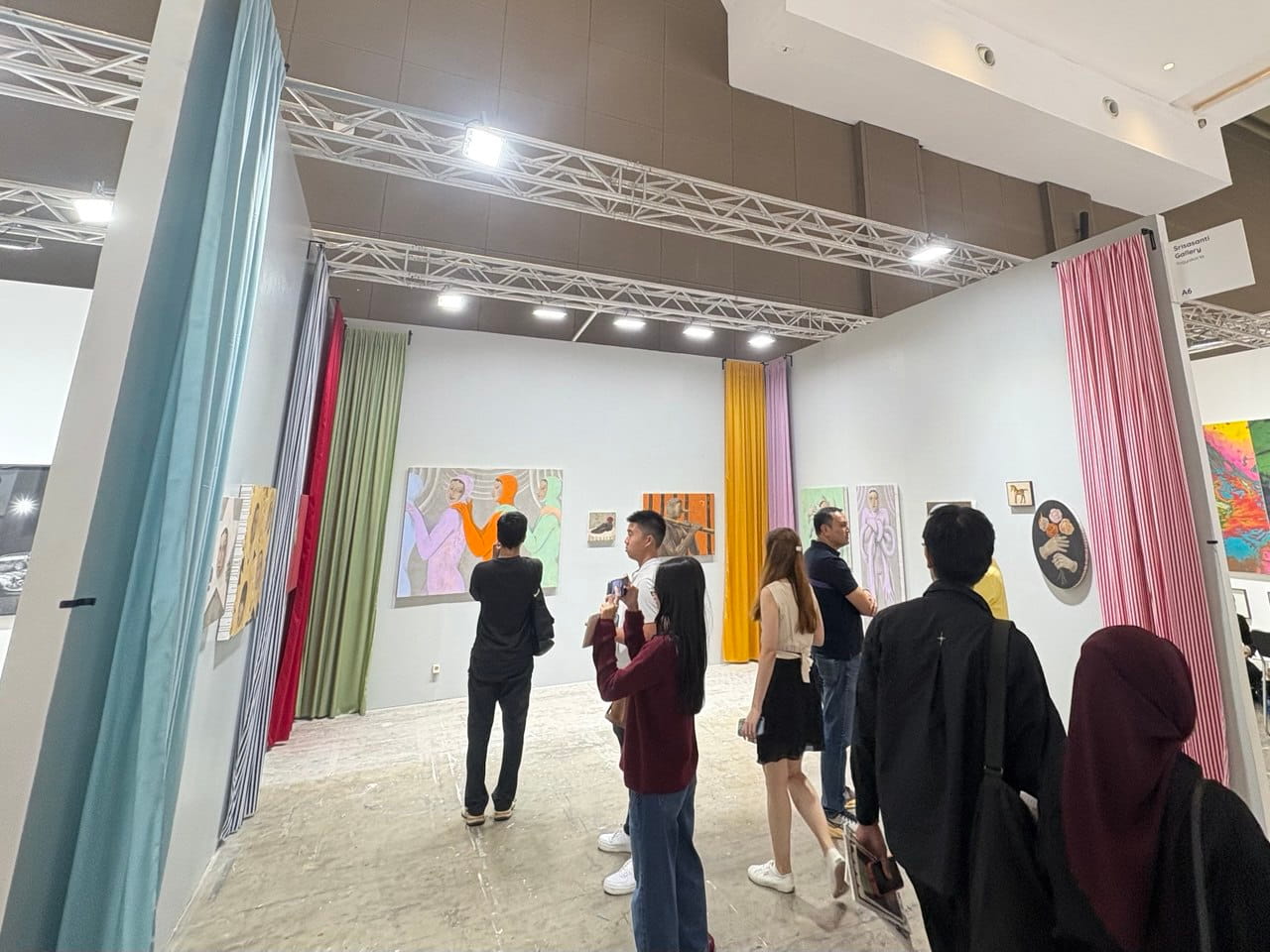
And one other thing remains true. Even in the most ostentatious temples of commerce, where there is art, there is also simple, down-to-earth, close-to-home humanity. Which can’t be taken away, no matter how much our new AI techno-overlords might hope otherwise. Over just two days, I witnessed so many small moments reminding me of this fact: a group of smiling women lining up to take a picture, matching their poses to the four figures in the painting behind them, or a gallerist, undoubtedly exhausted, showing two colleagues how to do a neck massage.
At one booth, I observed the gallerist intently staring at his computer, a half-drunk cup of coffee at his side, the wall behind him entirely plastered with Korean artist Sejin Kwon’s Rain Drop II (2025) — 60 tiles of paper coming together to form an immense black-and-white picture of ripples on water. An image, to me, of how art is always present, and how life, and work, always go on.
Isn’t all this what we art-world dwellers are in the game for? That paradoxical way an experience with art can be private, sacred, taking place entirely in one’s own head, but also shared with a few close friends, or extended to the public at large? How it runs alongside and interweaves itself with everyday life? Making art, seeing art, living with art — isn’t that what we care about, in the end?
On one of my turns around the fair, I stopped to look at Keng Chieh Sheng’s work at YIRI ARTS. Several other fairgoers had gathered around the small cluster of kinetic sculptures, each consisting of a wooden figure in a suit and tie, balanced on a moving, lurching steel ball whose reflective surface threw back a distorted version of its surroundings. A simple image of precarity, instantly relatable to anyone struggling to keep a footing in the working world.
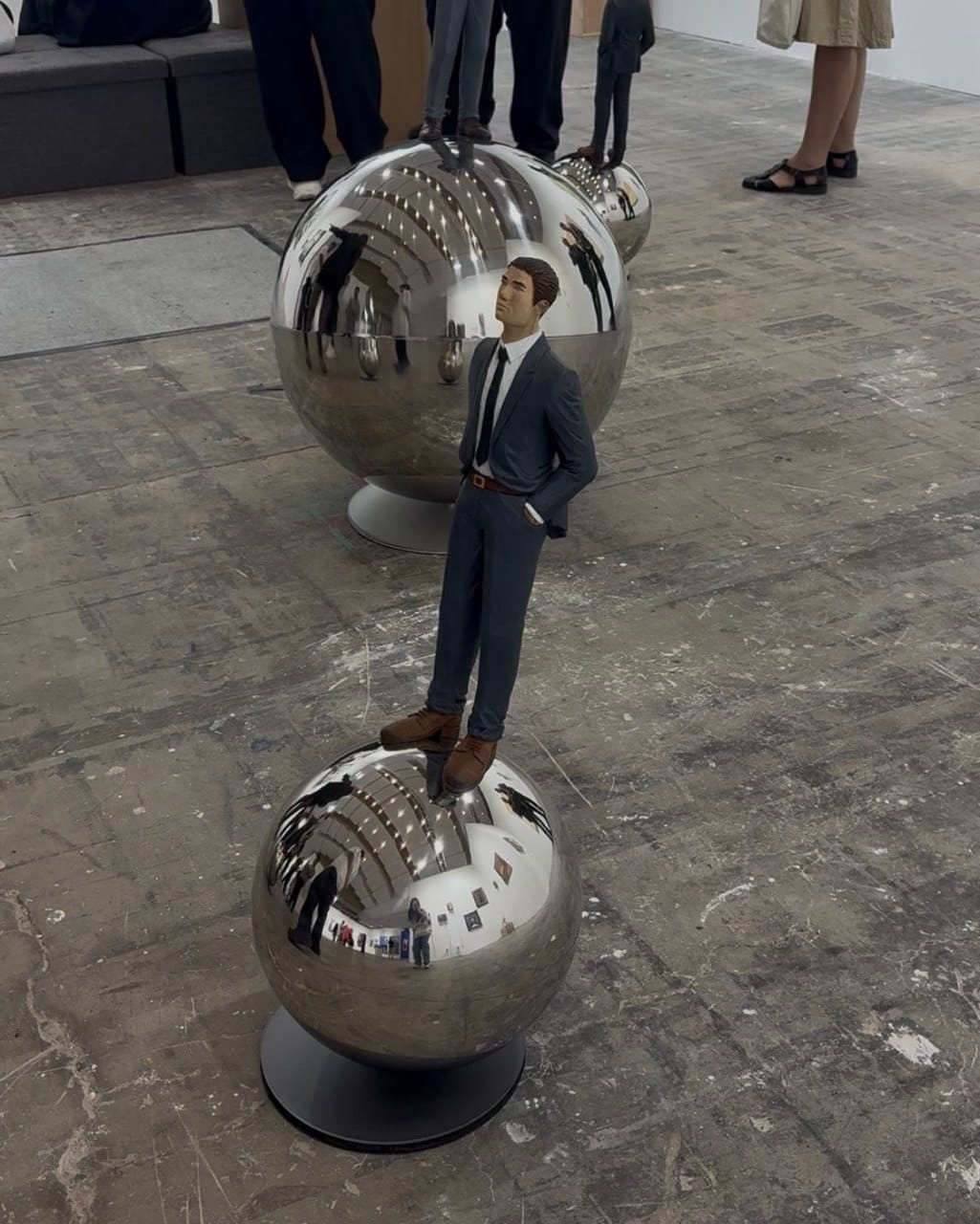
Keng, who also goes by Jason, was in Jakarta for the first time. People easily connected with the suit, he told me — “[from] Monday to Friday, we try so hard to balance at work.” Each figure had a random English name, and their faces were all slightly different, but they looked identical from afar. A fairgoer taking a photo nearly backed right into one of the sculptures; Keng noted that sometimes a figure would come back from an exhibition with a flattened nose.
Then he told me about an old lady, who said his work reminded her of her husband, who had passed away. It made her feel like her husband was still with her. I was amazed, amidst the bedlam of the art fair, to hear such a moving, simply human story. But perhaps I shouldn’t have been. The truth of the world — what really matters about being alive — is always close at hand. You just have to know how to look.
___________________________________
The fifth edition of Art Jakarta Gardens, an outdoor art fair, will take place from 5-10 May 2026. Follow @artjakarta on Instagram for the latest updates.
Plural Art Mag is a media partner of Art Jakarta.
Header image: Art Jakarta 2025 at the JIExpo Kemayoran. Image courtesy of Art Jakarta.
Support our work on Patreon
Become a memberYou might also like
The Indomitable Lino Brocka: Philippine Political Art Finds a Home in Museums Abroad
When Art Becomes Script: T:>Works’ 24-Hour Playwriting Competition at the National Gallery Singapore
Fair Play? Rethinking Pop Culture Conventions and Their Place in the Art Landscape