
I still remember when Singapore first introduced R ratings for local cinemas in the early 1990s. It genuinely boggled the mind and I remember the titles vividly: Natural Born Killers, Pulp Fiction and, later, even The English Patient. Amongst my peers at school, it quickly became a race to see who might first acquire a bootlegged videotape from Johor Bahru and, in doing so, attain “hero” status for the week. The R rating functioned as both mystery and challenge, complete with its own mythology. Who had successfully sneaked into the cinema while still in school uniform? Who had organised illicit viewing parties at home? In a world before social media, all we really had was gossip, and there was something deliciously naughty and mysterious about these R-rated films and whatever it was the authorities seemed so anxious to conceal.
Fast forward several decades, and the National Gallery Singapore now finds itself hosting its first-ever Restricted-18 (R18)-rated exhibition.
Interestingly the Gallery as an institution is itself exempt from having to apply for an arts entertainment licence under IMDA rules, but has nonetheless chosen to present the exhibition with an R18 rating. When asked, the Gallery had this response: “Passion is Volcanic: Desire in Southeast Asian Art engages with themes of desire, the body, and intimacy through the lens of Southeast Asian art. The R18 classification reflects the nature of these themes and ensures they are experienced within an appropriate context.” (For those interested, the R18 rating applies to the arts entertainment licence for art exhibitions whereas Restricted 21 (R21) and Mature 18 (M18) ratings apply to film).
First impressions
The first thing that hits you when you enter the show is, ironically, the lack of anything obviously salacious. Nguyễn Quân’s large-scale works reimagine Vietnamese spiritual and ancestral altars as sensuous female nudes. The work contains hints of disembodied dark holes, breast-like forms and finger-like protrusions wending their way across the canvas, but these remain as suggestions of vulgarity rather than overt expressions of eroticism.
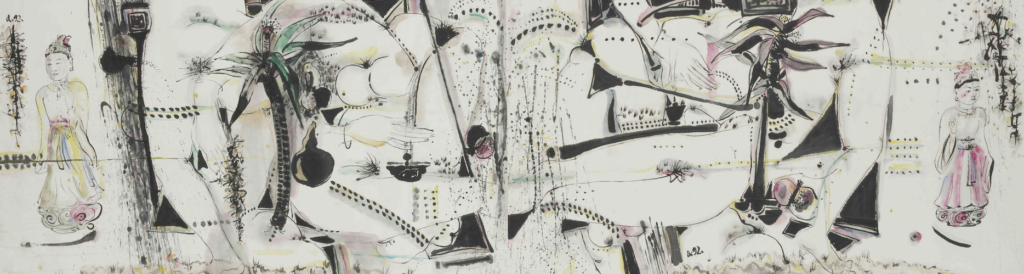
And that somewhat meandering, neither-here-nor-there quality persists throughout the exhibition. It almost feels as though the show is challenging viewers to locate the smut for themselves. An encounter with the works unfolds something like this: Here is a Tan Peng work depicting a bare-bodied male figure embracing a swanlike creature. Where exactly is the eroticism there? Then, a beat later—ah. Leda and the Swan? Oh dear.
And so one eventually arrives at a potential sexual undercurrent in the work, but only after having mentally wandered there oneself.
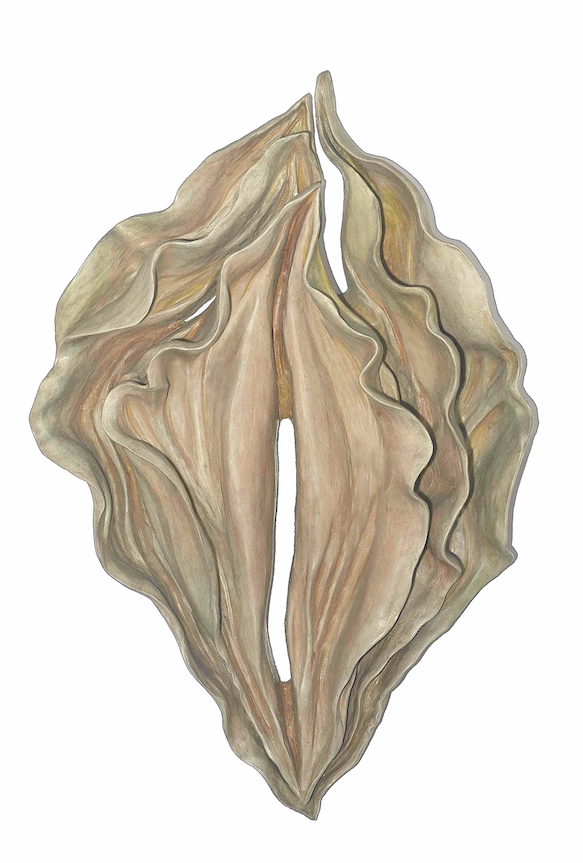
In a similar vein, all we see of Marla Bendini’s form is a tiger-striped bare back, with a long braid of hair, in the work Tiger Lily (2020). Julie Lluch’s LILY FROM GEORGIA O’KEEFE (2009) is an ode to Georgia O’Keeffe’s painting resembling female anatomy, but could just as easily be mistaken for a floral sculpture of some sort. (In any event, as the exhibition wall text reminds us, O’Keeffe had always denied any erotic associations with her work.)
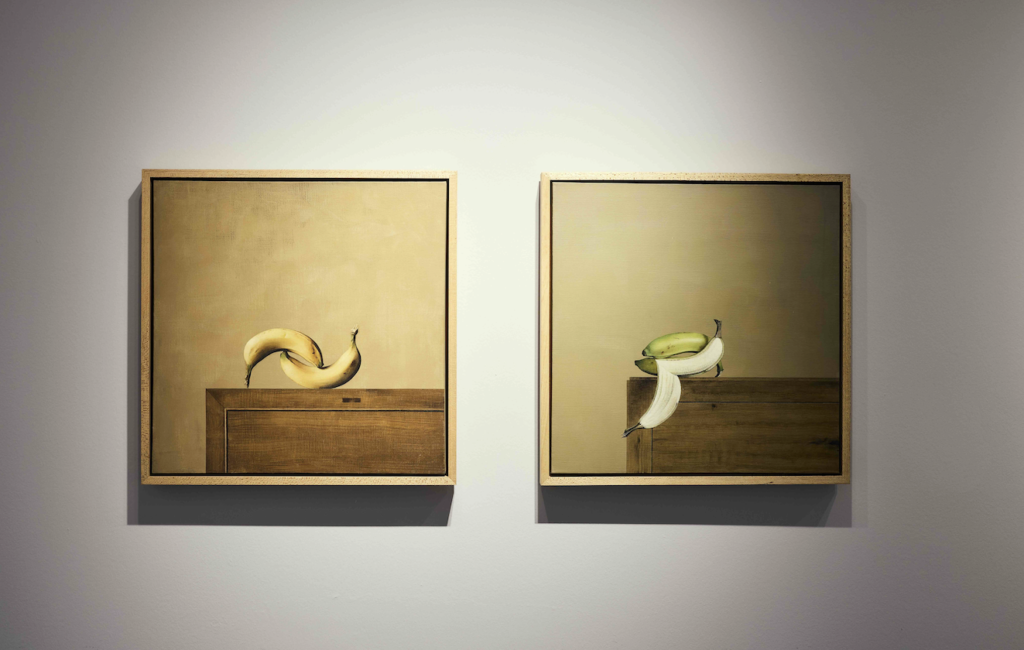
Ahmad Zakii Anwar paints bananas in compromising poses, but really, if the works were not titled in suggestive ways (see below) and the wall text was not so explicit, would one even be thinking of sex when looking at them?
That being said, there is still a fair amount of nudity in other parts of the exhibition. Liu Xiaodong’s Bath House (2000) is a moody work with a penis on full display, but honestly, the part of the painting that truly draws the viewer in is not the nudity so much as the expressions of beatific calm and almost bland nonchalance, on the faces of the men. The water is rendered as an almost shimmery blur of greenish-blue, with the slightest hints of feet and flesh beneath its surface. It draws the viewer in and prompts one to look more closely, even though we already know perfectly well that the water is not really moving, that the people are not real, and that there cannot possibly be anything more to the static painting than what the artist has already allowed us to see.
The complexities of desire
Liu’s work anchors the section of the exhibition dealing with LGBTQ+ desire, and Tan Peng pops up here again. His pastel painting on paper, TV for Everyone (1992), depicting two men in an embrace while watching a display of heterosexual romance on what appears to be national television, is both tender and painful. In this section, the exhibition reminds viewers that certain forms of erotic feeling continue to have little room within many societies. Singaporean audiences will inevitably think of the long-running controversies surrounding Section 377A, but the exhibition also gestures towards similar taboos, restrictions and histories of repression elsewhere in the region, while reminding viewers of the longer trajectory of LGBTQ+ struggles within Singapore itself. There is open acknowledgement here in the wall text that Tan Peng was likely the only openly gay artist of his time and that, “despite” this, his work depicting “the alluring bodies of young men, entered the country’s national collection.”
In a brief interview with curators of the show Drs. Adele Tan and Kathleen Ditzig, I’m informed that plans for this show had been in motion for a long time, “way before Covid.” Tan also cites a 2023 show for OH Open House, Desire is Dead, as a kind of “test experiment” for what would eventually become Passion is Volcanic.
Tan cites, in particular, the Teng Nee Cheong and Tan Peng works in the show, which, while in the National Collection, have not been seen for a long time. “These are works that, unless you have a very specific exhibition framing… are not likely to see the light of day. They will continue to languish in the collection,” she explains.
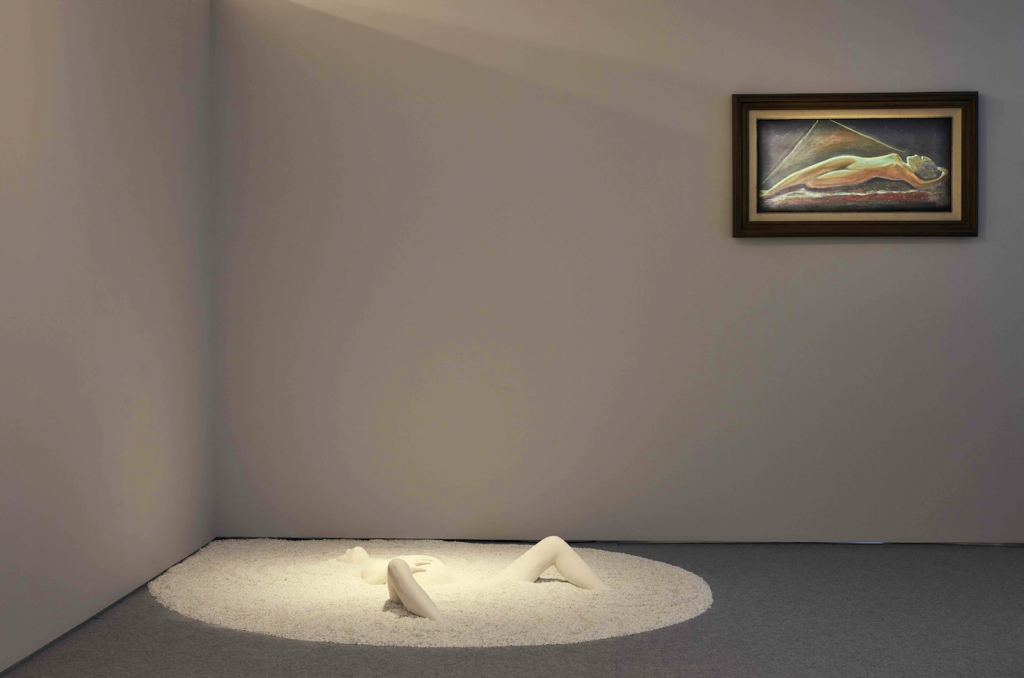
There is also a current of violence—both metaphorical and physical—that bookends the exhibition. Agnes Arellano’s Haliya Bathing (1983) is a morbid marble sculpture of a pregnant woman appearing to dissolve or drown into a puddle of marble chips, while one of the final works encountered in the exhibition is Grace Quek’s performance as Annabel Chong, the organiser of what was once billed as the world’s largest gang bang and one of Singapore’s most controversial public figures of the 1990s.
Reclaiming the margins
I must admit I was slightly surprised to see Quek framed here primarily as an artist, given that many Singaporeans would probably still instinctively remember her as a controversial porn star. Yet, as it turns out, the pornographic performance had been conceived of as a piece of performance art, with ‘Annabel Chong’ being a persona created by Quek as a performing artist in Los Angeles between 1994 and 2001. The recurring floral motif surfaces once again through a dress worn by Quek for the promotion of the documentary about her life, Sex: The Annabel Chong Story. The curators describe her Oscar de la Renta outfit as being “interpreted to be repellent” and to keep others at bay.
Ditzig shares that, in her mid-twenties, she began collecting historical artefacts relating to Grace Quek, or Annabel Chong, and her infamous gangbang, as part of a wider curatorial project on Chong and the late model Bonnie Hicks. Even then, she says, there was an instinct that “creative and artistic practices” lay behind these forms of expression, hence her conceptual comparison with Hicks. Chong’s appearance on The Jerry Springer Show, where she spoke about feminist theory, further suggested to Ditzig that there was a broader intellectual context to the work. She recalls, too, that some of the male participants in the pornographic film who later appeared on the show spoke of wanting to be part of “a commentary that was bigger than themselves”.
“There was a cultural commentary,” Ditzig says. “It’s clear that this was an artwork; this was not just porn.”
Tan chimes in, agreeing that Quek’s work was very much part of Singapore’s 1990s “cultural zeitgeist”, a period whose significance, she feels, is too quickly forgotten. She recalls that, on leaving junior college, her school principal had even warned her not to “go and be like Annabel Chong”, an anecdote which, for Tan, demonstrates the cultural currency Quek’s name once carried. Yet Quek had also become “a stick to beat us with”. The exhibition, she suggests, presents an opportunity to unpack what happened, including the way Quek was packaged by the media, while allowing the artist to make a kind of “revenge move”: to return to that moment on her own terms and explicate it “as part of a performance, as part of an artwork”.
Other artefacts of note that stand out as much for their historical significance as their surprising inclusion in an art museum setting include Judy Chia’s photograph collection. Chia, a trans woman who had worked in Bugis Street in the 1970s, shares her collection of amorous photographs of trans women and their clients, which were used as calling cards and gifts between friends. As the exhibition reminds us, in 1959, the Singapore Free Press called Bugis Street “the Montmartre of Singapore.” The photos offer a rare glimpse into the colourful history behind the plastic shininess of bubble tea and knick-knack shops which currently infuse the locale.
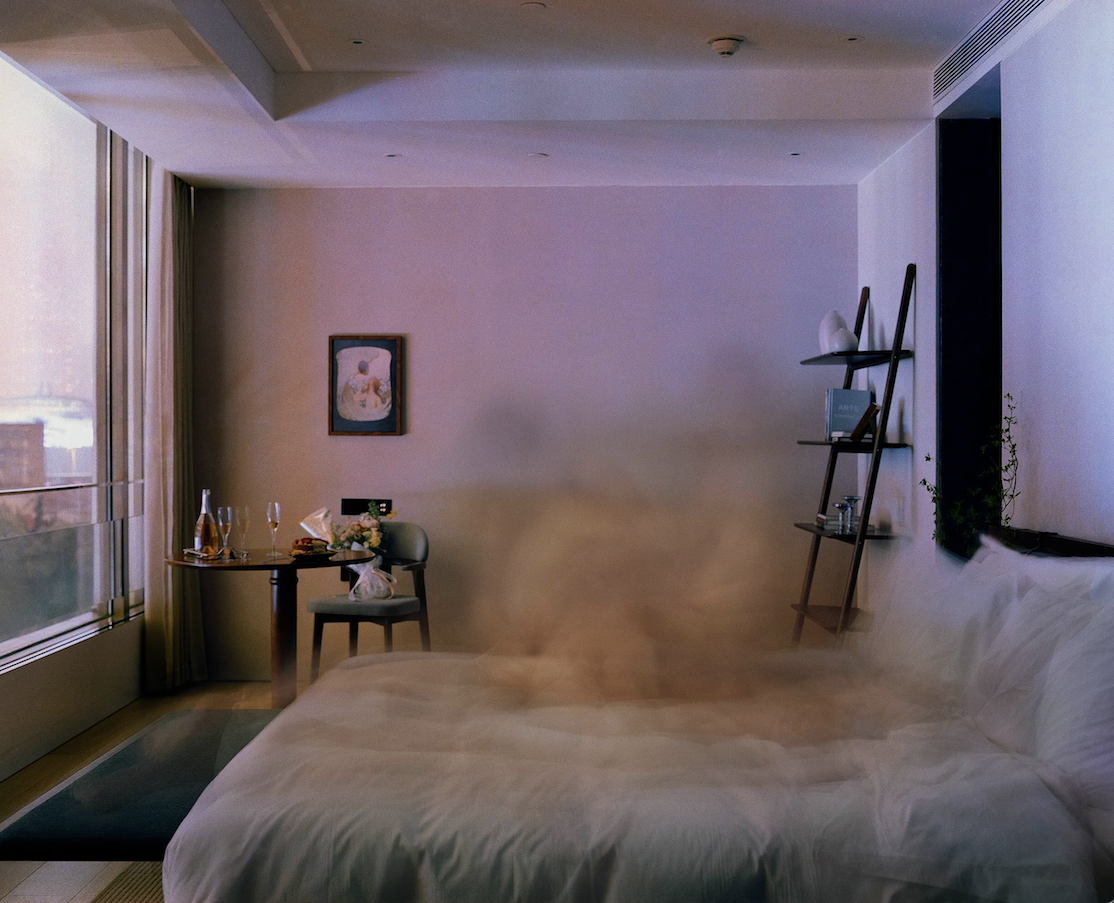
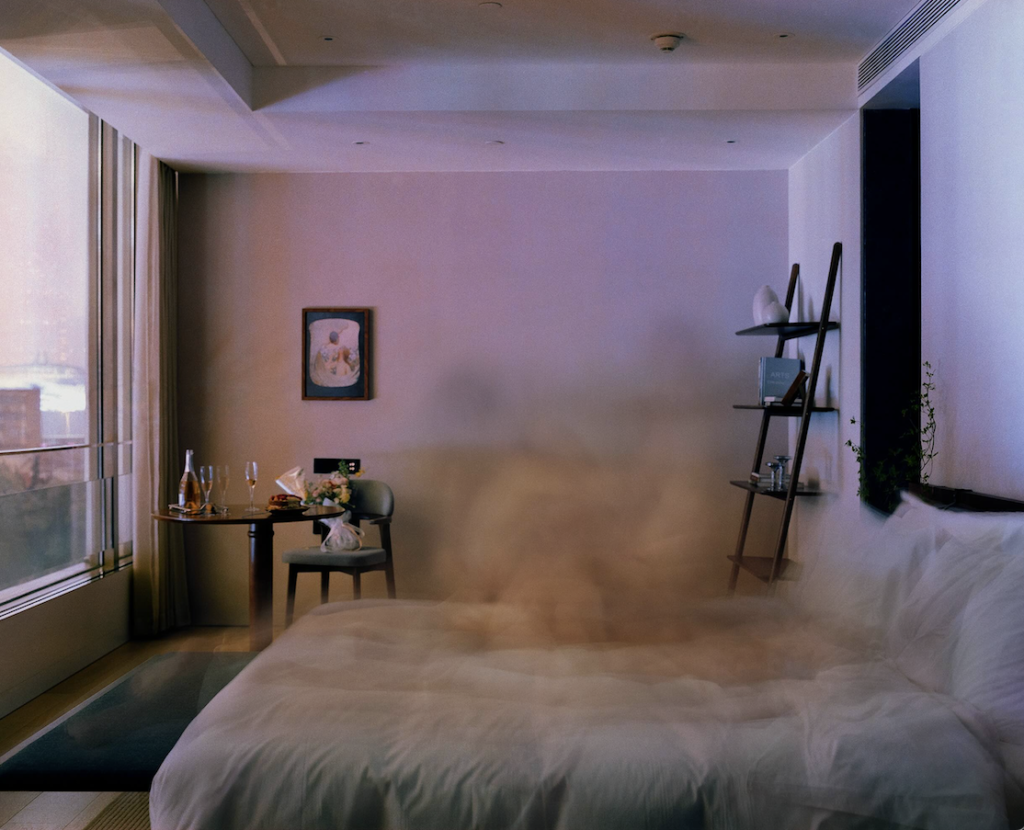
Lavender Chang’s series of photographs, Dissolving into the Same Breath, provides a strong conclusion to the exhibition. Her photographs of intertwined bodies appear to dissolve into coils and soft plumes of mist and smoke, with the use of long-exposure photography lending the images a fantastical sense of impermanence. Once again, the viewer is left searching for the obscenity within the image, only to realise that much of the exhibition’s provocation lies in how insistently it asks us to participate in constructing it ourselves.
Pics or it didn’t happen?
As a visitor to the show, however, the overall experience was strange and discomfiting on many levels. For an hour or so, I was forced to detach myself from my devices and fully immerse myself in the exhibition as photography was prohibited. It reminded me just how much of the contemporary museum-going experience now revolves around documenting, sharing and re-sharing online, or even simply taking photographs as keepsakes of works that resonated emotionally. Without the ability to memorialise the visit on Instagram or share photos with friends afterwards, what was I left with?
As it turns out, a surprisingly contemplative experience: one that felt less performative, though also slightly fraught because I kept worrying that I would forget the works I liked. The absence of phones also meant that I suddenly had an unusual amount of time and mental space to observe the other visitors to the show. On the day of my visit, there were several couples there too (on dates?), giggling quietly with their heads leaning together as they reacted to the weirdly alien qualities of the I GAK Murniasih works on display.
The curators offer a few suggestions for those interested in visiting the show. Ditzig hopes visitors will simply take the time to be present with the works, describing it as a show that “gives a lot” to those willing to slow down and spend time with it. Beyond the individual experience of encountering the art, she hopes the exhibition might encourage a greater sense of empathy and allow visitors to “learn to relate in a different way.”
Tan echoes these thoughts, describing the exhibition as an invitation to pay attention not only to the works, but also to the communities and lives that made them possible. Many of these lives, she notes, have gone through struggles both personal and societal. The show’s negotiation between “public arenas” and “private interiors” also reflects the curators’ own process and the difficult line they have had to tread in bringing these stories into view.
Yet for Tan, there is also “a lot of tenderness” in the exhibition. Citing a line from Araya Rasdjarmrearnsook, “love and yearning do not have to hide”, she adds simply: “There’s no need to hide in this exhibition.”
The politics of looking
As Singapore continues to fret publicly over falling total fertility rates, I found myself wondering whether exhibitions like this might also have a social role to play: normalising conversations around eroticism and sex while also offering a more thoughtful lens through which to consider the many anxieties, absurdities and vulnerabilities that accompany them. After all, several of the works in the exhibition ultimately return not to provocation alone, but to the idea of reproduction, fertility and the complicated emotional terrain that surrounds the notions of desire and human connection. (In fact, Arellano’s Haliya Bathing could be the perfect image to accompany Teo You Yenn’s commentary on the gendered roles of family life in Singapore in her latest book, Unease: Life in Singapore Families.)
The prohibition against photography in the exhibition also means that I can’t show you images of Grace Quek’s work, nor of the stunning Liu Xiaodong piece that continues to live rent-free in my mind many weeks after I viewed the show. These works are not part of the official media pack, and I am told that only images from the press kit may be published. The National Gallery Singapore had this explanation : “for all our exhibitions, we prepare a press kit with a selection of images to provide an overview of the exhibition and support media reporting. As Passion is Volcanic: Desire in Southeast Asian Art features more than 70 works, the press kit provides an overview rather than including every work on display.”
A fair enough response, but with the ban on photography in the exhibition, the overall effect is that works which were not included in the press kit, are effectively excluded from media coverage and public discussion.
While the art history nerd and content creator in me loves the fact that you’ll have to visit the show in person to experience the works I’m talking about, the advocate for greater accessibility in art in me bristles at what feels like another layer of effective censorship.
In that sense, the exhibition has a good deal more in common with the R-rated films of my youth than I’d initially realised. The real provocation lies less in what is explicitly shown than in the curious mixture of wonder, anxiety, projection, social norms and gossip that surrounds the act of looking itself. Much like those films of the 1990s, the exhibition derives part of its power from suggestion, from the feeling that there may always be something slightly illicit or transgressive lurking just beneath the surface, waiting for the viewer to discover it. Add to that the layers of complexity that emerge from intertwined issues such as the subjugation of women, the suppression of the LGBTQ+ community, and the unfair judgement of sex work and sex workers, and viewers begin to understand just how profoundly societal norms shape our perceptions of what is erotic.
And perhaps that is ultimately what stays with the viewer long after leaving the gallery: the unsettling realisation that so much of the dirtier material may have been supplied by us all along.
______________________________________________
Passion is Volcanic: Desire in Southeast Asian Art (R18) runs at the National Gallery Singapore till 20 September 2026. This exhibition is rated R18 and is open to visitors aged 18 and above only. Valid ID may be required for age verification at the entrance. To preserve the experience, photography and videography are not permitted within the exhibition space.
Support our work on Patreon
Become a memberYou might also like
Beyond the Cinema Screen: 4 Art Highlights to Discover at SGIFF’s Undercurrent
Sentul Biennale and the Politics of Friendship in Contemporary Art
Affordable Art Fair Hong Kong 2026: Why the Under- US$50,000 Market Matters